DoubleDown Interactive's Faith Price on D2C growth, ageing apps and the real cost of AI

- D2C has grown faster than the attribution tools built to support it, leaving publishers to push vendors to catch up.
- Faith Price says nothing about post-ATT measurement has substantially improved, only that the industry has built workarounds.
- On AI, Price argues vendors are not yet delivering on the promise at a reasonable cost.


Direct-to-consumer has moved from a side channel to the centre of the social casino business and few companies illustrate that shift more clearly than DoubleDown Interactive.
The NASDAQ-listed publisher reported D2C revenue of $40.5 million in Q2 2026, up from $10.7 million a year earlier, taking D2C to 52.4% of total social casino revenue against 15.4% in the same quarter of 2025.
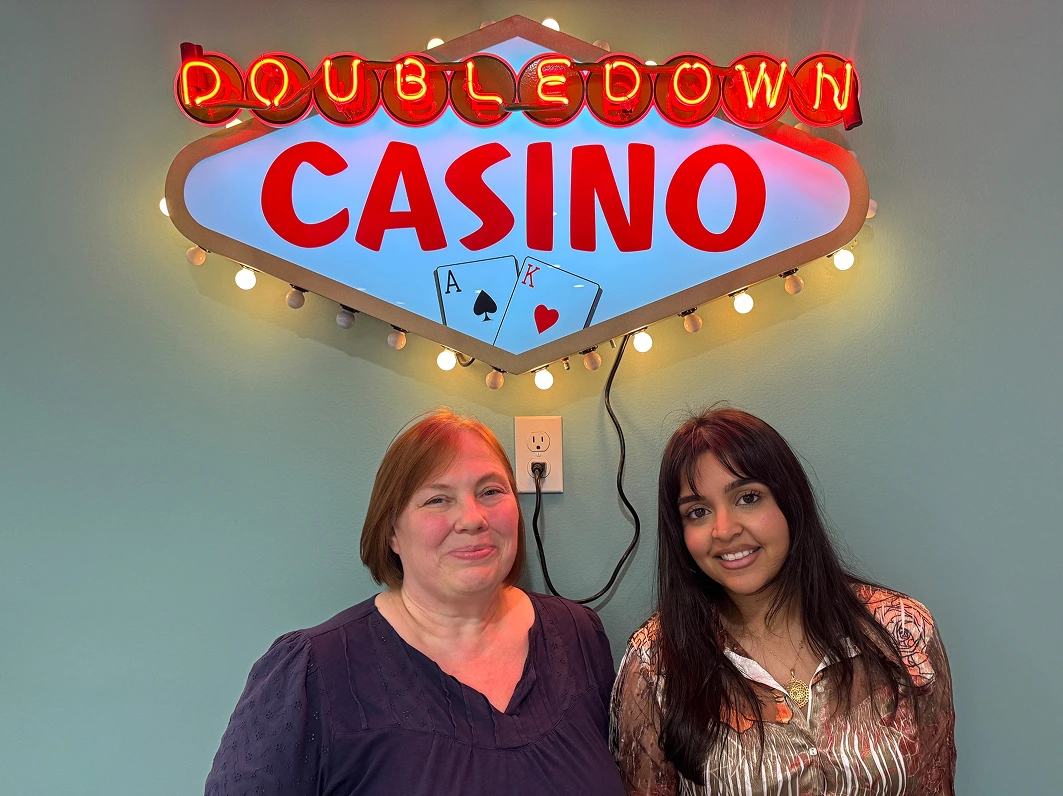
We met Faith Price, director of growth marketing, user acquisition and user engagement at DoubleDown Interactive, at the company's Seattle office to discuss what the shift has exposed about how unprepared the industry was, how acquisition works for an app that launched on Facebook in 2010 and why her team is auditing its own processes before it goes shopping for AI.
The chat took place just ahead of the Big Indie Pitch at SLICE 2026.
D2C and an industry that wasn't ready
Price is careful not to overstate the disruption. D2C has not broken DoubleDown's UA model, she says, but it has surfaced how little of the surrounding infrastructure was built with it in mind.
"Obviously D2C has been around for a long time, but more recently it's started growing," she says. "And I think that things like attribution, working with your MMPs, working with your media partners; they weren't necessarily prepared for the shift."
That has put DoubleDown in the unusual position of driving the roadmap conversation with its own suppliers, rather than the other way round.
"It's been a little unusual in this instance where we're one of the ones sort of saying to our vendors, 'hey, this is happening, what do you guys have in place to make sure that all of the information gets appropriately attributed?'"
Internally, she says, the company has the visibility it needs. The open question is how the rest of the ecosystem - everyone who isn't the publisher - gets the same view and learns to use the data correctly.
Lifecycle marketing as the bridge
Price resists framing D2C as a break with the past. DoubleDown Casino's website has existed for 16 years and lifecycle marketing has always carried the job of explaining it to players.
"The lifecycle marketing has always played a key role in helping educate the player about the advantage of the website - what's the value to the player?"
The current growth phase, in her telling, is less a new strategy than an extension of an old one: work out what else can be added and make the information digestible at the point the player encounters it.

"Players want something that they understand, that they trust and that's easy," she says. "And so the job of lifecycle marketing is to give them that information" - and to remove roadblocks along the way.
She is blunt about why the channel is growing at all. "The reason why I think D2C has grown is because it's providing value to the player. I think D2C provides another way for players to engage directly with a game they enjoy."
Acquiring players for a 16-year-old app
DoubleDown Casino launched on Facebook in 2010, which cuts both ways. Brand recognition and a loyal player base are real assets; a saturated category and five years of attribution upheaval are not.
"With all of the changes in the marketplace to attribution, especially over the past five years, finding those new players is much more expensive and it's much more difficult."
Her wider concern is structural. If studios cannot grow new players profitably, she argues, "the industry circles around itself" - a dynamic she sees reflected in how few new games break through.
For DoubleDown, the practical answer is to stop chasing incremental channel tests that no longer move the needle. Another DSP is unlikely to be the answer after a decade of trying them, she says.
"If there are new players who are watching ads in games, odds are they've already seen our ad. So what we really look for is where else are they in the ecosystem and how do we go find them?"
Silos vs. collaboration
Price oversees various functions in her role - UA, lifecycle, retargeting, ASO and AEO. But she is quick to say the org chart is not what makes things at the company work.
"If things are siloed and their teams are competing rather than cooperating, it won't matter that you can see everything."
The payoff, when the collaboration is there, is campaigns that hang together. "We are able to build more campaigns and communications that work well together, that really speak to the player where they are in the lifecycle."
In practice that means routing findings between channels - a message that lands in email gets surfaced to retargeting, then to social, then to promotions - supported by a quarterly cadence of cross-team brainstorms and shared test results.
"It's great if I have all the data," she says. "But it's even better if they have all the data."
Measurement hasn't recovered
Asked what has genuinely improved in acquisition measurement since ATT, Price does not hedge.
"I can't really point to anything that's gotten substantially better. I think we've all figured out ways to adapt to the new normal."
“By making the cost of acquisition so high, I sometimes wonder where are you going to get all those innovations?”
The consequence lands hardest on soft launch. With costs up, the bar for a title worth years of investment has risen sharply, which she links directly to how few new games succeed.
She points to an independently circulated industry deck - heavily console-weighted, with some mobile - showing that the majority of spending sits with IPs and games produced before roughly 2016 to 2018.
"By making the cost of acquisition so high, I sometimes wonder, where are you going to get all those innovations?" she says. "Where are you going to get the thing that helps continue to drive the games industry forward?"
Some of that is familiarity, she says. But it also shows how hard it has become for anything new to break in.
The promise, the reality and the cost of AI
Price splits AI into three parts, and it is the third that shapes DoubleDown's approach.
"You have the promise of AI, you have the reality of AI, and then you have the cost of AI."
The promise was large enough, she argues, that vendors did not anticipate having to raise prices sharply a year in. On her own evidence from talking to companies in the space: "They're not yet able to deliver on the promise" - and not at a reasonable cost.
But there is a fourth cost she says has gone largely unrecognised, and it is not one DoubleDown chose to take on: the cost of everyone else adopting AI.
"One of the costs that I feel has not been recognised is the cost of other people using AI and the impact it has on us," she says. "A human cost."
She points to the wave of layoffs and efficiency drives across big tech, and to platforms that have shifted processes to automation and stripped out the human component. Because the technology has not caught up with what it is being asked to do, the burden lands on the partners downstream.
“The number of false positives and things that the team has to deal with has 10 or 20x'd.”
In campaign operations, approvals and creative, she says the effect has been stark: "After they moved away from as much human touch and more to automation, the number of false positives and things that the team has to deal with has 10 or 20x'd."
The result is a straight swap of time that used to go into improving campaigns for time spent fixing problems - and fewer people on the other side to help fix them.
"Everything just takes more time," she says. Given the platforms' own stated goal of helping partners grow and market effectively, she adds, "this really gets in the way".
Against that backdrop, the team is running a different sequence. First, establish how efficient the existing processes can be made without AI at all, through BI work and better use of tools already in place. Then decide what genuinely requires AI on top.
"It turns out there are things you can improve. You don't necessarily need AI to help you do all of these tasks."
Only once those efficiency gains are exhausted, she says, does the team ask what the next advantage is that actually needs AI - and how to get it cost-effectively.
Staying out of the real-world rewards race
DoubleDown Casino has not moved into real-world rewards, a decision Price frames as focus rather than judgement - and one shaped by timing. When the game launched, and for years afterwards, real-world rewards did not exist as a category. "That's, I would say, a bit more of a recent thing, recent being relative in anything after COVID."
"It is a different player who participates in real world rewards," she says. What DoubleDown Interactive built well, Price continues, was a social casino game delivering the Vegas experience its audience wants. The case for continuing to do that well outweighs the case for chasing an adjacent model.
She is careful to scope that to DoubleDown Casino in the US. DoubleDown Interactive also owns SuprNation, its European iGaming operation, which runs as a separate business under the same parent company.
For the game she markets, though, the answer is the same one that runs through everything else she says about D2C, channel testing and AI - work out what you already do well and go deeper, rather than wider.
"Let's continue to do what we do really, really well rather than looking externally at what's going on with the real world rewards," she says. "It's just not our space."
None of it works, in any case, without the game underneath it.
"Our job is to provide the best experience for the player. It's to give them a trustworthy site. It's to give them authentic Vegas excitement. It's to give them a real social casino experience. And if they get that, then they're willing to participate in the site, to play, to spend.
"If we don't do that as the core job, none of the rest of this would matter."
Learn more about marketing, D2C and AI at our Pocket Gamer Connects conferences around the world. The next big show will be PGC Nordics in Helsinki on October 20th and 21st.
Companies

People
