In the Hot Seat: Hilmar Pétursson on Eve Online's $120m buyback and the games industry's unplanned disassembly

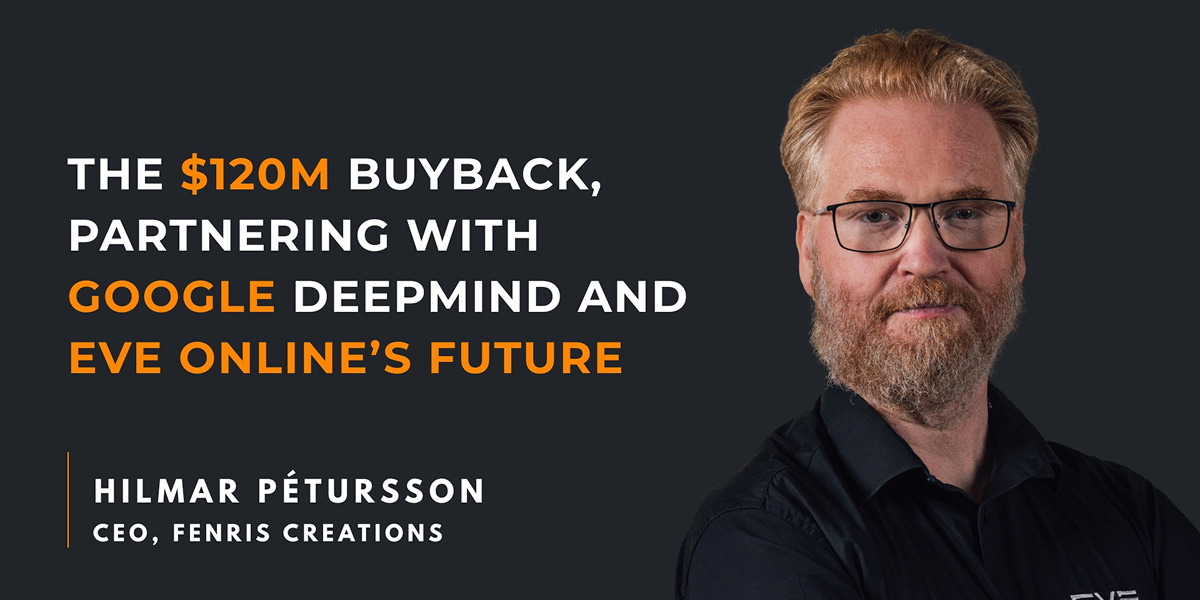
- The industry is in "rapid, unplanned disassembly", says Pétursson - Eve's $120m buyback is a symptom of it.
- DeepMind is training AI inside an offline Eve, drawn to 23 years of documented human behaviour.
- Eve Frontier has moved onto the Sui blockchain, where players write their own smart contracts to build their own universe.
Our next guest for In the Hot Seat has spent more than two decades at the helm of one of Iceland’s best-known game studios - through changing markets, changing ambitions and now, a changing name.
Hilmar Veigar Pétursson joined the Icelandic studio, then called CCP Games, as CTO in 2000 and became CEO in 2004. His company now answers to a third name, Fenris Creations.
This year alone, the studio has gone independent, partnered with Google DeepMind and moved its second game on to the Sui blockchain, which allows players to program the world's structures themselves.

An industry coming apart
On May 1st, 2026, Pearl Abyss confirmed it had sold CCP Games back to its own management for $120m - $100m in cash and $20m in Eve Frontier tokens. The Korean publisher had previously acquired the studio in a deal worth up to $425m in 2018.
Pétursson doesn't read the discount as a distress signal so much as a symptom. "I think we're in some deconsolidation phase right now," he says. "There's rapid, unplanned disassembly of the gaming industry."
He describes the split as mutual - Pearl Abyss is consumed by Crimson Desert's success, Fenris has what he calls its own "crazy portfolio" and expects more studios to make the same move. "We are probably better off going our own way," he says.
The Iceland question
Pétursson has a foot in policy as well as production: he chaired IGI, the Icelandic games industry body, in 2015-16 and has sat on the government's Science and Innovation Council since 2023.
IGI was set up in 2009, in the wreckage of a banking collapse that had just freed up a large pool of technical talent - "Iceland set a world record in collapsing", as he puts it.
What helped, in his telling, was less any specific scheme than the speed of the recovery that followed. "I think that frankly has been the biggest help - just the inspiration of never giving up."
Giving the engine away
Just two months ago, in July, Fenris open-sourced Carbon and Trinity, the engine and renderer Eve has run on since 2003, rather than licensing them. The reasoning is longevity. "If you want to build something that lasts forever, open source is really a good way to do it," Pétursson says, noting how much proprietary software withers inside companies.
It's also audience-specific. Eve players already build extensively on the game's ESI API, and Pétursson frames the release as an extension of the sandbox: "Now you can literally reprogram the universe."
Google takes a minority stake in Fenris
Google DeepMind is using an offline build of Eve Online to study long-horizon planning, memory and continual learning. The tech giant also took a minority stake in Fenris.
Pétursson says he and Demis Hassabis, co-founder and chair of Google DeepMind, first discussed an "AlphaEve" in early 2017, when it was "far away from being a doable thing".
— Demis Hassabis
View post
"I doubt there are really more than 10 MMOs" with real longevity, he says and after nearly three decades he can't reduce it to a formula: "It's a mixture of serendipity and timing and organic growth and emergence."
He points to roughly 5,200 papers referencing Eve on Google Scholar as evidence of what two decades of documented behaviour is worth. Constraining agents inside "arguably human environments", he argues, beats letting them "run loose in reality".
The Sui blockchain and the case for friction
Eve Frontier has moved from an Ethereum testnet to the Sui blockchain. Sui organises everything as individual objects, an approach Pétursson recognised straight away: "It was reassuring to see we weren't completely off the reservation when we did this back in the early 2000s."
Players trading in-game currency for real money has shadowed Eve since launch - ISK (Eve's in-game currency) was for sale on eBay "the same day", he says. Eve Online will stay a closed economy "for decades to come". Frontier is where he's testing the opposite in letting that trade happen out in the open, by design.
That extends to difficulty, at a moment when most retention playbooks are all about reducing player friction.
"I am a big believer in not underestimating the human condition," Pétursson says, "especially when people are organising around a big problem." Eve, in his framing, is a conflict generation and resolution machine.
“It's just as well throwing the playbook out and trying something really different rather than doing what everyone else is doing”
He's unbothered by whether that matches the market. "It's just as well throwing the playbook out and trying something really different rather than doing what everyone else is doing - which I think is largely finding no one as an audience these days."
What's next for Fenris?
Eve Vanguard, the new extraction shooter, ran its first alpha playtest in July and moves to a persistent build in November - a category Pétursson is cautiously realistic about. "Getting extremely competent shooters off the ground is, as people have seen in recent times, extremely hard."
Eve Frontier, meanwhile, is the more distant prospect - still in Founder Access and only recently ported to its Sui testnet.
Overall, Pétursson remains optimistic about the future and what is still to come for the studio: "I think everyone here at Fenris thinks our best work is ahead of us."

Fenris's story is one of many playing out across the Nordic region right now. Catch the rest at PGC Nordics in Helsinki, October 20th and 21st. Secure your spot.
Companies


People
