Puzzle games rise as mobile genres compete for attention in 2026

- Mobile game installs are declining as user attention shifts towards short-form video.
- More than half of the current top 300 games by installs were released before 2024.
- New teams should look for genres where established players do not have a major expertise advantage.
Eugene Tatonkin is publishing / M&A lead at Azur Games.
Today, we’ll look at how a fresh take on a familiar genre can disrupt even broad market trends. For convenience, this is a condensed version of our internal Azur Games report.
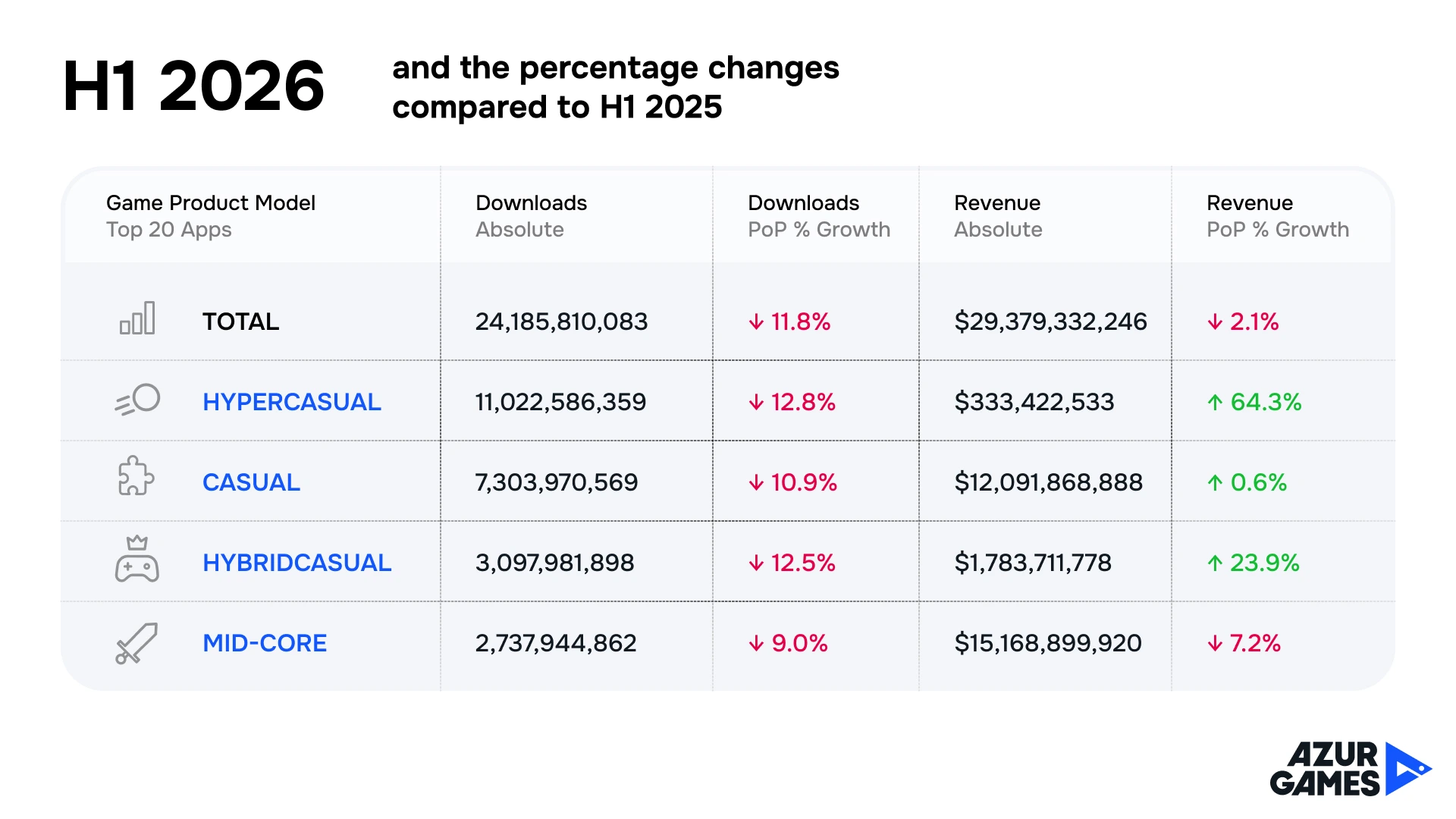
If we take mobile market data for the first half of 2026 and focus on top-performing titles, we can see a noticeable decline in installs compared with the same period last year. At the same time, revenue increased across most genres.
Midcore stands somewhat apart from the rest. It has enough scale to influence the overall picture and is not benefiting from a low base effect, since its revenue is already higher than that of all other genres combined.
The decline in installs is not caused only by growing competition between mobile games as more titles enter the market. Mobile games are now competing for user attention with apps, messengers, and social platforms such as TikTok, Instagram, and YouTube.
A growing share of the audience chooses short-form video over a gaming session. This becomes clear when looking at mobile download data overall: a massive share of installs goes to these platforms.
Azur Games eCPM
The chart uses abstract internal data from Azur Games. Still, since eCPM is one of the key indicators of market health, the trend is encouraging.
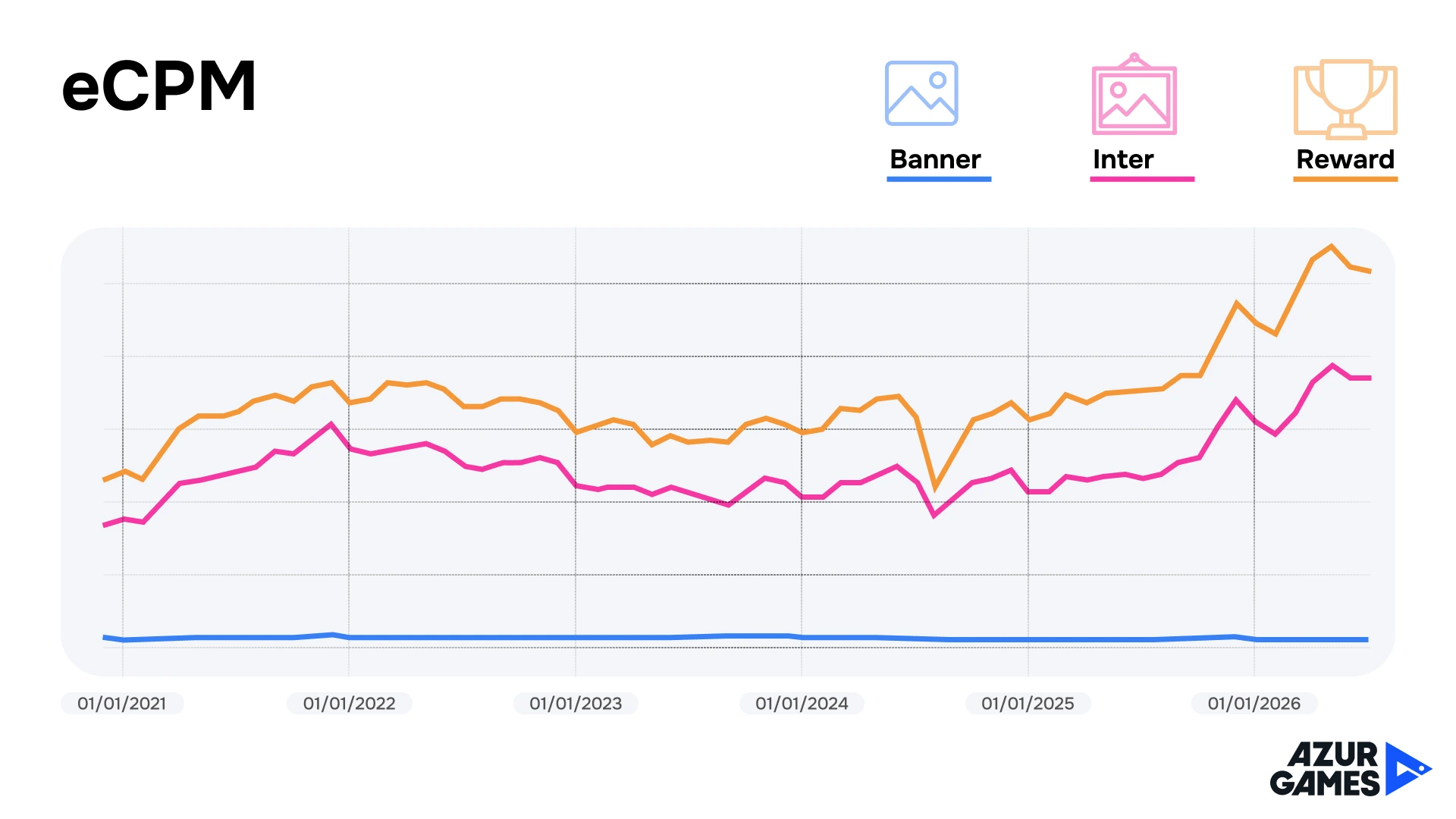
eCPM has been growing since the beginning of 2025. This suggests that despite intense competition and audiences shifting between genres, a strong long-term approach to building and operating games can offset declining install volumes.
Old vs new: The top 300 then and now
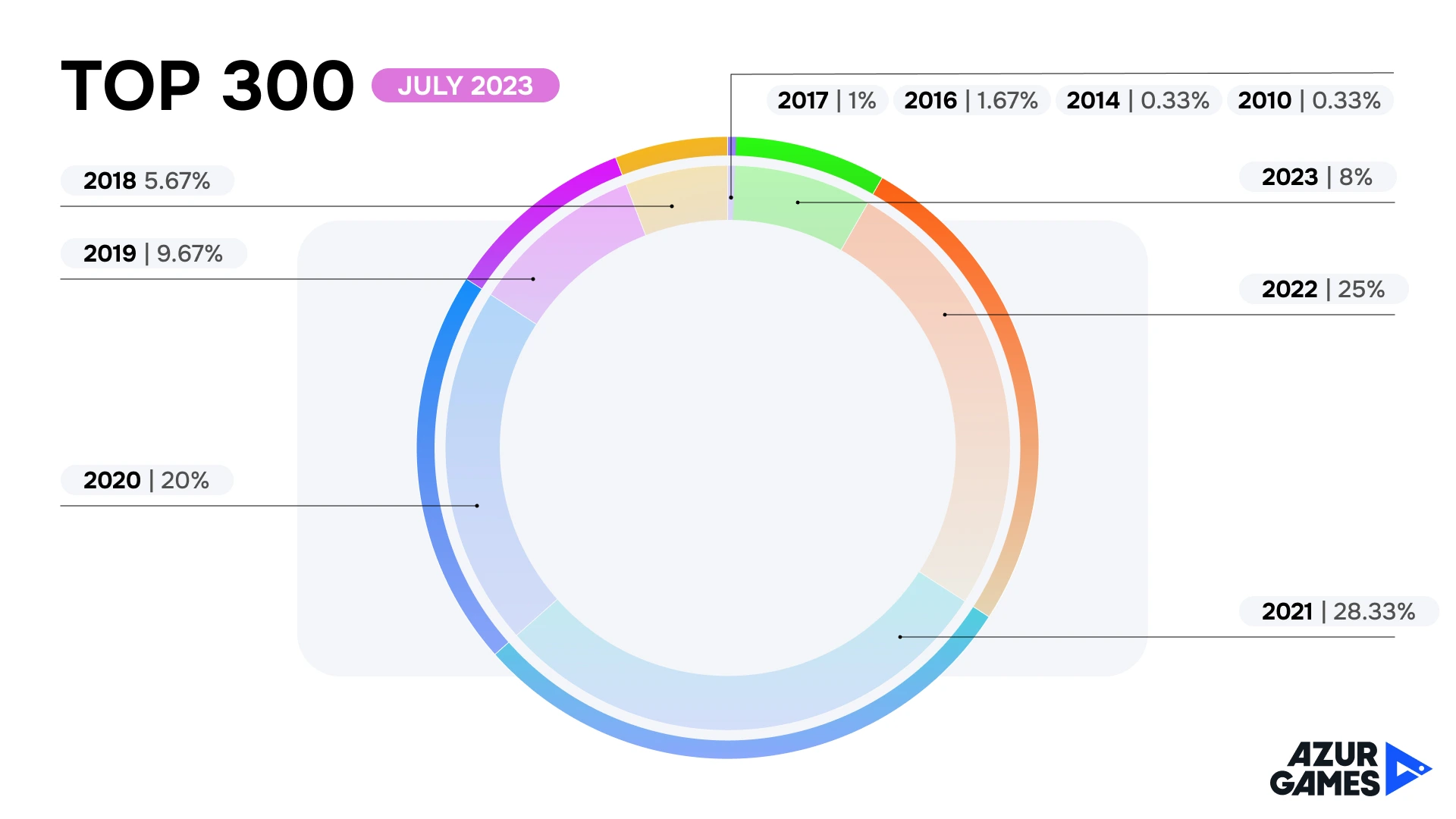
More than half of the current top 300 games by installs were released before 2024. Some of the titles in the ranking are already ten or even eleven years old.
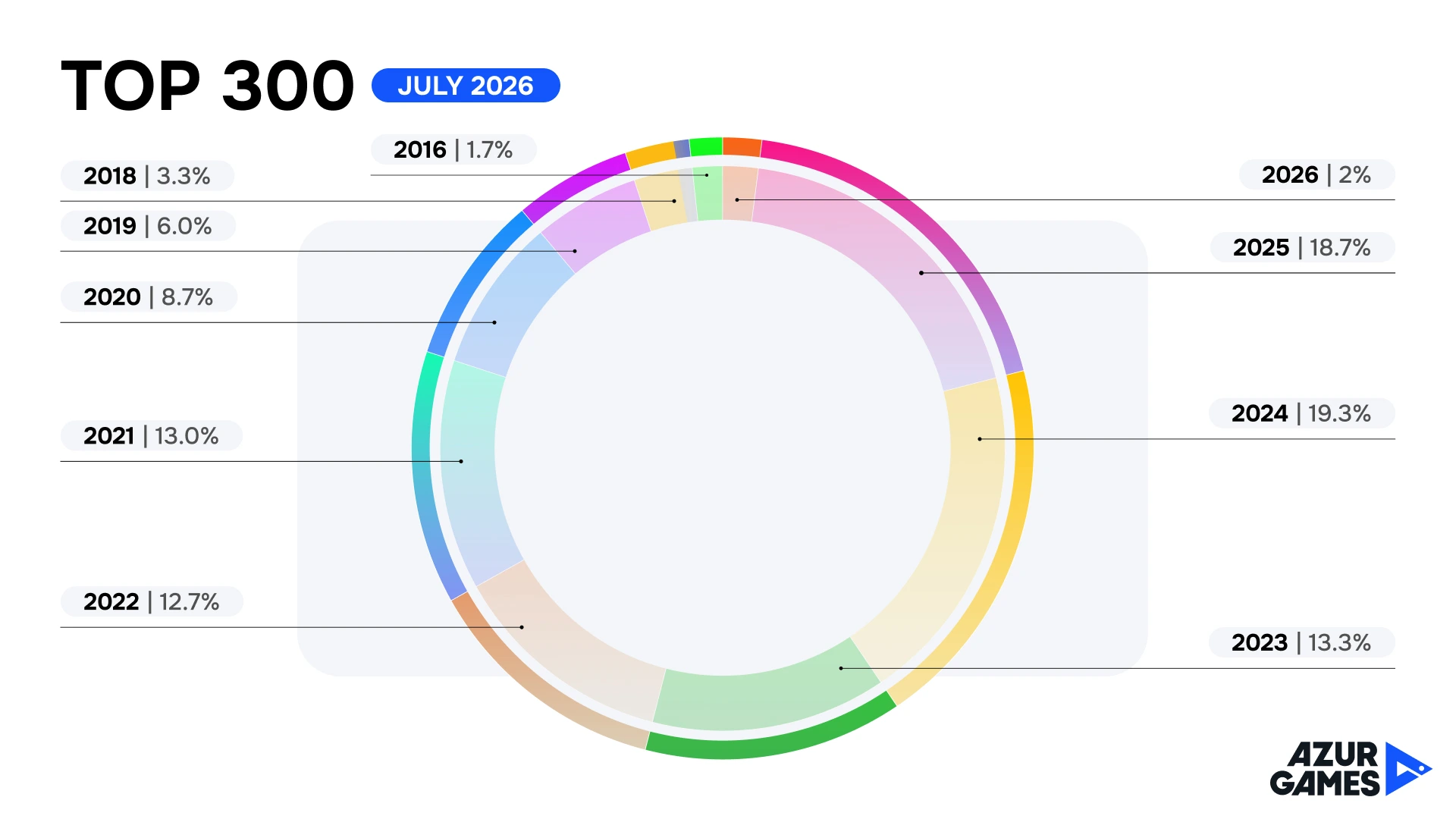
For comparison, here is the top 300 in mid-2023. At the time, new releases accounted for 8% of the chart, compared with just 2% this year.
However, it is important to understand what kinds of “old” games and genres we are talking about.
There are quite a few projects that successfully reinvented themselves and found a new approach. A good example is Pixel Flow: the team introduced a different take on the genre, and the gameplay flow genuinely changed.
Hybrid casual grew mainly because experienced market players who had previously built and scaled successful hypercasual games shifted their focus toward hybrid products.
In casual and midcore, however, there has been relatively little that feels truly new. Most teams continue doing what they already know how to do well.
Hybrid casual grew mainly because experienced market players who had previously built and scaled successful hypercasual games shifted their focus toward hybrid products.
Puzzle games are a separate case. Before the early 2020s, they were not nearly as widespread or as prominent as they are today. In this genre, developers genuinely managed to find a new approach. Many other genres lack this kind of reinvention, which makes it extremely difficult for new titles to compete against large, established projects.
The rise and decline of puzzle games
The first chart shows all genres, with the Arcade line serving as a useful reference point. After a period of decline, Arcade reached a plateau and is now testing its lower boundary, broadly reflecting the overall downward trend in mobile game installs.
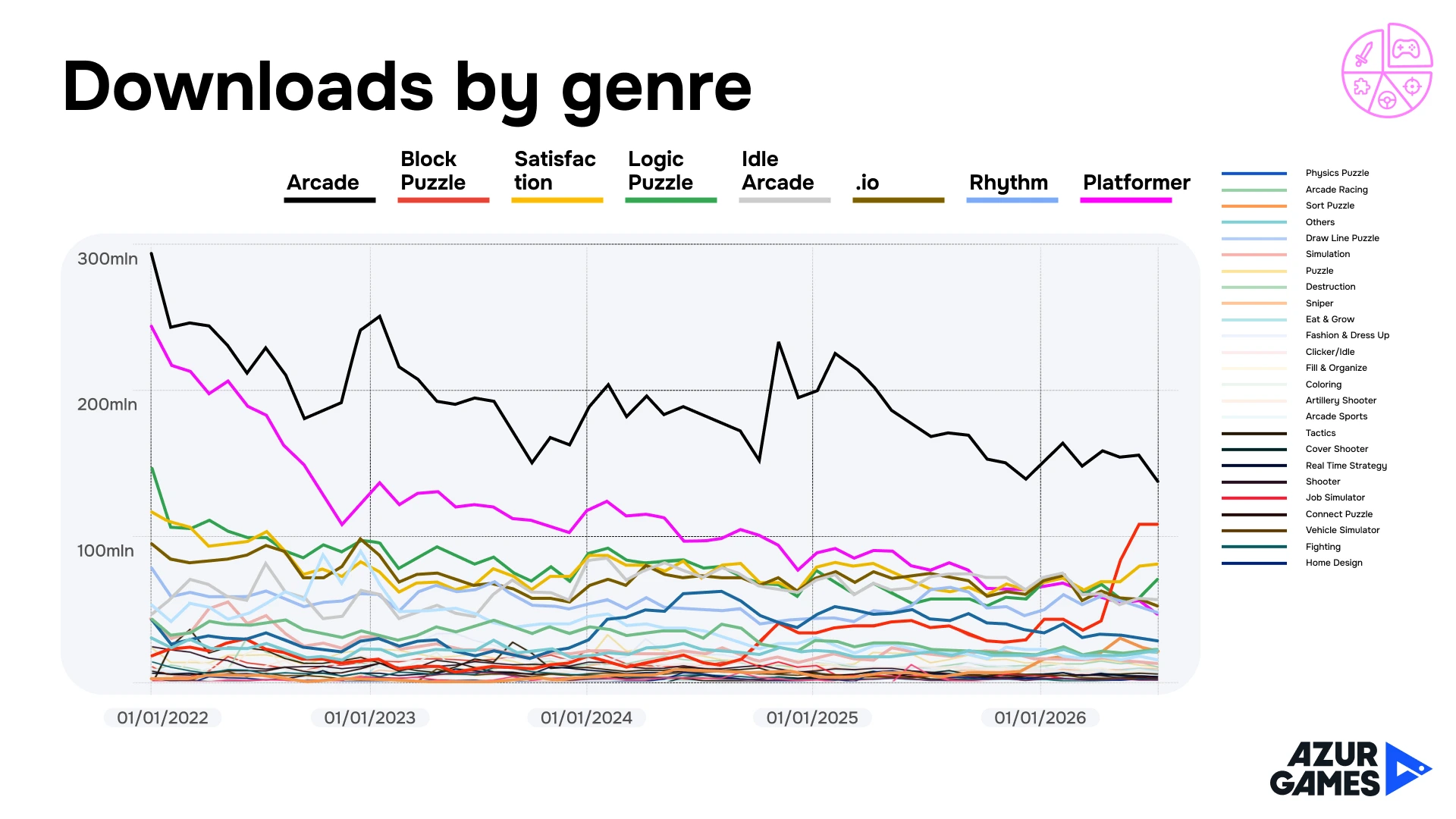
On the right-hand side, however, between January and summer 2026, we can see a sharp increase in the Block Puzzle line. In this dataset, that category also includes Arrow-style games.
Let’s remove the other genres to make the trend clearer.
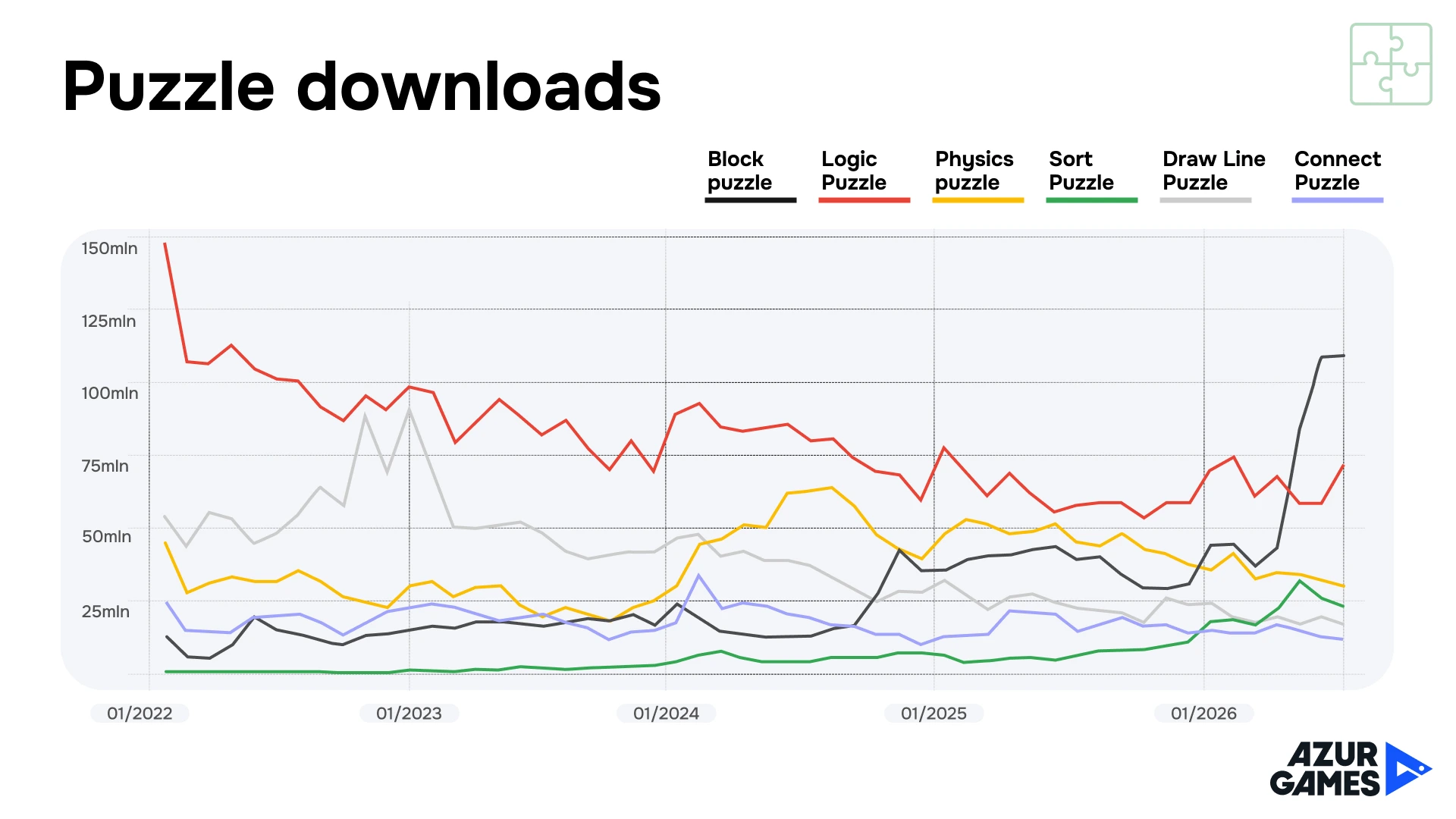
Based on block puzzle performance, we can probably say that a new subgenre has now become established. These mechanics are not merely working - they are taking leading positions by downloads. This indicates sustained audience interest that cannot be ignored.
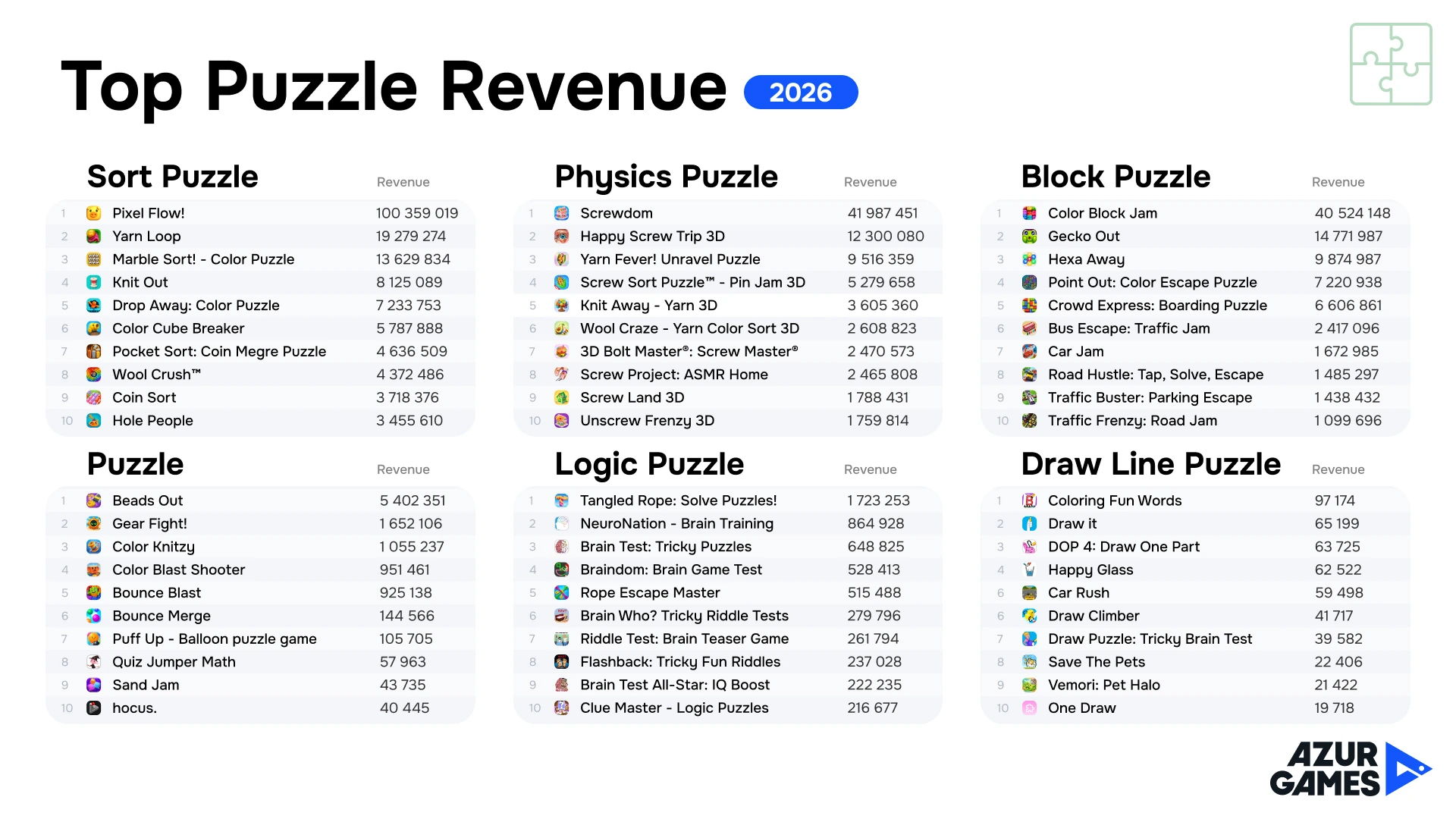
Revenue is a different story, of course, because much of it comes from advertising. In terms of IAP revenue, Sort Puzzle significantly outperforms Sort. This is partly because games within the same subgenre can monetise very differently depending on the specifics of their core gameplay.
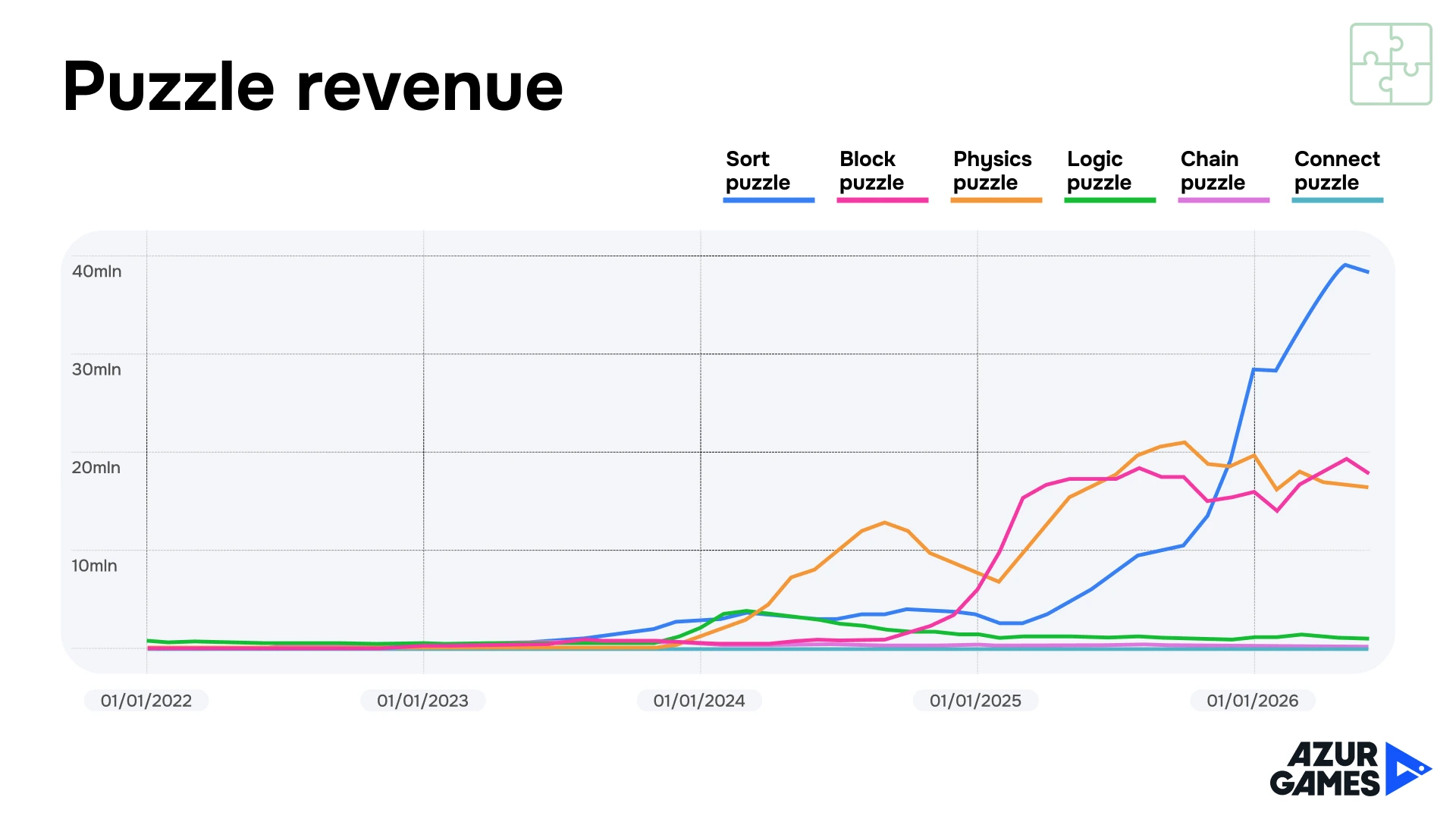
Project tagging also needs to be taken into account.
Analytics platforms classify games differently, and titles belonging to the same genre may appear in separate categories. Any final conclusion about a genre should therefore be double-checked at the level of individual titles.
As for other puzzle subgenres, Physics Puzzle was one of the earlier categories to show strong growth. Its audience is now shifting toward adjacent genres, including block and sort puzzles. Overall, though, the puzzle category remains healthy and continues to develop.
A brief side note: does this mean everyone should start making puzzle games?
Analytics platforms classify games differently, and titles belonging to the same genre may appear in separate categories.
Not really. Building a good puzzle game is extremely difficult. Puzzle is a highly content-intensive genre. If the game is good, players burn through levels very quickly, which means you need a huge amount of content.
First, you need a skilled team. Second, you need to know who will continuously handle level math, design new levels, and generate additional content. Yes, many teams now use AI to generate levels and difficulty curves. But AI is not a substitute for experience.
You still need a clear understanding of the entire workflow. The team needs to have played a huge number of puzzle games and understand how balance, pacing, and the gameplay loop are constructed.
Difficulty should rise from simple to complex, and in practice, that progression has to be extremely gradual. Otherwise, players leave when levels become too difficult - or get bored when they remain too easy.
Large companies have been operating in this genre for years and have built up enormous expertise. Competing with them as a newcomer is exceptionally difficult.
Another look at Idle games
This is what the chart looks like without puzzle games.
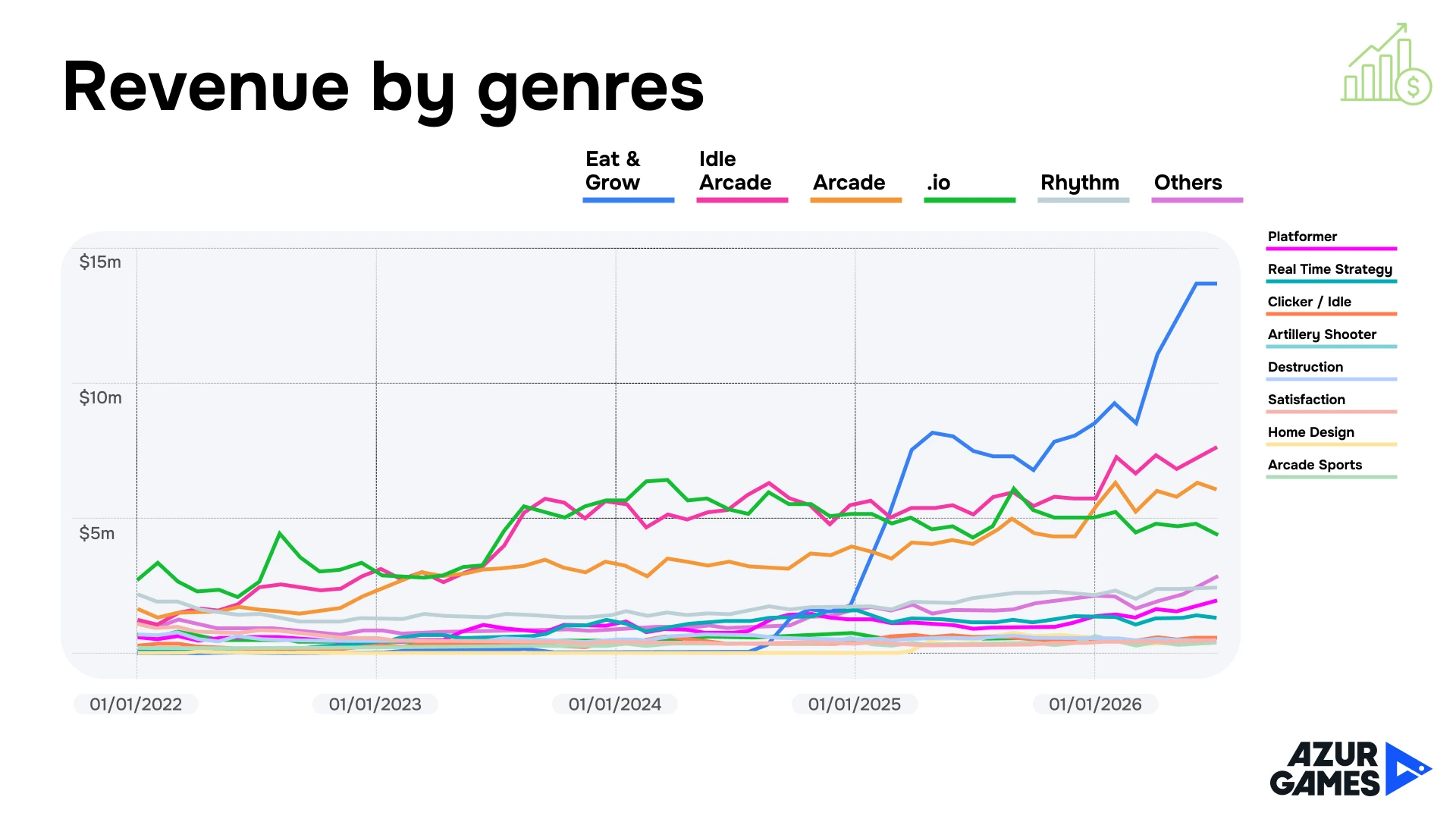
Apart from the rise of Eat & Grow, there is another important detail we have mentioned before. Some games that could reasonably fall under Eat & Grow may instead be classified under the .io category. This should be kept in mind when interpreting the data.
We have been describing Idle as a growing, or at least stable, genre for several years. Even when installs plateau, it can still show revenue growth. Right now, we can see some decline in installs. But most genres are currently declining, so the drop itself is not necessarily a negative signal.
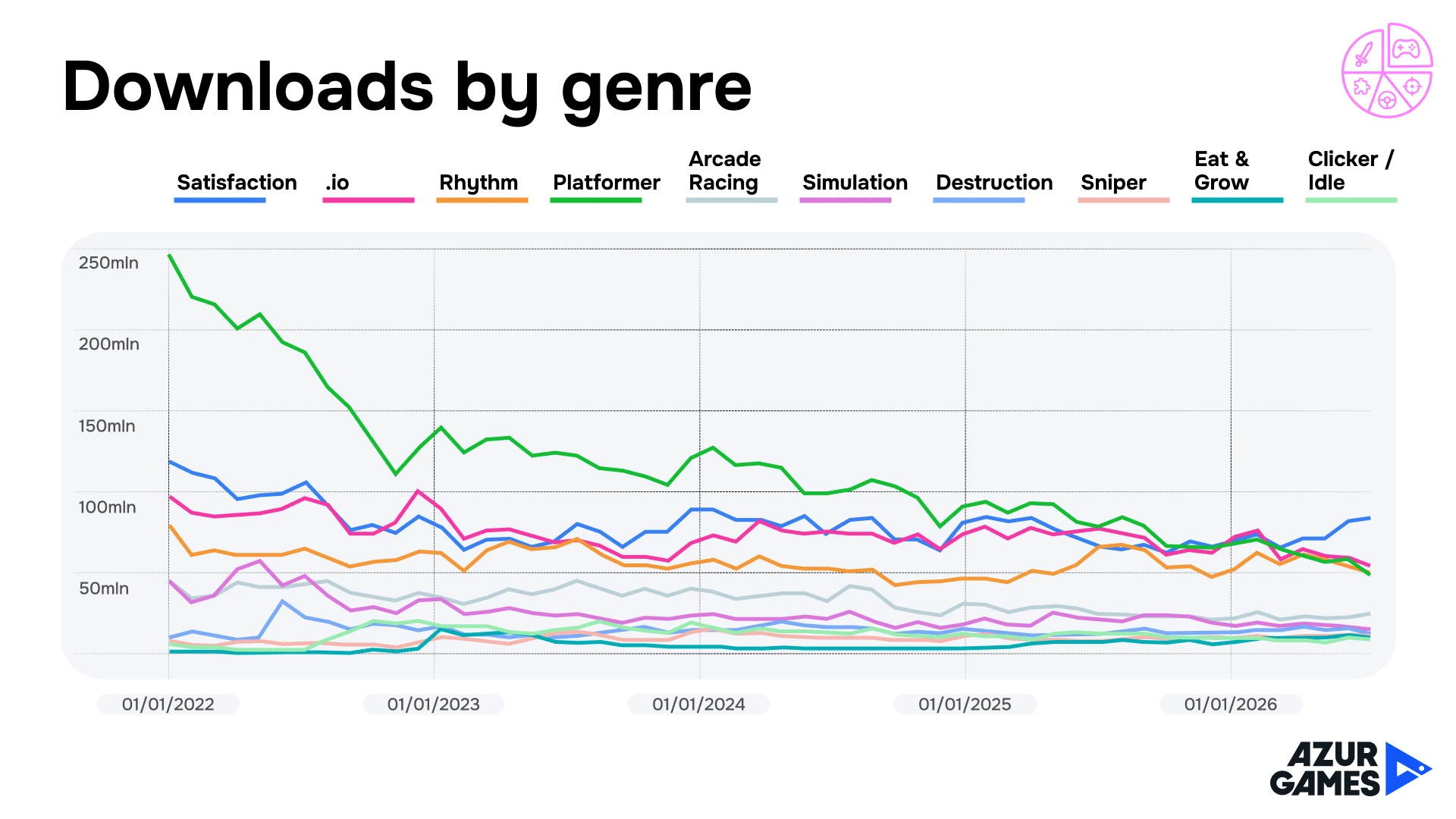
Idle therefore remains a promising genre, with one important caveat.
It is already a mature category with a huge number of existing projects. Unless a breakthrough mechanic or genuine game-changer appears, the genre will probably continue to stagnate gradually.
Top titles
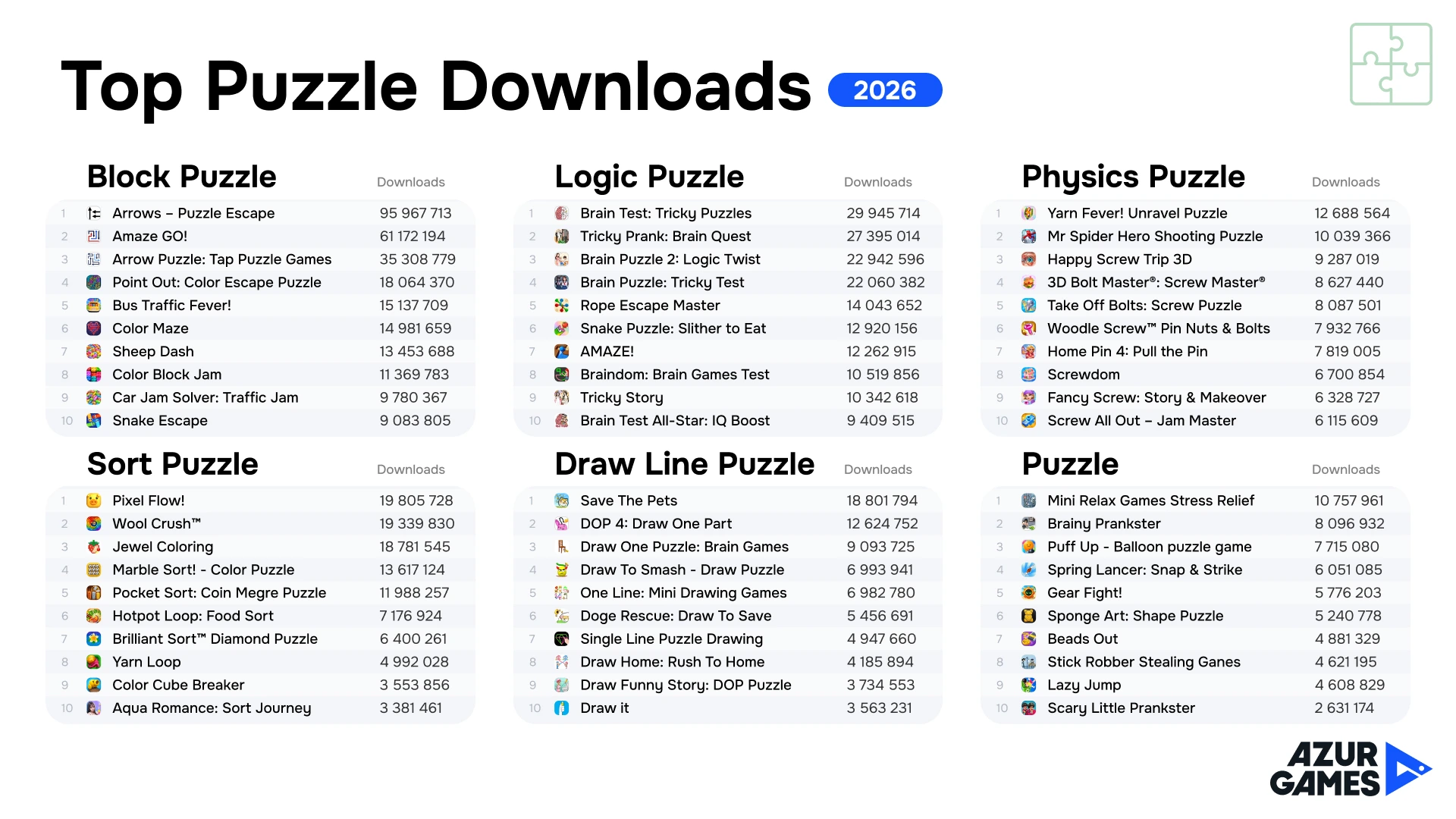
Since we have focused separately on puzzle games, let’s look at the individual titles leading this year in installs and IAP revenue.
Key takeaways
There are more charts in the full report on our blog, but If we bring everything together, the mobile market in the first half of 2026 looks like this:
-
The market is not growing, and user attention is moving elsewhere. Declining installs are caused not only by competition between games, but also by competition for screen time with short-form video platforms.
-
Block puzzle has established itself as a major subgenre and cannot be ignored. At the same time, entering the category without expertise, a strong content pipeline, and a clear understanding of balance is extremely difficult.
-
Install volume and revenue are increasingly disconnected. Within the same subgenre, revenue can differ by several orders of magnitude. The tag itself is not what determines success - the decisive factors are the specific core gameplay and its monetisation logic.
-
Any genre-level conclusion should be verified against individual titles.
-
New teams should look for genres where established players do not have a tenfold expertise advantage. The hybrid casual boom, for example, was largely driven by experienced hypercasual teams that successfully repositioned themselves. Competing with them directly is not always the best strategy.
-
Across the entire market, production quality alone is no longer enough. Teams also need to know how to operate successful games over the long term, plan monetisation early, and build workflows that can support years of content production and live ops. They also need to adapt to market changes with the future in mind. A long-term approach like this can help offset declining installs and broader market volatility.
Companies

People
