What 195 industry leaders think about player retention and engagement challenges


| Date | Type | Companies Involved | Key Datapoint |
|---|---|---|---|
| Nov 26, 2026 | report | ZBD | Retention and re-engagement |
Gaming and fintech firm ZBD conducted a survey of 195 games industry leaders earlier this year to research the challenges and trends for player retention and engagement in their games.
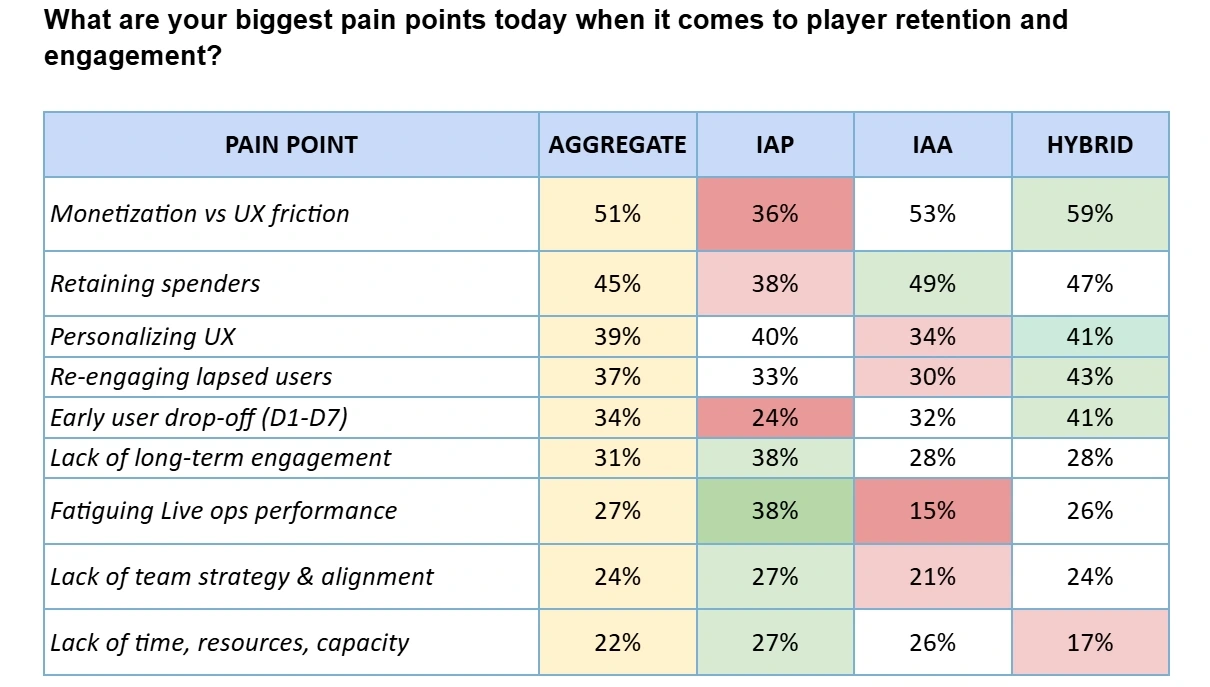
In exclusive new data provided to PocketGamer.biz, the survey showed that developers monetising primarily with IAPs reported less of a challenge in balancing their game’s monetisation strategies with the user experience. 36% reported this as a pain point for IAP games, compared to 53% for in-app advertising and 59% for hybrid monetisation.
Early user drop-off was said to be a greater challenge with hybrid games (41%), compared to 32% for IAA and 24% for IAP games.
The biggest challenges for all monetisation types was monetisation vs UX friction (51% aggregate) and retaining spenders (45%).
Strategic impact
IAP games reported that community and social features have a higher impact on retention and engagement than other monetisation models. Notably, live ops features, promotions and events had a significantly higher effect on retention and engagement for IAA games than IAP and hybrid titles at 85%.
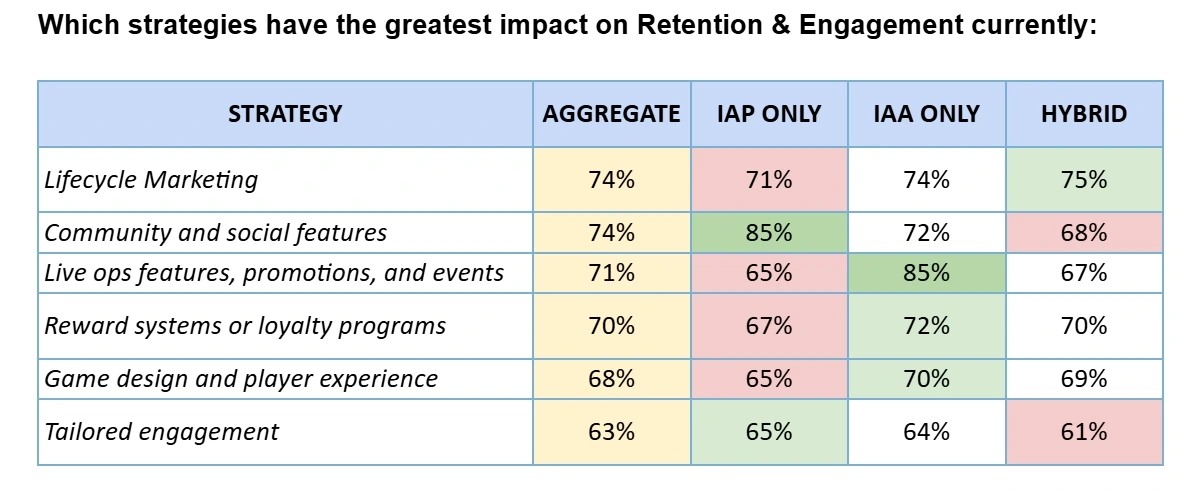
Asked about that latter data point, ZBD chief commercial officer Gordon Thornton told PocketGamer.biz that the data simply reinforces the state of the industry and natural performance evolution.
“IAP games have been building their player engagement strategies for over a decade," he said. "However, many are now starting to experience live ops performance fatigue, which is consistent with what we found in our original report. Alternatively, IAA games have only started leaning heavily into live ops in recent years, so they're likely reaping the initial benefit of fresh mechanics boosting player engagement.”

Two and a Half Gamers’ Jakub Remiar commented: “Live ops events mainly drive revenue spikes for IAP games; no amount of live ops will save your game if retention is weak.
“On the other hand, IAA games usually have much less robust economies and metagame systems to begin with. So I can imagine it is fixing some of those shortfalls there, where it's also being positioned as a metagame feature, which would make sense if it drives retention.”
Retention and engagement improvements
Asked which factors will drive the biggest improvements in retention and engagement over the next 12 to 24 months, IAA games (43%) rated real-money referrals as potentially the largest driver. That compared to 29% for IAP games and 25% for hybrid.
Hybrid games (51%) rated stronger player personalisation as the most impactful potential for improvement, followed by better cross-team collaboration at 47%. By comparison, IAA games rated stronger player personalisation at 34% and better cross-team collaboration impact at 23%.
IAP games noted that strong player personalisation and in-game rewards and loyalty systems would drive the biggest improvement. Live ops strategies were rated higher at 42% for IAP games than IAA (32%) and hybrid (34%).
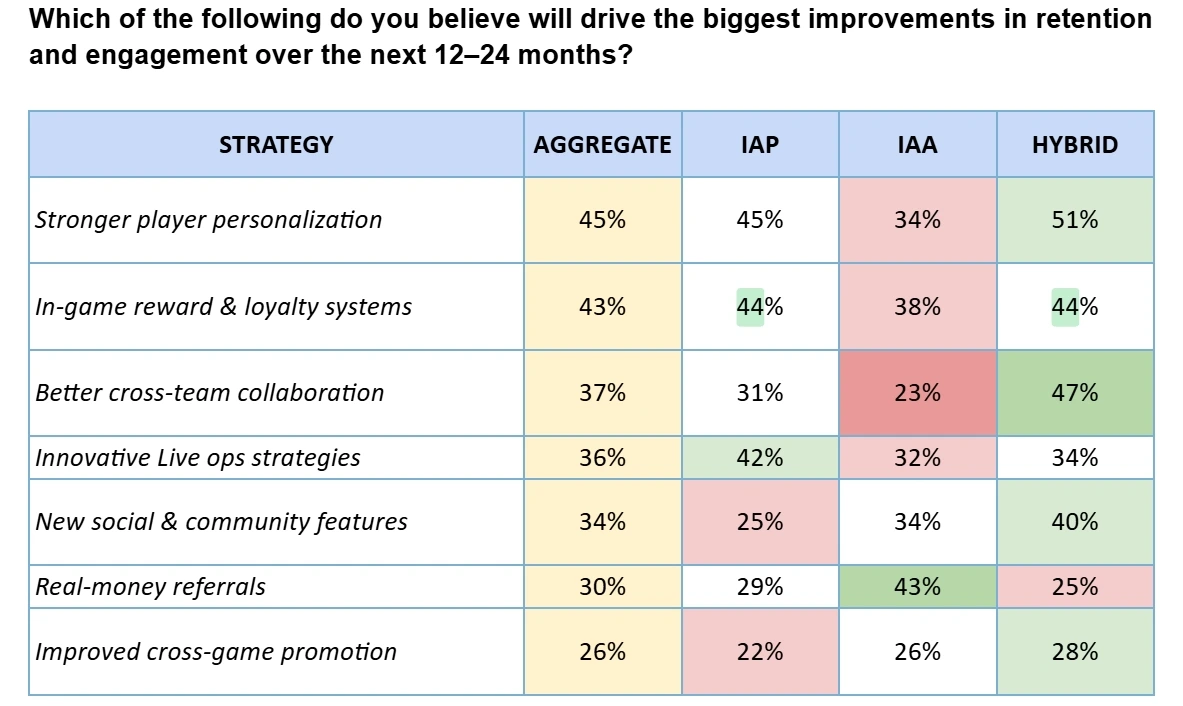
Remiar said personalisation and in-game rewards and loyalty systems were likely seen as the b biggest improvement rivers because games that already have a firm grip on how to monetise their player base are now heavily into the optimisation phase, where each tweak is able to squeeze more revenue per user.
“Personalisation across all verticals, not just in-game, is supporting this. This is great for developers who are still growing (which is basically everyone) as they can focus on their users and keep them playing for longer. In-game rewards complement this directly.”
On real-money referrals and why they are rated lower in IAP and hybrid games compared to IAA, Remiar said: “User quality differs drastically between IAP and IAA games, as does player motivation. In IAP games, players already have money; therefore, they don’t find real money referrals that attractive. IAA players, by contrast, are there for cheaper dollar-per-hour entertainment, so they find real-money referrals much more attractive.”
Past performance
Industry leaders surveyed were asked whether their retention and re-engagement budget had increased, decreased or stayed the same over the past year.
Hybrid (59%) and IAP (56%) developers said they saw their budgets increase over the prior 12 months. Meanwhile 60% of IAA developers said their budgets stayed the same, with 13% stating their budgets had decreased.
The survey also reported that 2% of IAA developers have no dedicated retention budget.
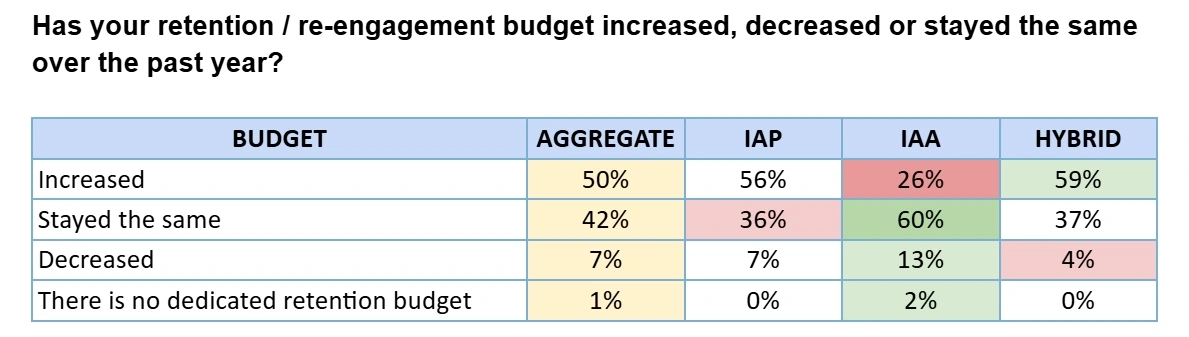
While over half of IAP developers are said to be increasing their budgets for retention and re-engagement, 44% aren’t. That’s despite the challenge of high and ever-increasing UA costs for new users, a point that Thornton highlights.
“Chasing the same new users as everyone else and hoping they stick around to spend is getting increasingly expensive and delivering a lower ROI," he said.
“On the flip side, investing in retaining existing users who have proven their worth can build a more sustainable active user base as a game’s lifecycle matures. Adding more context to the 44% data point: of the 44%, only 7% are decreasing budgets, while the rest are holding budgets steady.
“Not every studio is going to be a first mover, and some may not feel the current headwinds as much as others, but I'd expect we'll see a continued shift toward more studios increasing retention budgets year over year."
Learn about player retention, engagement, UA and more at Pocket Gamer Connects London on January 18th and 19th.
Companies

People