Xbox's major reset continues and reflections on AppLovin's studio acquisitions | Week in Views

The games industry moves quickly and while stories may come and go there are some that we just can't let go of…
So, to give those particularly thorny topics a further going over we've created a weekly digest where the members of the PocketGamer.biz team share their thoughts and go that little bit deeper on some of the more interesting things that have happened in mobile gaming in the past week.

Paige Cook
Xbox to cut 268 jobs as it shakes up studio structure
Xbox has had a lot going on this week. The Xbox reset continued, and watching it unfold feels like we are seeing one of the biggest changes the company has ever gone through.
Another 268 jobs were cut, and the company is also undergoing major restructuring across its studios. Microsoft Casual Games is moving to King, Obsidian is joining Bethesda, and Activision is expanding its remit to include Rare and World’s Edge. Not to mention it's also now taking charge of the next Halo.
A clear focus seems to be emerging from these changes, centred on Xbox’s biggest IPs. To me, some of the studios being pulled together make sense, and perhaps it helps to facilitate seeing big Xbox franchise games make it to market more frequently.

However, there are also major losses alongside the changes. Undead Labs has managed to go independent, but it still had to lay off staff. Elsewhere, Ninja Theory’s future remains uncertain after two potential buyers fell through, so what we saw of Senua back at the Xbox Games Showcase in June may never come to fruition.
And this isn’t the end, Microsoft says the reset is around three-quarters complete, so there’s more change to come.
As a side note, we also had a story this week about an Xbox patent for an ad-credit system that could show adverts during natural breaks in games. Of course, we are very used to this on the mobile games side, but I'm not sure how it would translate to console or PC. As always, a patent doesn’t mean this will actually happen, so I won’t read too much into it yet.
When all is said and done, I’m curious to see what Xbox looks like once the reset is complete.

Craig Chapple
AppLovin grows 60% Y/Y rounding to $20bn in annual platform ad spend
“We bought them originally as a data play,” AppLovin CEO Adam Foroughi said in a recent interview for the All-In Summit.
He was talking about the ad tech company’s acquisition of game studios. I remember at the time speaking with marketers who weren’t happy that AppLovin had gotten into games publishing with Lion Studios. They were worried that AppLovin might have access to rivals’ data, which would give it a competitive advantage.
I remember, amid this controversy, an IronSource executive telling me they wouldn’t be getting into publishing. Not long after, they launched Supersonic Studios (now recently snapped up by Tripledot, a haven for ex-ad tech gaming portfolios).
“When we built our first deep learning model, we needed to have data to train it, and games studios don’t tend to want to share data to third-party companies. So we bought our own studios, we seeded the training data in our first model, we built the model that was really successful in the market and we started growing really quickly. Once we started doing that, third-parties were coming in and that was that, we divested that.”

This got me thinking about the announcement around AppLovin’s acquisition of famed 4X strategy studio Machine Zone back in 2020. Here’s the press release.
Now, for those in the industry, it was, like Foroughi depicts, a clear play for user data. The company had a successful casual portfolio, but this would give it access to the ‘core’ market.
The press release from 2020 alludes to this reasoning, particularly with talk of a “win-win” for combining Machine Zone with AppLovin’s mobile marketing platform. But the PR would not have looked like that to players.
“AppLovin will combine talent, games and technologies with Machine Zone to bring new immersive mobile games to the market while continuing to help game developers successfully market and monetise their games.”
Foroughi himself said “...we are excited to bring together our two creative brands and market leading technology platforms to continue to entertain their millions of fans around the world.”
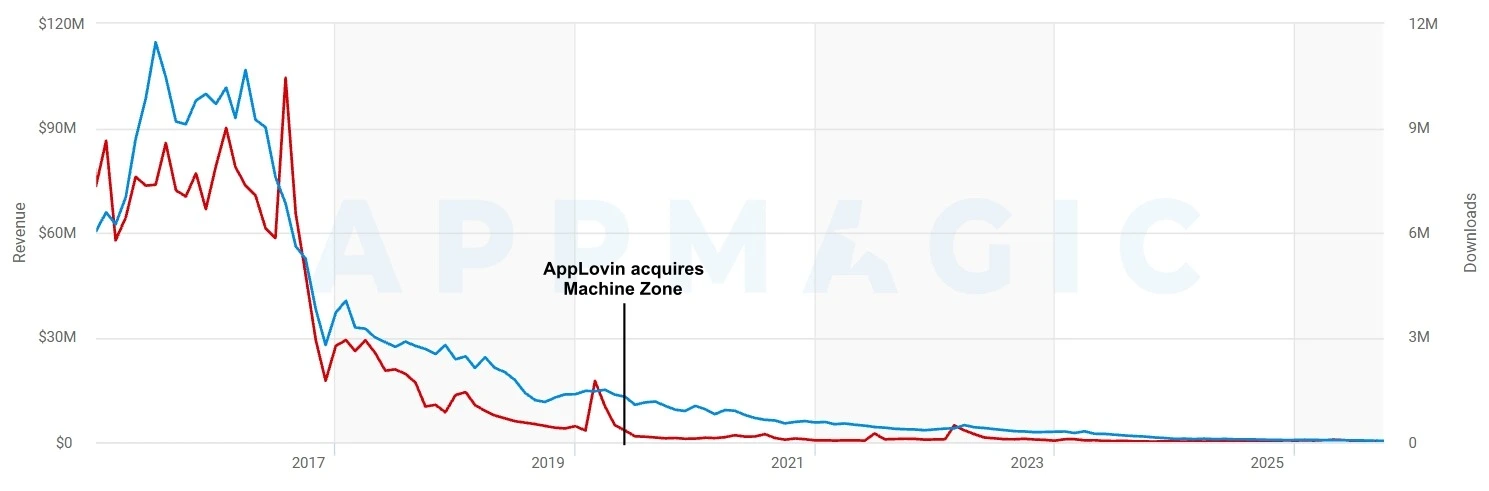
Now, by May 2020, Machine Zone was long past its hay day when Game of War and Mobile Strike were generating billions of dollars. The decline didn’t suddenly start post-AppLovin’s deal, but the downloads for a studio famed for its UA fell and did not pick up. This is a developer owned by what is now one of the biggest mobile ad platforms used for that exact purpose.
Following the acquisition and prior to the sale of AppLovin’s games business to Tripledot, the studio launched a single game, Final Fantasy XV: War for Eos, which didn’t perform to the heights of its predecessors, including Final Fantasy XV: A New Empire.
I’m not trying to cry foul, say whether AppLovin’s PR was right or wrong, or even dispute the company’s success - it’s certainly scaled substantially the days of this deal.
But the acquisition is an example that, oftentimes, what a company doesn’t say publicly in a press release can speak louder than what they do say - particularly when it comes to the why of a particular deal or announcement.
Companies

