How doubling down on physics expertise helped Rollance stand out in a crowded market


- Rollance succeeded by building on expertise developed in Action Balls not by chasing trends.
- Content expansion after launch delivered the biggest metric gains.
- Rollance’s realistic physics attracted a smaller but more loyal audience with high retention.
Nikita Tikhomirov is a producer at Azur Games.
Over three years ago, we approached Ates Games with the idea of creating a game centred around controlling a rolling ball that moves through levels and overcomes various obstacles. At the time, they’d already released Action Balls, a project in which they’d begun applying their deep understanding of physics to create a distinct feel.
Sait Ates, co-founder of Ates Games: “The idea for Action Balls came from an old PC game called Ballance, veterans will remember it. That was our inspiration. But we wanted to take it further and create something more physics-driven. Our second co-founder and developer - also my brother - Onur Ates, is a physicist. I think that explains a lot.”
Thanks to its nuanced physics, Rollance resonated with hardcore players seeking a real challenge.
That foundation gave rise to a new game, Rollance. The vision was to build on their experience but shift the style toward realism, similar to PC physics games. At the time, there were no comparable mobile games on the market. Most were cartoonish and used primarily scripted physics. Rollance aimed to fill that gap.
We hypothesised that the realistic style would help lower CPI, and while that was true to an extent, it wasn't the full story. Thanks to its nuanced physics, Rollance resonated with hardcore players seeking a real challenge. It earned a loyal audience and strong retention, but it also came with a whole new set of “growing pains."
Launch and development
Rollance launched with 20 levels already built - without pre-testing the visual setting. But the team had already gained deep technical experience from Action Balls, where they had experimented extensively with Unity’s physics. That know-how was carried directly into Rollance.
Sait Ates, Ates Games co-founder: “After we released Action Balls, we were thrilled, especially when we saw how positively players reacted. Physics is an integral part of our lives; everything around us follows its laws. That’s why we decided to focus on creating a mobile game with the most realistic physics possible. This became our unique expertise and the foundation for future projects.
Realistic physics and visuals meant that every level took much longer to build, at least twice as long as in Action Balls.
Action Balls was also a physics‑based game, but it leaned more toward arcade gameplay. With Rollance, we wanted to make everything even more realistic - the world, the ball itself, and every game element. At first glance, the two games may look similar, but in reality, they’re very different thanks to countless small details, gameplay features, and, most importantly, completely different game speeds.”
The cost of realism
Content development turned out to be a significant bottleneck. Realistic physics and visuals meant that every level took much longer to build, at least twice as long as in Action Balls. Balancing realism without overwhelming complexity became the central challenge.
Sait Ates, Ates Games co-founder: “On one hand, our focus on physics slowed us down. We were striving for realism. Every detail had to feel real - how the ball moved, how it interacted with different surfaces and objects. We spent a lot of time experimenting and refining. But on the other hand, that very approach helped us carve out a unique style.
Instead of just copying others, we ended up creating something genuinely our own. That’s what made the game stand out in the market, and it laid the groundwork for future projects. In the end, the extra time we spent paid off with the game’s success."
If we had gone with a cartoony style instead, many of the obstacles, traps, and level elements could have been scripted - much easier to build. But that would have alienated our players, and the performance metrics would’ve looked entirely different.
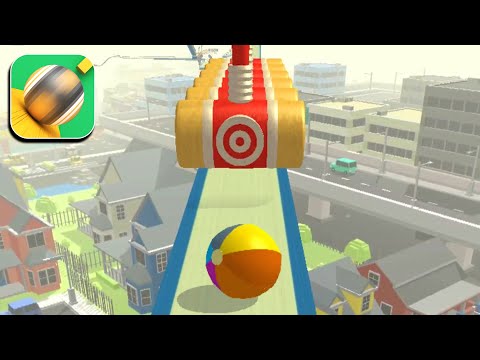
After it became clear the launch was a success, our first major win came from content expansion. As we added more levels, metrics jumped: R1 improved by 10 percentage points; R30 hit 4.2%; worldwide CPI: $0.10 ($0.67 in the US); average daily playtime: 15 minutes. This is why we’re putting out new content non-stop now.
The biggest production hurdle wasn’t visuals, but physics complexity. Each new mechanic, from slopes and curves to fans that lift the ball and level geometry, introduced more variables to balance and keep the player experience consistent.
Unlike arcade games, where many of these can be simplified, Rollance treats physics as a core feature and a competitive edge.
We also added a smooth, scripted camera system so players didn’t have to rotate it manually, which brought extra development costs.
Gameplay variety
One of our most impactful updates in terms of metrics was the introduction of material switching. Originally, the game had a single ball with realistic behaviour. We then added a feature that allowed players to change the ball’s material - for example, switching from wood to metal or paper. Each material behaved differently, creating gameplay variety unlike anything else in mobile games.
The biggest production hurdle wasn’t visuals, but physics complexity.
This update led us into experimentation with progression systems. Initially, we borrowed a concept from hyper-casual games, where players chose a ball type before each level. If they picked the wrong one, they might fail. In practice, this didn’t perform well, but we’re revisiting the concept in upcoming event-based updates.
We also tried visual monetisation - skins, trails, cosmetic effects - but those didn’t resonate with our audience. Rollance players were there for the physics and the challenge. Visual clutter only distracted.

Another win came from tech optimisation: we implemented adaptive graphics. Because we were going for a realistic setting, the game ended up being pretty heavy in terms of device load.
To make it work across a wider range of phones, we started monitoring device performance on the fly, and when FPS dropped, we’d dynamically lower the visual quality. We had presets for things like shader complexity, texture resolution, lighting, etc., and would switch between them in real time to keep the gameplay experience smooth and satisfying. That alone gave us around a 20% boost in LTV.
Rollance has strong long-term retention, which helps us recover project costs.
Rollance has strong long-term retention, which helps us recover project costs. Several studios have tried to build competitors, pouring a lot of resources into development, but none have reached the same level.
Sait Ates, Ates Games co-founder: “My advice to younger studios is to build deep internal expertise in one specific area they could later use as an USP. Today’s mobile market is brutally competitive. Making a ‘good’ game isn’t enough, you need a unique angle. Whether it’s physics, storytelling, or a distinct visual style, having that sharp focus gives you an edge.

It helps you stand out, and more importantly, it allows you to keep improving your product because you understand all the intricacies of your chosen field. That kind of specialisation keeps you from spreading yourself too thin and lets you double down on what you do best.”
And I’d also point out something that often gets overlooked: even if a game has strong long-term retention, not every studio knows how to turn that into a profitable UA loop. That’s a separate competitive edge, and one that really only clicked for us because of the close connection we built with the studio.
We’ve begun transitioning toward hybrid monetisation, in line with industry trends.
Rollance now features over 50 levels. We’ve begun transitioning toward hybrid monetisation, in line with industry trends. We’re planning to introduce metagame layers and event-based monetisation in upcoming updates.
Sait Ates, Ates Games co-founder: “One last thought - I truly believe our success comes down to doing what we love. We focused on what brought us joy and leaned into that. If you genuinely enjoy the process of making games and keep sharpening your skills, success will follow. But if you're constantly bouncing between genres, it’s easy to lose that focus. These days, that kind of scatter can be a real risk.”
Companies

People
