How SayGames uses game analytics to balance difficulty in hybrid puzzle games


- SayGames uses player data and testing to balance difficulty in hybrid puzzle games.
- Finding the right balance between challenge, retention and monetisation requires continuous testing and iteration.
- What appears to be player churn may simply be players taking longer to complete difficult levels.
Pavel Korbut is a producer at SayGames.
Over the past few years, SayGames has been steadily growing its in-app purchase revenue.
May 2024: $3.53M
May 2025: $6.19M (+75.4% YoY)
May 2026: $8.49M (+37.2% YoY)
(According to Sensor Tower)
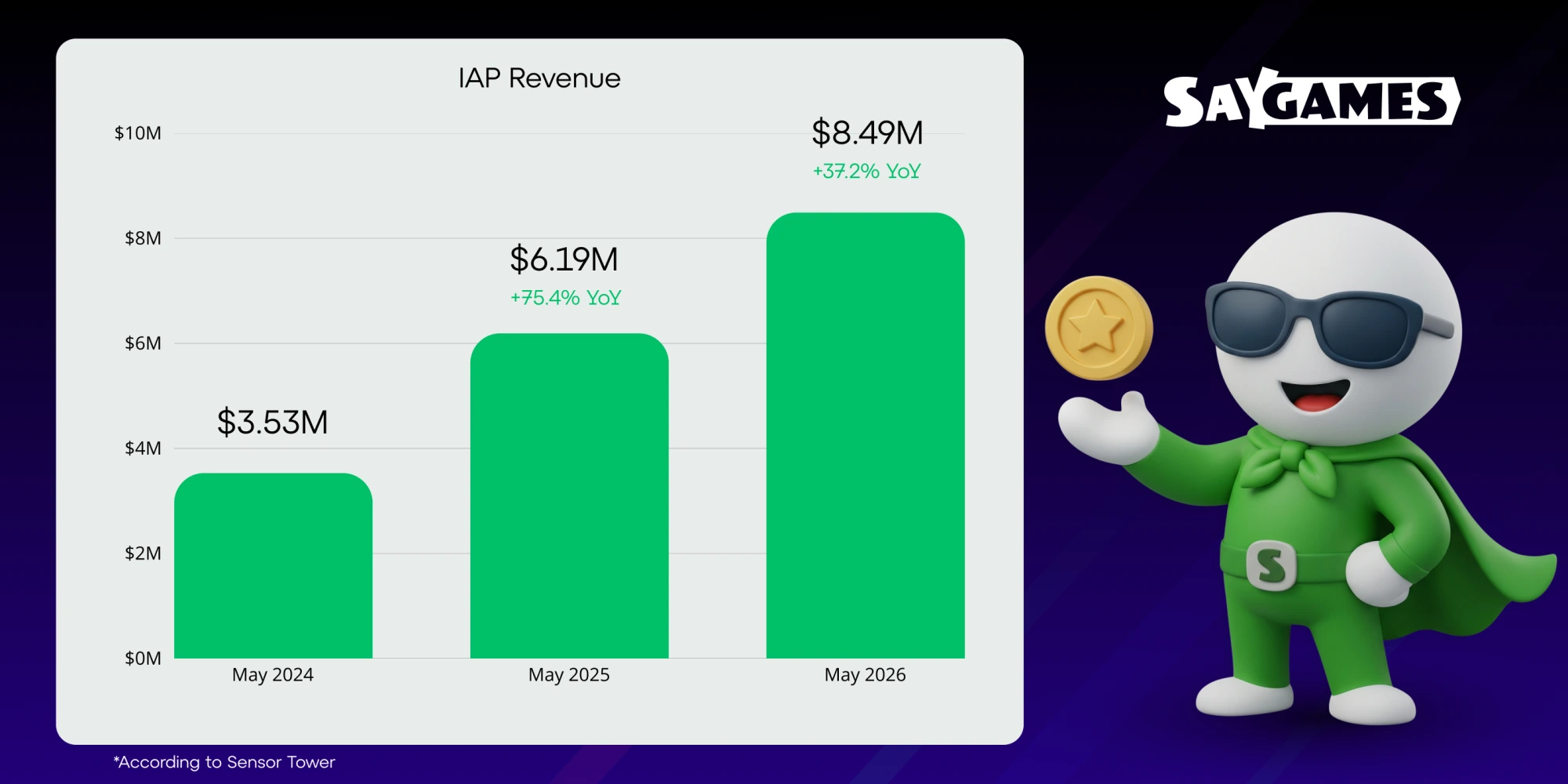
IAP revenue has more than doubled over the past two years. A significant part of this growth came from the company’s strategic expansion into the hybrid puzzle genre - and from learning how to manage difficulty correctly in products where ads and in-app purchases coexist and directly influence each other.
In this article, Pavel Korbut, Producer at SayGames, explains how his team approaches level difficulty in hybrid puzzle games - so that players stay longer and generate higher LTV.
Levels can ruin everything. And save everything
In a puzzle, levels are the game. They are the core content. The most important thing the player interacts with.
Bad levels can kill even a great mechanic.
Too hard - players quit.
Too easy - it’s boring.
Too long - it’s exhausting.
Too short - it creates no emotion.
So how do you deal with this? Only through testing. You can’t rely on intuition - even if you have years of game development experience.
Our principle is simple:
We release levels to players as early as possible and look at real data: fail rate, churn, number of attempts, booster usage, rewarded ad views.
“Nobody knows anything.”
We release levels to players as early as possible and look at real data: fail rate, churn, number of attempts, booster usage, rewarded ad views.
When we analyse fail rate, we often see spikes in difficulty. That’s neither good nor bad - it’s simply information. It helps us understand where players struggle and where the experience may need adjustment.
From there, we form hypotheses and begin testing.
Fail rate and the difficulty curve
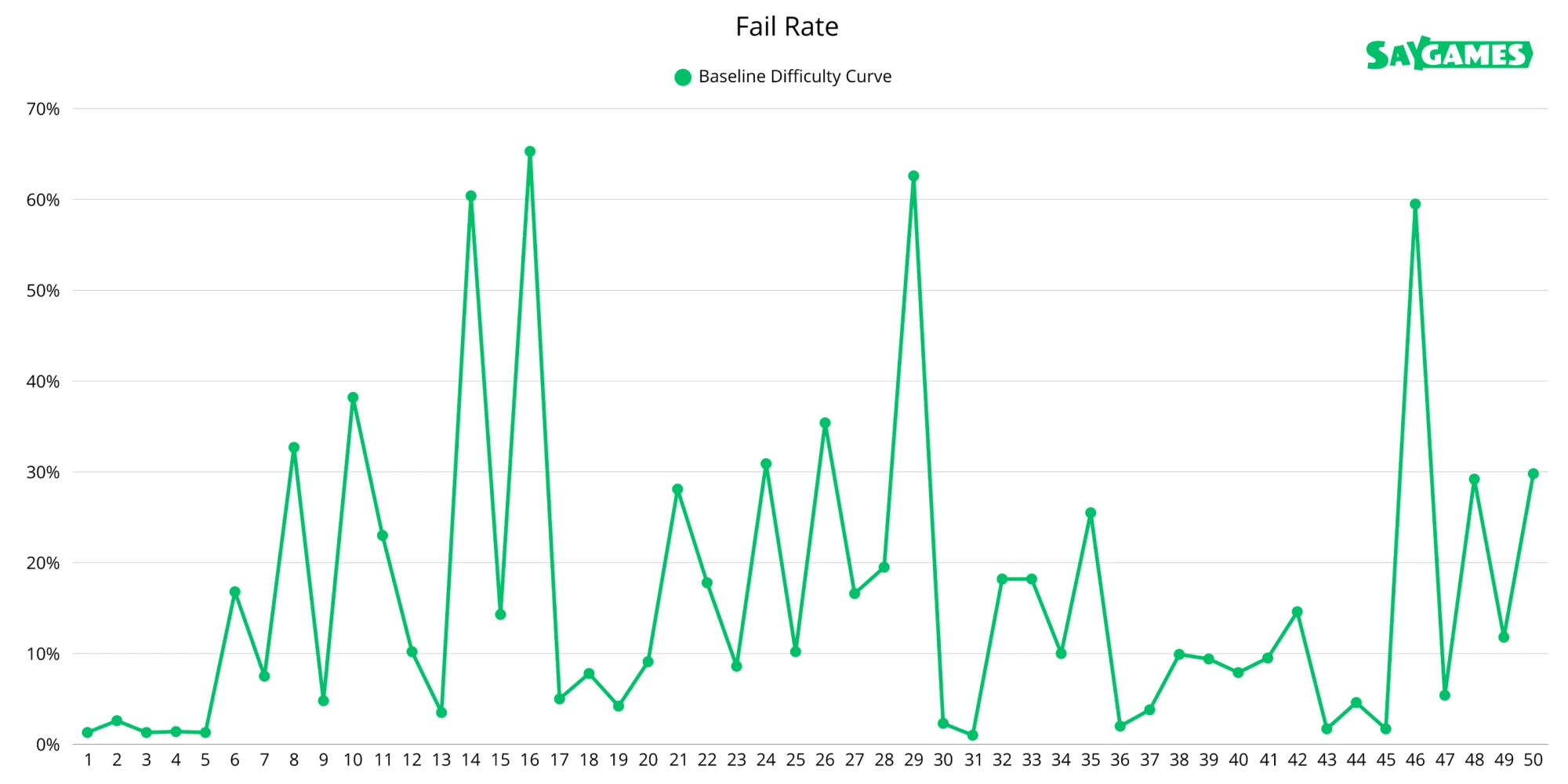
Once we start receiving real player data, we begin experimenting with the difficulty curve.
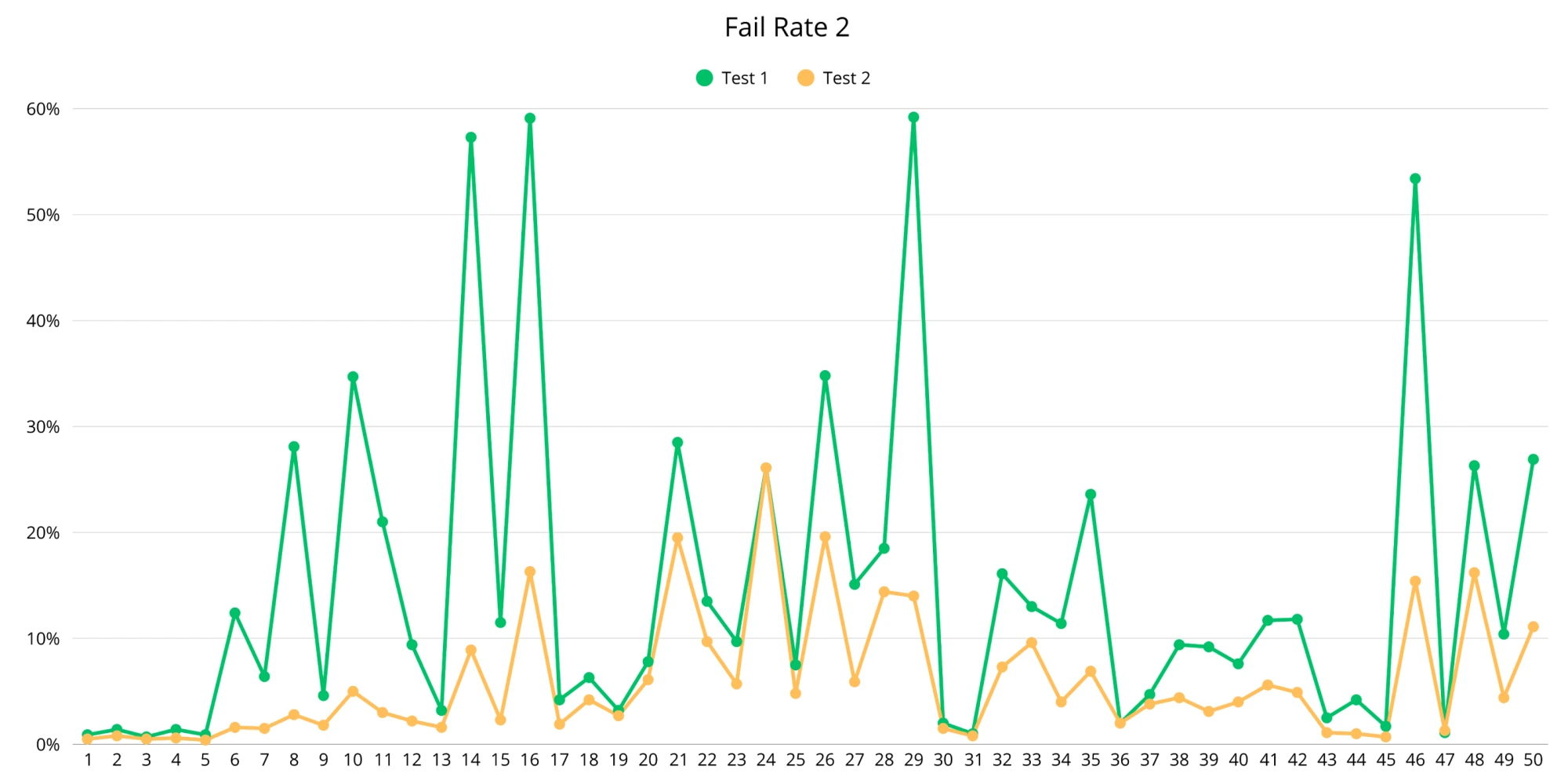
We test different variations - making parts of the curve slightly softer, slightly harder, or shifting where difficulty spikes appear.
Sometimes a smoother curve allows players to progress through the game more naturally. In other cases, stronger spikes can create moments of challenge that make the gameplay more exciting.
That’s why we keep repeating the same rule:
Nobody knows anything.
Only testing gives you answers.
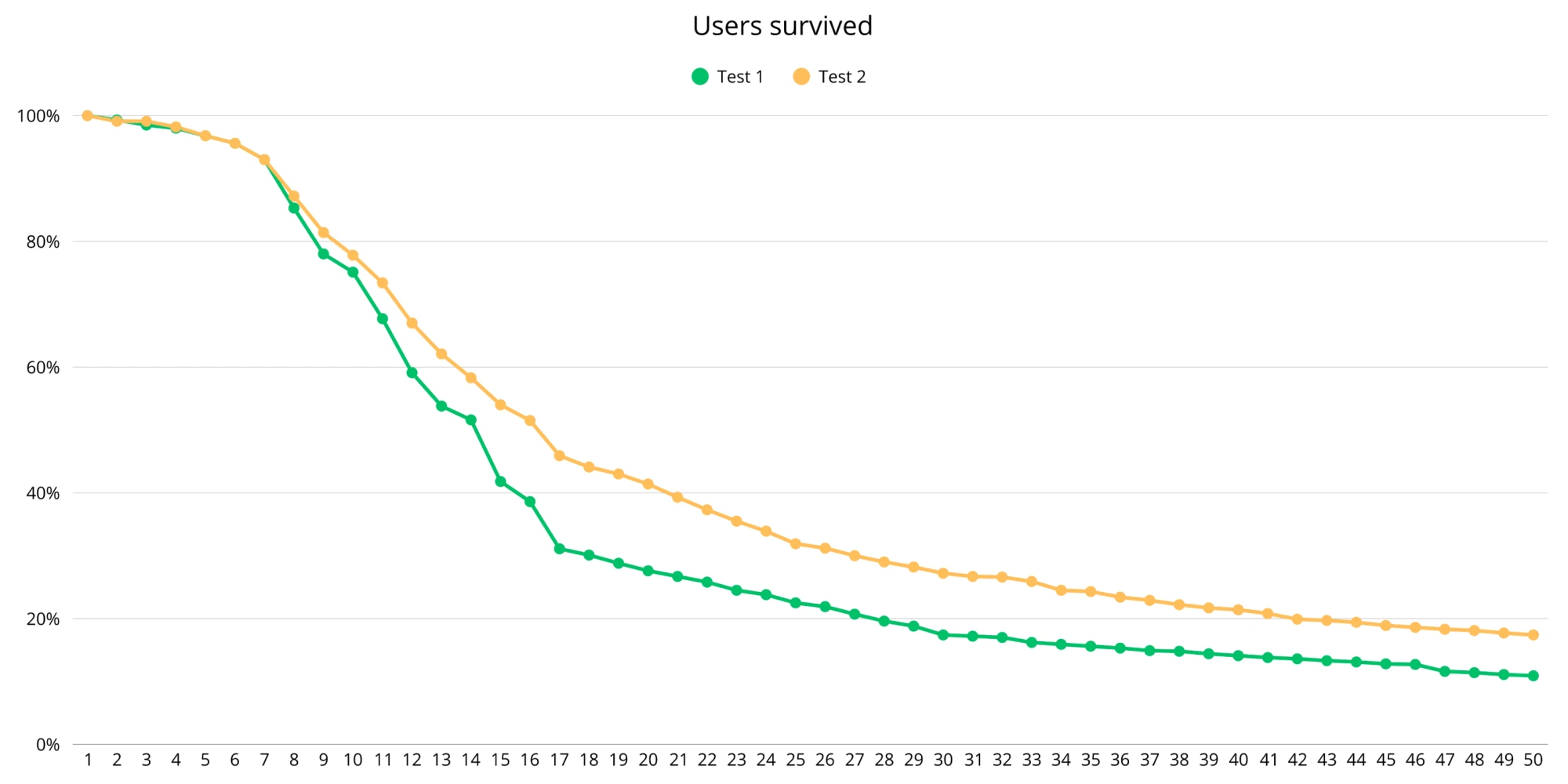
In one case, we experimented with adjusting the balance of levels without redesigning them. By slightly softening parts of the difficulty curve, the overall pacing of the game improved. Levels felt less frustrating, and the progression through the game became smoother.
The game simply started to feel more natural to play.
This balance is especially important in hybrid puzzle games.
-
In ad-driven puzzles, the goal is usually to keep players in the game longer - the longer they play, the more opportunities there are for ad engagement.
-
But games built around in-app purchases work differently. If the game becomes too easy, players may never feel the need to use boosters or other resources to progress.
Hybrid puzzles sit somewhere in between these two models.
The challenge is not to make the game simply easier or harder, but to find the right relationship between challenge, progression, and player motivation.
And the only reliable way to find that balance is through testing.
A few practical tips from our experience
The Emotion of a “Close Win”
It’s important to manage not only the overall difficulty curve of the game, but also the difficulty inside each individual level.
A great level has controlled tension peaks - moments when the player feels they’re about to lose, but still has a chance to win.
These moments create a powerful emotional experience - a “close win.” Because of that experience, next time the player won’t quit the level even if defeat seems inevitable. They already know that a comeback is possible at the very last moment.
A “close win” moment:
-
Strengthens the feeling of reward.
-
Makes the experience more dramatic.
-
Increases the perceived value of boosters.
-
Raises willingness to pay or watch ads, because the player is buying a chance to recover - not a mandatory resource.
How we look at difficulty: Fail rate and attempts
One non-obvious challenge is how to interpret the fail rate.
Formally, it’s simple:
50% fail rate means two attempts per level on average.
80% means five attempts.
It may seem like 50–60–70–80% is just “somewhere between two and five attempts,” and not such a big difference.
But real data tells a more complicated story.
Where analytics show an average of two starts per level, there are players who need 10 or even 20 attempts to win. Where the average is five starts, there will be players who try 50 times and still fail. In games with randomness, there will always be “unlucky” players - those who fall into the tail of the distribution and face a nearly unbeatable level.
From a metrics perspective, there aren’t many of them - it won’t immediately crash retention.
But these are often your most loyal players - the ones who stay despite difficulty. From a game design standpoint, you need to take care of them.
The goal is to prevent situations where a level becomes a “black hole” - a place where motivated players lose momentum instead of progressing.
It may sound obvious - help players who are stuck too long.
But it directly impacts your metrics.
When churn isn’t actually churn
We used to look at churn in a very straightforward way.
If 100 players entered a level and 90 moved on, it would seem that 10 players had dropped off. But in puzzle games with higher difficulty, that interpretation is often misleading.
What looks like churn can simply be a pause.
To better understand what’s really happening, it’s important to look at player behaviour over time - not just at a single moment.
Players don’t always leave - sometimes they stay on the same level for a while, trying to beat it. It may take multiple sessions or even several days before they finally progress.
As a result, progression data alone doesn’t always reflect actual player loss.
To better understand what’s really happening, it’s important to look at player behaviour over time - not just at a single moment. This helps distinguish between players who are truly leaving the game and those who are still engaged but temporarily stuck.
Taking this into account allows us to:
-
Avoid overreacting to difficulty spikes.
-
Avoid adjusting levels too early.
-
Feel more confident working with challenging content.
In practice, this shift in perspective makes it easier to design levels that are challenging without being discouraging.
How we monitor level quality
When launching a game, we usually follow a similar pattern.
For the first public version, we'd say 100 levels are enough (or less, depending on their average length). When we see the project has potential and we want to evaluate D7+ metrics, we double the content. With 200 levels, we start looking at D14+ metrics.
This puts us in a constant race against time to produce enough unique content. But in that race, you can’t always maintain top quality - and level quality directly impacts LTV.
When we see that the game has potential and enough content depth, we allow ourselves to test every content pack before releasing it to all players.
You might release new content with new mechanics, but it turns out to be too easy - and players burn through it quickly. Or it might be too hard - and players churn.
So what do we do?
At every stage of development, we need to be careful about the quality of released content. When we see that the game has potential and enough content depth, we allow ourselves to test every content pack before releasing it to all players.
Here’s how it works:
-
New level chains first go to a limited audience.
-
We track fail rate, churn, attempts, level duration, and rewarded ad views.
-
Only then do we decide whether to roll these levels out to the full audience or refine them further.
This approach not only protects us from monetisation losses, but also helps us identify problematic or broken levels before a full rollout.
Test-and-learn instead of “I know”
At SayGames, we cultivate a test-and-learn culture.
Even a specialist with 10 years of experience cannot say:
“This is the correct difficulty curve” or “This level is too boring.”
We don’t accept statements like that - and we don’t make them ourselves.
Hard, easy, boring, fun - these are subjective judgments.
Sometimes a “too easy” level delivers excellent monetisation.
Sometimes a “too hard” one drives the best retention.
Our strategy is simple:
-
Every hypothesis must go through data - A/B tests, experiments, analytics.
-
If a feature or event brings no value in testing, we don’t ship it.
-
If it works, we scale it.
We try to validate every change with data. That applies to the difficulty curve, live ops, and level tuning. In puzzle games, where one extra step can turn a fan into a lost user, this approach pays off.
And yes - nobody knows anything.
Until they test it.
When we work with partner studios, we approach development the same way - as a shared process of testing, learning, and refining the game step by step. Hybrid puzzle games rarely succeed because of one perfect idea. Success usually comes from iteration, data, and collaboration.
Companies

People