In the Hot Seat: How a former Dow Jones investigator is bringing due diligence to games


The next guest in our In the Hot Seat interview series is Chelsea Anglin, founder of DD For Games, who we spoke to ahead of her appearance at Pocket Gamer Connects Summit Shanghai on July 29th.
Anglin spent five-plus years as an investigative researcher at Dow Jones, tracing the murkier corners of global finance, before turning that same lens on games. Now based in Taipei, she runs a due diligence practice built for an industry that, by her account, still treats background checks as optional.

A hunch that became a business
Anglin's route into games ran through language rather than finance. She started learning Chinese specifically to play Japanese games in their original script, since the two languages share a character system - a hobby that eventually pulled her toward Taiwan's indie scene and, later, into founding DD For Games.
The gap she found was structural. Game industry partnerships, she says, tend to form casually - over Discord, at a game jam, through a friend of a friend - with little more vetting than "the first page of Google or asking AI."
That's a problem once real money and international contracts enter the picture, particularly for US-dollar deals, where KYC obligations exist precisely to keep companies from unknowingly funding sanctioned entities or bribery schemes.
Narrative alignment is the tell
Ask Anglin for the red flag that makes her stop and dig, and the answer isn't dramatic. It's misalignment - a slick pitch deck sitting on top of a company registration that's lapsed, a website with no social activity behind it, or a founder nobody will name. None of these sink a deal on their own, she says, but they change what she looks for next: "If this isn't in alignment, what else isn't?"
The rare, genuinely disqualifying finds do exist. Anglin has seen entities show up on the US Treasury's OFAC sanctions list, and even a background featuring a murder charge - though she's quick to note the latter is not exactly common in games.
The free checklist
Anglin's practical advice is compiled into a self-guided background-check framework, distributed through her newsletter, Game Intelligence Direct. The core asks are straightforward: a verifiable corporate registration, a public location (even just a country, not a full address), a named founder or someone who can vouch for the studio, and - however unloved - a LinkedIn presence, which she calls part of the basic language of doing business in games.
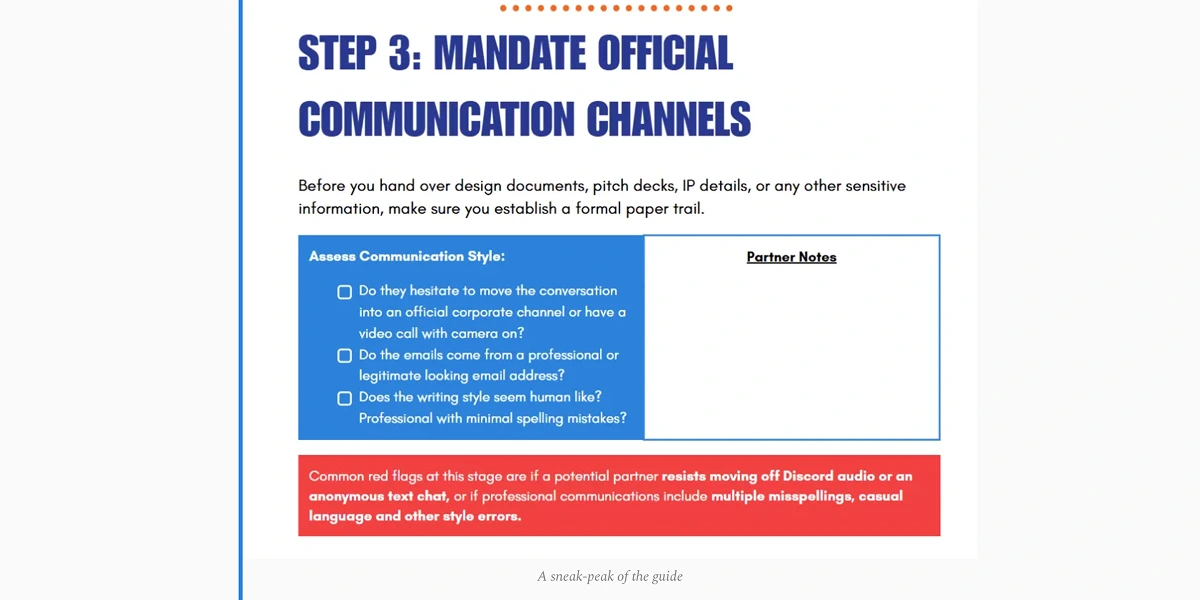
Operational transparency, she argues, is the cheapest fix available. A studio that won't say where it's based, or who runs it, isn't necessarily hiding anything - but it makes verification impossible, and verification is the entire point.
Why Chinese due diligence is its own discipline
Vetting Chinese partners flips several Western assumptions. Common surnames make name searches a "needle in a haystack" problem, and LinkedIn is far less reliable outside firms with an international footprint. But on ultimate beneficial ownership - often the hardest thing to establish in a private US deal, since shareholding data isn't public, China and Japan actually disclose more: shareholders are listed on the business registry, letting researchers trace ownership trees upward through holding companies.
Anglin's broader recommendation for Western studios chasing funding in China largely sidesteps the money question itself. Grant landscapes and funding sources are opaque to non-Chinese speakers, she says, and that's exactly why a local partner isn't optional - it's close to a legal necessity, and the only reliable route to translating both the funding landscape and the regulatory one, which covers everything from screen-time rules to gambling mechanics.
What she's bringing to Shanghai
At PGC Summit Shanghai's "Under the Microscope: How Are Chinese Studios Being Funded in 2026?" panel, Anglin plans to work both sides of the table - helping studios understand how to present themselves credibly to investors, and warning publishers and investors that a six-figure invoice deserves the same background check as any other partnership decision. "I did realise that deal was kind of sketchy," she imagines one attendee admitting, "but I didn't know I was supposed to check."

Hear from Anglin and a full lineup of speakers at PGC Summit Shanghai on July 29th. Tickets are available here.
Companies

People

Events
