Inside Poki's vision for the future of browser gaming


- Poki has grown from 10 million to 100 million monthly players over the last five years as browser gaming has continued to evolve.
- According to Poki, some developers now generate up to $1 million annually through browser-based advertising.
- Poki now works with more than 600 developer partners, including established mobile studios such as SYBO, Fingersoft and Outfit7.
Browser gaming, once known mostly for its Flash-based games, largely faded from the spotlight as mobile app stores became more popular and started to dominate the industry's distribution model.
However, behind the scenes, web gaming has never stopped evolving.
The transition to HTML5, improvements in browser technology and growing questions about the long-term economics of app stores have created new opportunities for developers.
One such developer involved in that shift is Poki, an Amsterdam-based browser gaming platform.
To learn more about the web gaming space, PocketGamer.biz spoke with Poki chief operating officer Stein Janssen about the platform’s journey, why mobile developers are increasingly embracing browsers and why he believes the web is becoming a core platform for games once again.
A decade backing the web
Poki’s origins date back to 2014, at a time when much of the games industry was already shifting its attention almost entirely toward smartphones and the app stores that accompanied them.
Rather than following that direction, founders Michiel van Amerongen and Sebastiaan Moeys believed that the browser still had an important role to play. Their ambition was to remove as much friction as possible from playing games, allowing anyone to jump into an experience without downloads, lengthy installs or accounts.
For Janssen, who joined the company after several years, that philosophy remains just as relevant today.
“The whole industry was running toward mobile apps, and Bas and Michiel had bet on the open web instead, because the web is what makes play universal.”Stein Janssen
"Bas and Michiel had a clear vision when they launched Poki in 2014: let the world play. Their mission was to build the ultimate online playground. Instant, free, on the web, no downloads, optional logins and no friction between a player and a game."
He explains that what stood out to him when he met the founders wasn’t simply the product but the conviction behind it.
"What excited me when I first met with them in 2016 was the vision sitting underneath the company. The whole industry was running toward mobile apps, and Bas and Michiel had bet on the open web instead, because the web is what makes play universal."
Janssen explains that Poki has always viewed games as fundamentally accessible and rooted in the belief that "play is how we learn", something he says has remained unchanged as the company has grown.

Today, Poki reaches 100 million monthly active players across more than 190 countries, and works with over 600 development partners. Despite that growth, Janssen argues that the original vision has remained intact.
"Today Poki is the leading web gaming platform in over 100 countries with 100 million monthly active players, and the vision has not moved: let the world play."
The wider browser gaming ecosystem has also undergone a dramatic transformation during this same period. When Poki first launched, Flash was already entering its final years, and its eventual retirement forced developers to modernise, while browser technology matured to the point where more technically ambitious experiences became possible.
"The biggest technical shift was moving from Flash to HTML5," Janssen explains.
He says that the transition was marked by improvements across browsers and the rise of engines such as Construct, GameMaker and DeFold, making browser development more accessible than it had been.
Alongside those technological advances came a shift in how browser games were monetised.
“Today, that shared model helps some studios earn $1,000,000 in annual revenue from ads alone.”Stein Janssen
Rather than relying on licensing deals, Poki introduced a revenue-sharing advertising model that would encourage developers to continue investing in their games after launch through updates and live ops.
"In terms of the commercial growth of browser gaming, Poki was the first company on the open web to provide web developers with a revenue share from advertising. Where others provided studios with a one-time licensing fee, we identified that a shared model encouraged studios to continuously invest in their games and add fresh content."
That approach, he says, has helped create sustainable businesses for developers operating on the web.
"Today, that shared model helps some studios earn $1 million in annual revenue from ads alone."
Janssen also believes border changes outside browser gaming have worked in Poki’s favour.
As more scrutiny has circled around digital ecosystems, alongside legislative pressures and ongoing discussion about discovery and platform fees, he says developers have once again started looking to browsers as an alternative route for players.
“Now, established mobile IPs are coming back to the browser to seek fresh growth.”Stein Janssen
"The move away from walled gardens has also worked in web gaming's favour, as closed ecosystems are challenged by gamers, developers and legislators alike who demand play that is accessible and easy to find,” says Janssen.
"Now, established mobile IPs are coming back to the browser to seek fresh growth. Between 2020 and 2025, our player base grew from 10 million to 100 million monthly users, with gameplays rising from 50 million to 1 billion every single month."
A different kind of player
While browser gaming is still often associated with its origins, perhaps as a distraction during a quick office break, or something played in the classroom, Janssen states that today’s audience is far broader.
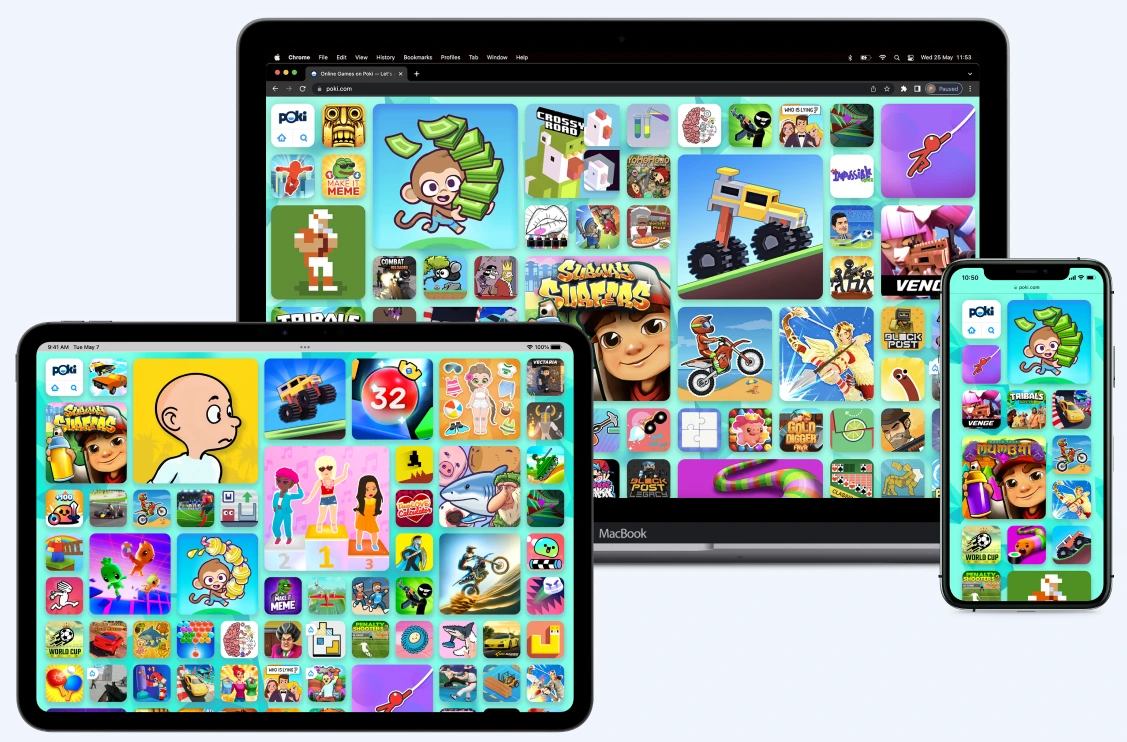
Poki’s player base now spans a diverse range of players all looking for “micro-moments” of gaming time throughout their day.
“The modern web player is fundamentally curiosity-driven.”Stein Janssen
"The web appeals to players because of its no-install nature; we find that many players will also own premium console or PC hardware, choosing the web to access a different kind of gaming experience."
This kind of accessibility, he says, changes player behaviour, as without download or installation barriers, users arrive expecting to explore rather than commit to a single title immediately.
"The modern web player is fundamentally curiosity-driven. Because players experience zero friction to enter a game, they arrive with a pure discovery mindset. They sample multiple titles, jump seamlessly between experiences, and frequently share games via simple links."
That has important implications for developers working on browser-based games.
Unlike traditional app stores, where much of the challenge lies in convincing users to install the game in the first place, browser developers must capture their attention almost immediately upon a player's click. Janssen believes this changes the strategy when it comes to the likes of repetition and discovery.
“Native mobile game design has always centred on fast attention, but web gaming makes this even more important.”Stein Janssen
"It means that a web gamer's loyalty is heavily tied to the browser gaming platform itself. They trust the environment. Discovery happens organically within an active session, meaning a brand-new game launching on the web immediately finds an eager audience."
As such, the result is an environment where first impressions matter more than they do on, say, a mobile device.
"Native mobile game design has always centred on fast attention, but web gaming makes this even more important,” says Janssen. "Native mobile is fast, but web gaming is faster. You have seconds to hook a player."
Building beyond the app stores
As browser gaming has matured, Poki’s role has evolved beyond just hosting games. Today, the company works closely with developers throughout the publishing process to help optimise games for the web.
For established mobile developers, Janssen says browsers are increasingly becoming a complementary platform rather than a replacement for app stores.
“The developer keeps creative control - our job is to give their game the best possible environment to find its audience.”Stein Janssen
“Poki provides the platform infrastructure that makes success on the web possible. That means an audience of 100 million monthly players from day one, ad mediation and monetisation, promotion across the platform, player insights and invoicing."
Beyond distribution, Poki also works directly with developers on aspects such as technical optimisation and optional features such as cross-device saves, which allow players to move between desktop, tablet and mobile without losing their progress.
"The developer keeps creative control - our job is to give their game the best possible environment to find its audience."
When it comes to which genres may be the best fit for browsers, rather than pointing to one single genre, Janssen states that success comes down to immediacy. Browser players expect to begin playing near instantly, meaning that the games have only a moment to show what makes them special.

"The most successful games are playable in under three seconds. They have intuitive controls. They show you the core fun immediately."
He goes on to explain that casual, puzzle, arcade and sports titles have performed well primarily when developers continue to refine them based on player feedback. Conversely, experiences that require lengthy onboarding, large downloads or mandatory account creation can often struggle to retain a browser-based audience.
This means that for browsers, technical optimisation is just as important as the game design itself.
“Technically, file size is everything.”Stein Janssen
"Technically, file size is everything. A massive hit like Drive Mad is just 3.7MB. It takes serious effort to optimise a game down to that size, but it's a process our team helps studios navigate."
Reducing waiting times has become a central aspect of Poki’s own development tools. Rather than asking players to download an entire game before they can begin, the company encourages studios to adopt progressive loading.
"Progressive loading is the answer, and it's built into the PokiSDK every developer integrates,” says Janssen. He goes on to talk about engine selection. "Some load everything at once, leaving a player waiting for a minute. A native HTML5 engine like PlayCanvas can do it in ten seconds."
Browser economics
Alongside advances in browser technology, Janssen believes the commercial model underpinning web gaming has also changed.
Unlike app stores, where success is often tied to user acquisition spending, Janssen says the economics of browser publishing are fundamentally different.
“Success on Poki looks like highly engaged players averaging 11 to 20-minute sessions, which drives meaningful advertising revenue.”Stein Janssen
"Success on Poki looks like highly engaged players averaging 11 to 20-minute sessions, which drives meaningful advertising revenue. The model is a value exchange built around advertising, with rewarded video at the core where a player watches an ad and gets an extra life or a cosmetic, alongside a range of other formats."
Janssen says one of the key differences between browser publishing and traditional app stores is how developers approach audience growth and distribution.
"Studios reach an established audience from day one, and there's no need to build a user-acquisition operation from scratch because Poki drives the discovery,” he says.
"In the app stores, a studio opens a credit line for user acquisition, runs at uncertain returns, and can take a loss on the spend; on the web, the investment is siloed to the cost of the port and the updates."
He believes those economics are making browser distribution a more attractive option for developers, particularly as advertising revenues continue to grow. Earnings across the developer community have grown sharply as the platform has scaled.
According to Janssen, that shift is no longer limited to browser-native studios. He points to franchises such as Subway Surfers and Hill Climb Racing as examples of established mobile IPs expanding onto the web.
Curation over scale
As Poki’s audience has grown, so too has the challenge of helping players discover new games.
With hundreds of developers publishing to the platform and browser gaming becoming increasingly accessible, Janssen believes quality control has become one of the company’s most important responsibilities.
Rather than relying solely on algorithms, every title released on Poki is manually reviewed before it reaches players. This looks at technical performance, quality, and brand safety, all of which play a role in the approval process.
"Curation is hugely important. Part of our process is to hand-review every game before release to guarantee quality, technical performance, and strict brand safety."
“Part of our process is to hand-review every game before release to guarantee quality, technical performance, and strict brand safety.”Stein Janssen
This process, he explains, benefits players because they have a catalogue they can trust, advertisers know their brand is appearing in suitable environments, and developers gain confidence that their title is being shared alongside other high-quality experiences.
However, Janssen also admits that the process can be demanding.
"Developers often tell me that getting accepted on Poki is hard, but I think that's a reflection of the quality standards we hold,” he says. "In 2025, we finalised just 227 game releases out of countless reviews."
Once games are live, however, discovery becomes a balance between editorial judgement and technology.
Rather than just rewarding the biggest titles, Poki combines human curation with personalised recommendations to ensure that games are more tailored to the player.
This is an approach that Janssen says has helped games across the wider catalogue build audiences rather than concentrating the focus on just a handful of hits.
"Last year, 1,018 games on Poki crossed the one million play mark. Once a game is on the platform, discovery is a mix of editorial curation and deep personalisation. We use algorithms to serve the right game at the exact right moment."
Building for the long-term
Another aspect that has shaped Poki's growth behind the scenes is that the company has never taken outside investment.
Janssen says remaining bootstrapped has allowed the business to make longer-term decisions while staying focused on the company's original vision.
"Operating without outside capital, investor exits, and IPO timeline pressure has allowed us to protect the founding core ethos of letting the world play,” says Janssen.
“Operating without outside capital, investor exits, and IPO timeline pressure has allowed us to protect the founding core ethos of letting the world play.”Stein Janssen
“One example of this is our developer revenue share model, which was unheard of back in 2014. We could afford to share that revenue with developers precisely because we were not paying back investors."
He says that same long-term thinking extends across the wider business, from platform technology to developer tools and community initiatives.
"We make deliberate, long-term investments in our tech, our tools and our community. Does that come with trade-offs? Of course. It means saying no a lot - to trends that don't fit, to growth that would dilute the experience. But it lets us invest on our own timeline and focus entirely on quality."
The browser's next chapter
Looking ahead, Janssen believes the industry’s relationship with browser gaming is beginning to change once again.
Rather than viewing HTML5 as a secondary platform or a place for specific experiences, he expects developers to begin to treat the browser as a core part of their publishing strategy.
"The next phase is web gaming becoming a default channel: a platform studios plan for from day one,” he says.
“The web works as both a destination and a launchpad for world-class content, and as cross-platform play grows, I expect studios to stop asking whether they should be on the web and start asking which version of their game lives there.”
For established mobile developers in particular, he believes diversification has become increasingly important as conversations and regulations continue to evolve regarding the long-term economics of the app stores.

"There is real uncertainty right now about whether the current app store model remains viable long-term. The smartest studios aren't waiting to find out. They are actively diversifying today."
He explains that this is already evident in studios such as Sybo, Fingersoft and Outfit7, and that he expects more publishers to follow suit.
“How do you pick the right games out of a fast-growing sea of AI-generated titles? It's a question we look to answer by using the same focus on curation our platform is known for.”Stein Janssen
Artificial intelligence is another development he believes will accelerate change across the browser ecosystem. Since web publishing has a low barrier to entry, Janssen expects AI-generated games and user-created content to appear there faster than on many other platforms.
However, he also notes that it reinforces the importance of careful platform curation. For Poki, the challenge will not simply be to support more games, but to maintain a high quality of the content on offer.
"It presents a massive opportunity for faster content creation, but it also makes strict curation even more important. How do you pick the right games out of a fast-growing sea of AI-generated titles? It's a question we look to answer by using the same focus on curation our platform is known for."
Ultimately, Janssen sees the browser following a trajectory similar to that of mobile gaming over the past decade. For Poki, the ambition remains largely unchanged from when the company was founded more than a decade ago.
"The next five years are about web gaming becoming a gaming standard, exactly the way mobile did."
Companies

People
