One genre, three strategies: How Magic Sort, Knit Out, and Pixel Flow are redefining sort puzzle monetisation


- The sort puzzle genre has generated nearly $200M in annual revenue across three titles - Magic Sort, Knit Out and Pixel Flow.
- Across the three games difficulty curve design, especially the timing of the first major challenge strongly reflects monetisation performance.
Oxana Fomina is founder at Gradient Universe.
The sort puzzle genre has emerged as one of the most commercially significant categories in mobile gaming over the past two years. Growing from near zero to almost $200M in annual net revenue across just three titles - Magic Sort (Grand Games), Knit Out (Take-Two Interactive), and Pixel Flow (Loom Games) - this trajectory clearly demonstrates strong product–market fit.
But looking beyond the topline numbers reveals something even more interesting: three fundamentally different answers to the same design question.
In terms of revenue, these games also rank among the top hybridcasual titles by growth in revenue over the past year. Pixel Flow ranks #2 - launched in August 2025, it reached top revenue positions in just seven months. Magic Sort holds the #5 position and was released in April 2024.
Knit Out, released in February 2025, is a little over a year old and currently ranks #15.
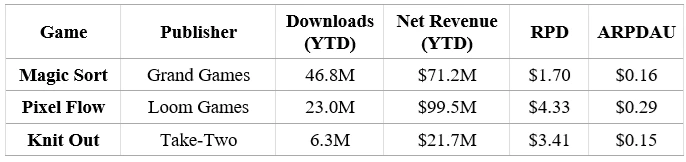
Source: Sensor Tower, Apr 28, 2025 – Apr 27, 2026, Worldwide (iOS + Android)
These are not three variations on the same mechanic. They represent three distinct product philosophies - and three different emotional contracts with players. Magic Sort sells comfort. Knit Out sells competence. Pixel Flow sells intensity.
Understanding why each strategy works - and where each is fragile - is the central question this article addresses.
Core mechanics comparison
The mechanical differences between these three games are not cosmetic. They determine player state, cognitive engagement, perceived control, and ultimately, the emotional basis on which monetisation is built.
Magic Sort - comfort by design
Magic Sort's core loop is colour-sorting into tubes: a mechanic that is maximally accessible and cognitively forgiving. Interaction is turn-based and entirely player-paced. The game presents a clearly solvable puzzle, invites the player to make a move, and rewards completion immediately. There is no timing pressure, no opponent, no irreversible error in early stages.
Magic Sort's core loop is colour-sorting into tubes: a mechanic that is maximally accessible and cognitively forgiving.
The result is a flow state - defined in psychological terms as deep, effortless engagement - sustained through low friction and continuous reward. Players complete dozens of levels per session with moderate cognitive effort: the difficulty is slightly higher than before, but not perceived as overwhelming, especially in the early game.
Cognitive load remains manageable, and the sense of progress is constant.
Knit Out - mastery through execution
Knit Out translates sorting into tactile yarn-untangling: players follow colored threads, clear knots in a defined sequence, and advance by solving spatial puzzles efficiently.
The mechanic is more execution-driven than Magic Sort's - it requires spatial planning and deliberate move-ordering - but still operates entirely at the player's pace.
The experience is competence-oriented rather than relaxation-oriented. Solving a level cleanly produces genuine satisfaction because the player feels responsible for the outcome. The game rewards thinking, not reflexes, and creates a feedback loop where skill feels demonstrable.
Pixel Flow: Pressure as a feature
Failure is unambiguously the result of player decisions. This sharpens both the mastery reward and the frustration of loss.
Pixel Flow breaks from both models. Players place colored shooter units ("pigs") onto a continuously moving conveyor belt that circles a pixelated image. Each shooter has limited ammo and destroys only its own colour. A buffer zone of five slots holds exhausted shooters; if all five are full and no new placement is possible, the player loses.
The mechanic introduces real-time elements, resource management, and genuine irreversibility. Crucially, the game is fully deterministic. Every board configuration is identical for every player. Failure is unambiguously the result of player decisions. This sharpens both the mastery reward and the frustration of loss.
Player needs and motivations
Understanding which psychological needs each game serves - and which it ignores - explains both the monetisation patterns and the churn risks embedded in each product.
Magic Sort: Relaxation and escape
The primary audience is comfort-seeking: players who want low-effort mental stimulation without stakes. The early game delivers this exceptionally well. The unmet need is depth: as difficulty escalates and streak-based events introduce competitive pressure, the game's core promise - effortless flow - is violated. The audience it attracts is precisely the audience least tolerant of friction.
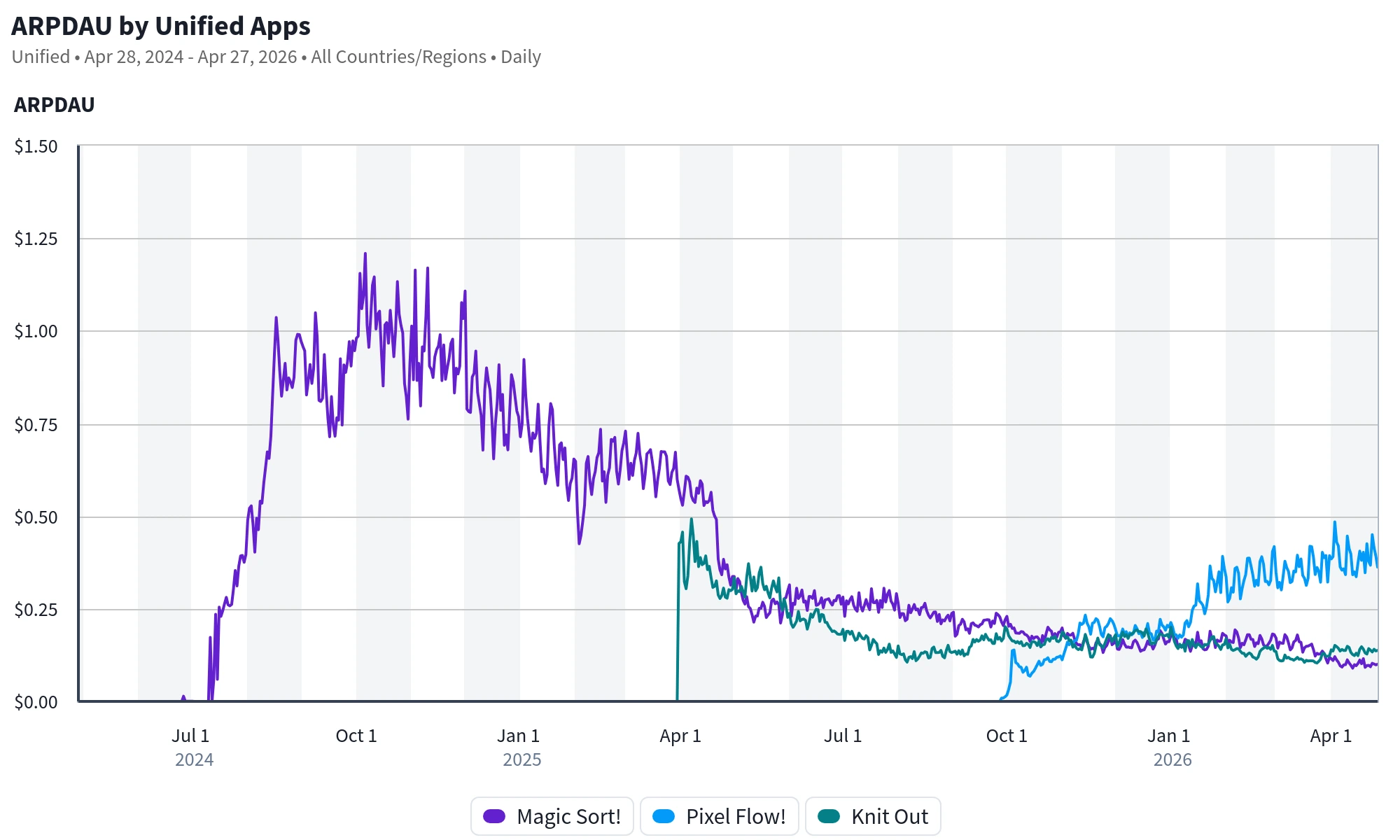
This mismatch between acquisition promise and mid-game experience is Magic Sort's central product tension. Its declining ARPDAU - from a peak in mid-2024 to the current $0.16 (according to Sensor Tower data) - is the financial signature of that tension.
Knit Out: Competence and control
Knit Out's metrics signal a high-quality, deliberately engaged player base. These players staying because the game makes them feel capable. The competence fulfillment loop retains them, and their willingness to pay reflects investment psychology rather than frustration relief.
Pixel Flow: Tension, Intensity, and Mastery
Pixel Flow's engagement numbers are exceptional by any standard: 51.4 average minutes per day, 9.4 sessions per day, 1.9M DAU (worldwide for the last 30 days). No other sort puzzle title comes close on engagement intensity. The game serves competitive, mastery-driven, and high-engagement players with the deepest loop in the category.
The critical gap is audience breadth. The game's difficulty curve and punishing loss conditions create a significant barrier that filters out casual and relaxation-oriented players - exactly the audiences Magic Sort has captured at scale. Pixel Flow maximises revenue per retained player but at the cost of a narrower funnel.
Difficulty curve design and FTUE
A Puzzle Difficulty Curves: A FTUE Competitive Analysis by Sensor Tower - a competitive analysis of 50 levels across 10 casual puzzle games (including all three titles studied here) reveals one of the most consistent patterns in mobile game design: the timing of the first major difficulty peak predicts revenue per download more reliably than download volume, average difficulty score, or the richness of the monetisation system.
Across the three games, difficulty curve architecture directly explains the monetisation gap.
Magic Sort starts well. The early game builds genuine flow - levels resolve cleanly, progress feels effortless, engagement is real. But the difficulty escalates before that habit solidifies, and streak-based events make it worse: players are asked to perform consistently at exactly the moment the curve starts working against them. Streaks break faster than flow can recover.
Spending should be a choice made from engagement, not a response to a broken experience.
What should feel like a natural challenge starts to feel like an interruption - and an interrupted player who sees a spend prompt hasn't yet decided they want to stay. Spending should be a choice made from engagement, not a response to a broken experience. That's the gap between Magic Sort's download volume and its revenue efficiency, and it's a solvable product problem.
Knit Out follows a disciplined three-phase arc: clean onboarding, a mid-game peak, and a genuine recovery zone through to the end of the FTUE. The difficulty spike lands after the spending habit is already formed, and the fail-free stretch that follows creates the emotional state - competence confirmed, momentum intact - in which its contextual offer converts most effectively.
Pixel Flow delivers the longest fail-free onboarding in the category, placing its first real friction point deep into the FTUE - precisely where player investment is highest and willingness to pay peaks.
The mechanism is straightforward: a player who has not yet formed a spending habit will churn when they hit a wall. A player who has already invested hours and established a daily routine will pay to continue.
Live ops strategy
Comparing live ops across Magic Sort, Pixel Flow, and Knit Out reveals something that goes beyond event design: three fundamentally different philosophies for managing player behaviour. The mechanics on the surface look similar - streaks, races, progression ladders, reward structures. The outcomes for players and for the business could not be more different.
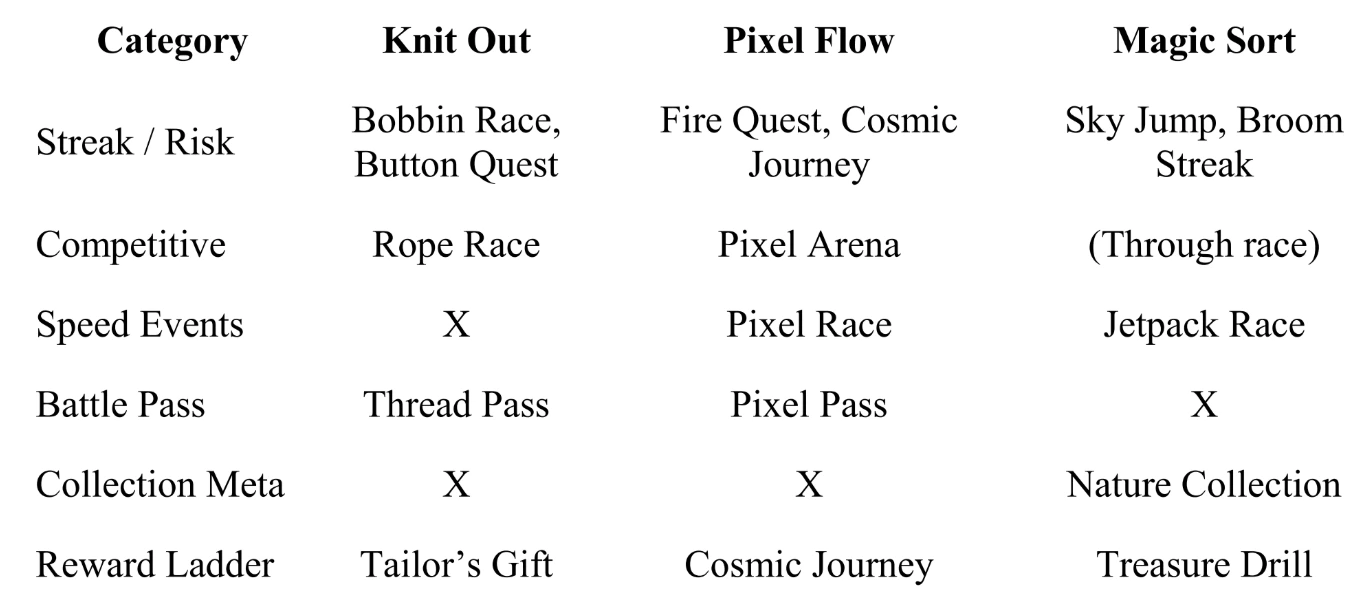
Knit Out plays a long game. Its live ops system - a battle pass, soft competition through Rope Race, and limited streak pressure - is designed to support the core loop rather than override it. Nothing in the event calendar asks the player to perform at a level that conflicts with where they are in the difficulty curve.
The result is stable, predictable engagement: players return consistently, frustration stays low, and monetisation follows a steady rhythm without sharp peaks or sudden drops. It isn't the most aggressive system in the category, but it is the most structurally honest - the events ask of players only what the game has already prepared them to give.
The events ask of players only what the game has already prepared them to give.
Pixel Flow builds its live ops around controlled tension. Streak events like Fire Quest and Cosmic Journey, multiplier-based competitions, and speed challenges keep players in a state of continuous risk - but crucially, risk they feel they can influence. The distinction matters: pressure that feels controllable produces engagement; pressure that feels arbitrary produces churn.
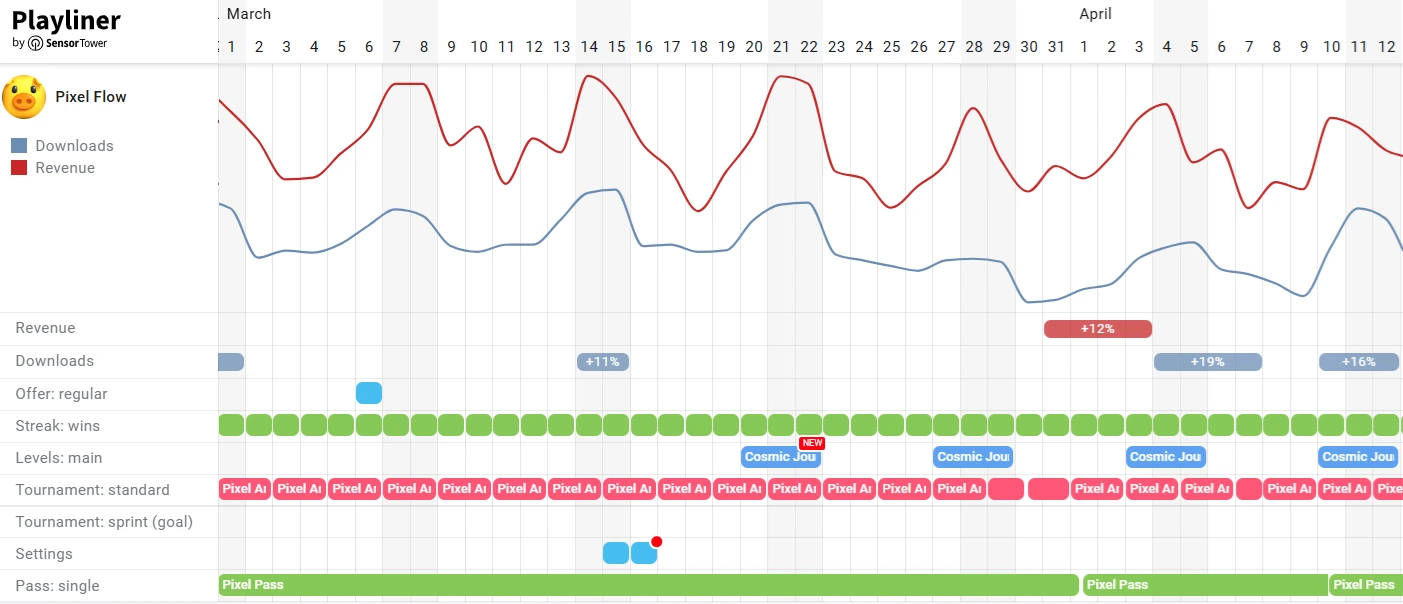
Pixel Flow stays on the right side of that line because its difficulty curve has already built 35 levels of competence before the first event stakes arrive. Players who enter competitions already feel capable, which means losing a streak reads as a recoverable setback rather than an unfair outcome. This is what drives the session density and the monetisation conversion - not the events themselves, but the emotional foundation beneath them.
Magic Sort runs almost identical event mechanics to Pixel Flow - Sky Jump, Broom Streak, Jetpack Race, Treasure Drill - and that is precisely what makes it instructive. The same structures that create excitement in Pixel Flow produce frustration in Magic Sort, not because the events are designed differently, but because the context they operate in is. When difficulty spikes interrupt flow before habit is formed, streak events stop being motivating and start being punishing.
Players who can't maintain a streak without spending feel neither challenged nor engaged - they feel taxed. The meta-layer of Nature Collection offers a longer-term goal that partially compensates, but it cannot resolve a core tension: an event system built on consistency layered over a difficulty curve that makes consistency feel impossible.
The conclusion for product teams is this: live ops mechanics do not determine success on their own.
The conclusion for product teams is this: live ops mechanics do not determine success on their own. The same event, in the right context, creates excitement; in the wrong context, it accelerates churn. What separates these three games is not what they ask players to do - it is whether the difficulty curve, the reward economy, and the sense of control have been calibrated to support the ask before it's made.
The sort puzzle category has produced nearly $200M in annual revenue from three games, each encoding a different theory of what players want - comfort, competence, or pressure - and how that translates into retention and monetisation.
Pixel Flow is winning the current revenue race. Its advantage comes from a highly aggressive system where engagement, retention, and monetisation are tightly coupled: layered LiveOps, constant events, and high session frequency create a state of continuous engagement where the player always has something at stake.
This forms a “momentum preservation” model - players pay to maintain progress, rankings, and streaks. This approach delivers record metrics ($4.33 RPD, 50+ minutes per day), but makes the system dependent on constant pressure. The key risk is sustainability: the higher the intensity, the more sensitive the audience (especially mastery-driven players) becomes to overload and perceived unfairness, including aggressive ad placement.
Magic Sort has the strongest advantage at the top of the funnel - it is perfectly optimised for mass acquisition through comfort.
Magic Sort has the strongest advantage at the top of the funnel - it is perfectly optimised for mass acquisition through comfort. Fast flow entry, low cognitive load, and a stable daily rhythm (4.8 sessions) build habit and scale a broad audience.
However, this same system becomes a limitation for retention and monetisation: streak-based events start working against the player when flow is disrupted by difficulty spikes. Monetisation here is reactive - “frustration after flow” - players pay to restore a lost state of comfort. This explains the low RPD ($1.7) and ARPDAU ($0.16): the model scales through volume but underperforms in efficiency and erodes long-term trust.
Knit Out is the smallest by audience but the strongest in terms of long-term signal. Its key advantage is alignment between player motivation, retention, and monetisation.
The game builds engagement through competence, retention through progression and mastery-enhancing events, and monetisation through an investment mindset: players pay not to remove frustration, but to improve their ability to play. This is reflected in a high RPD ($3.41) despite a relatively small base and strong revenue growth. This model is less dependent on pressure and scales more effectively with product investment.
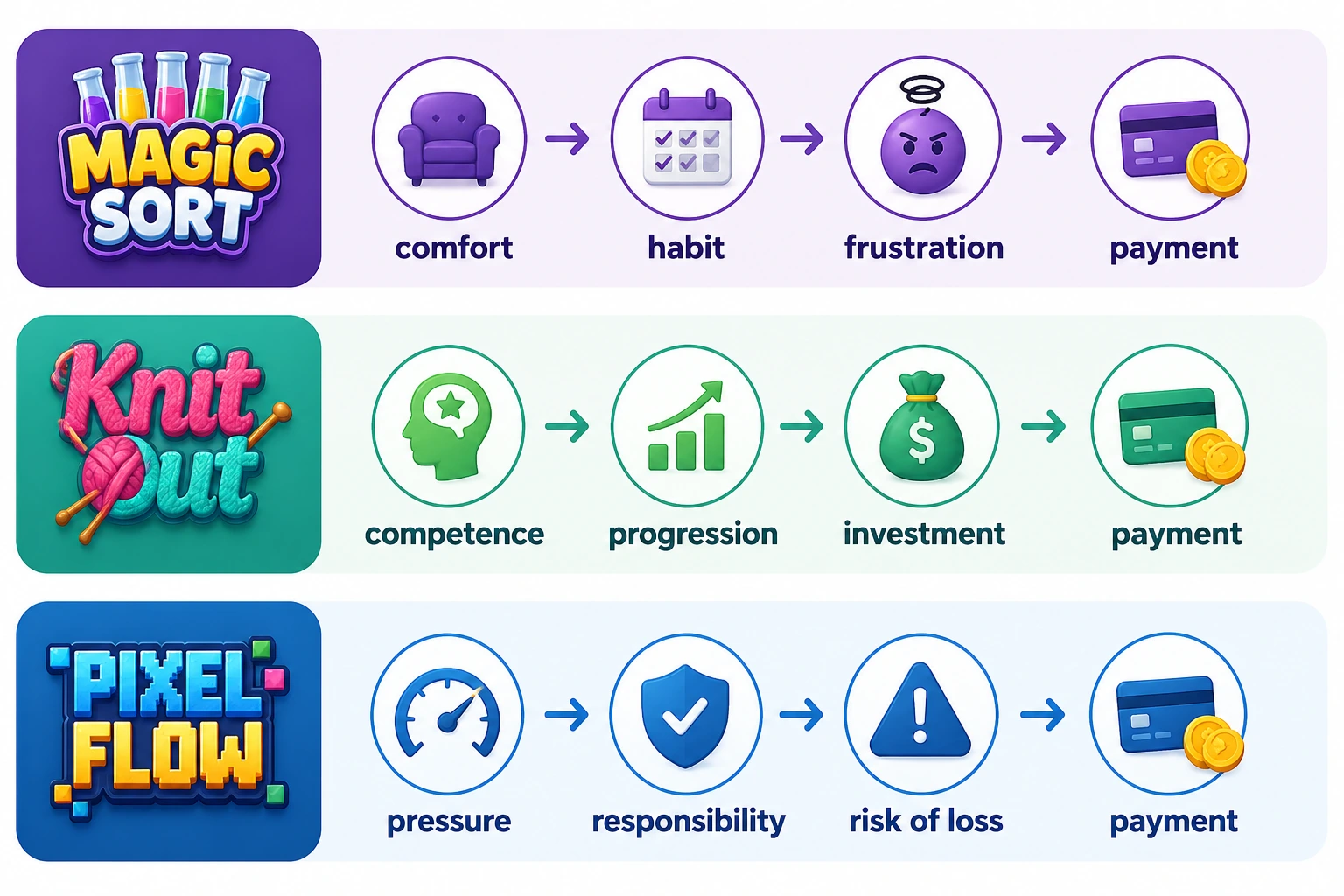
Ultimately, the differences between the games can be framed as three distinct models.
The future of the genre likely belongs to a hybrid model that can combine these elements: comfort at acquisition, competence as the foundation of retention, and pressure applied only when the player has enough perceived control to experience it as challenge rather than punishment.
People
