Why simple puzzle games keep players hooked and how to advertise them


- Simple puzzle games succeed by creating a loop of low effort visible progress objectives and satisfying completion that keeps players coming back.
- Playables, gameplay videos and ASMR-style creative can help advertisers replicate the addictive nature of puzzle games.
- Effective ads for these games showcase the same core emotions as the gameplay such as fixing a mess or getting close to solving a problem.
Alexandra Pulinets is senior creative strategist at AppAgent.
This kitten is AI. And this dragon is AI. Oh, what the heck - this game is mostly, if not entirely, made from AI-generated assets.
I already wrote about having a love-hate relationship with AI as a creative strategist. And still - those are my screenshots.
I can see lots of grammar mistakes, a totally stolen main screen, events and live ops structure lifted from Royal Match, characters with dead eyes, and an inconsistent art style.
Also, I graduated from a pretty good university, read philosophy for leisure, and can analyse complex data from big campaigns. So WHY THE HECK CAN’T I PUT DOWN THIS DUMB GAME AFTER COMPLETING 400 LEVELS?
And that’s not all of the confessions I have to make. Here are some of my other screenshots.
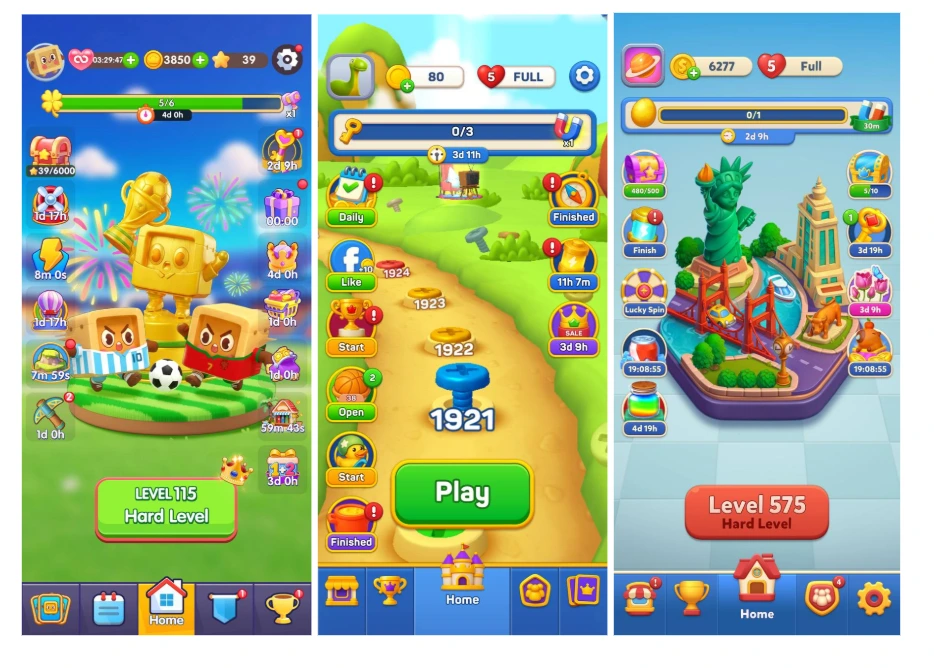
I feel like a drug dealer who broke their own rule: don’t use what you’re selling. And here we are.
So the question is: if we realise that these games are dumb, cheap, and sometimes use very predatory practices, why do we still install them in secret and sometimes completely mess up our sleep schedules just to complete another level?
What makes a puzzle game stick
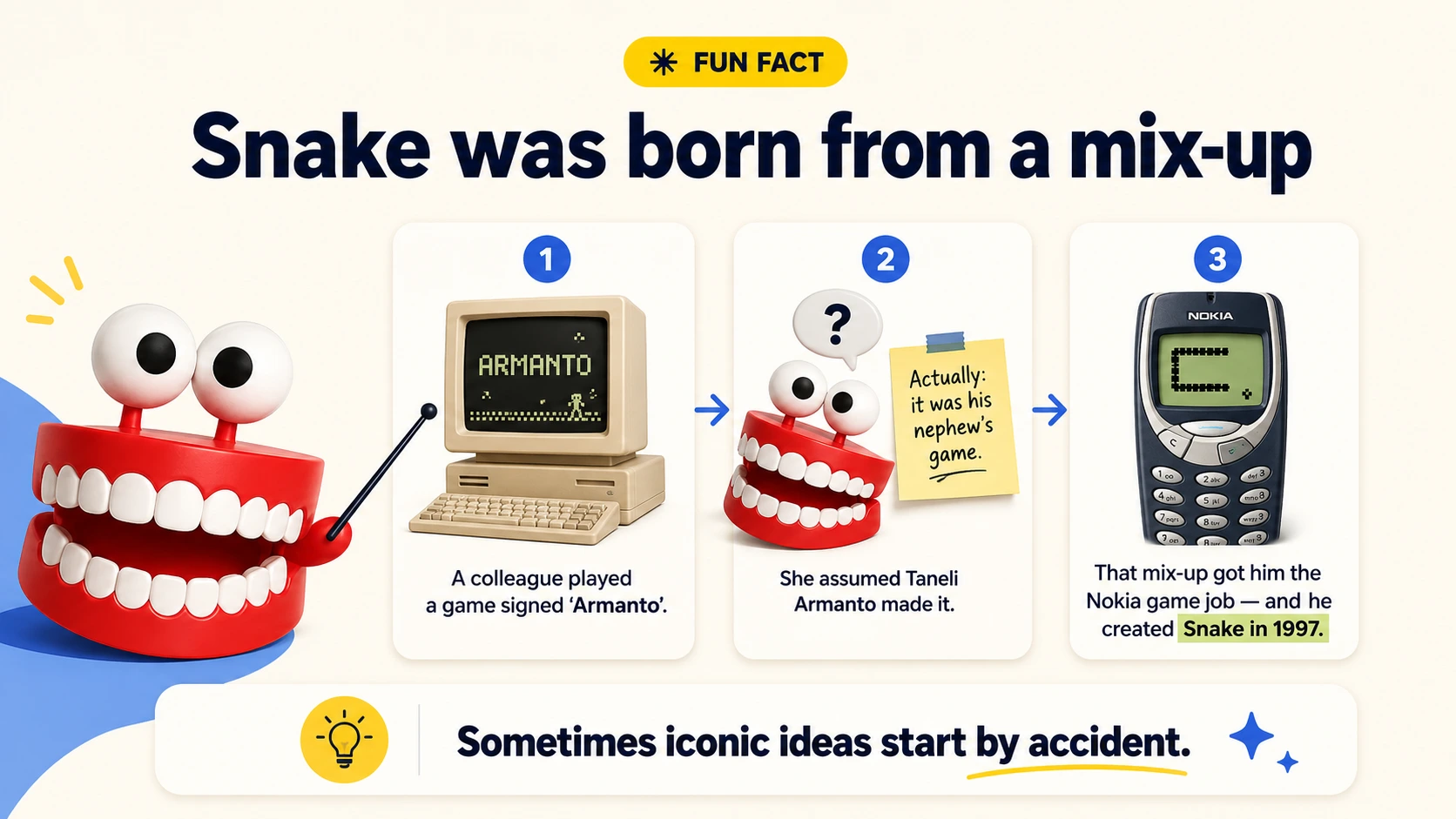
Remember your old Nokia? Remember the OG Snake game? We didn’t have much choice back then. And even after completing the game, we still continued putting our fingers through button pain and completing it again and again.
What about Sudoku? Now only your mom or dad buys those magazines where they’re printed and fills them in during a flight. But you did it too. It’s just that now you have a better, brighter version of that right on your phone.
Remember your old Nokia? Remember the OG Snake game? We didn’t have much choice back then.
Puzzle games like colour sorting are addictive because they hit a very specific brain loop: low effort → clear problem → tiny uncertainty → visible progress → satisfying closure → immediate next problem.
They are “addictive” not only because of dopamine (which is such a buzzword right now, honestly), but because they are perfectly shaped for the brain’s prediction, correction, and completion systems.
1. Your brain instantly understands the goal
colour sorting has almost no cognitive barrier. You see the tubes, colours, empty spaces, and the desired end state immediately.
That means the brain doesn’t spend energy asking: “What am I supposed to do?”
It goes straight to: "I can fix this.”
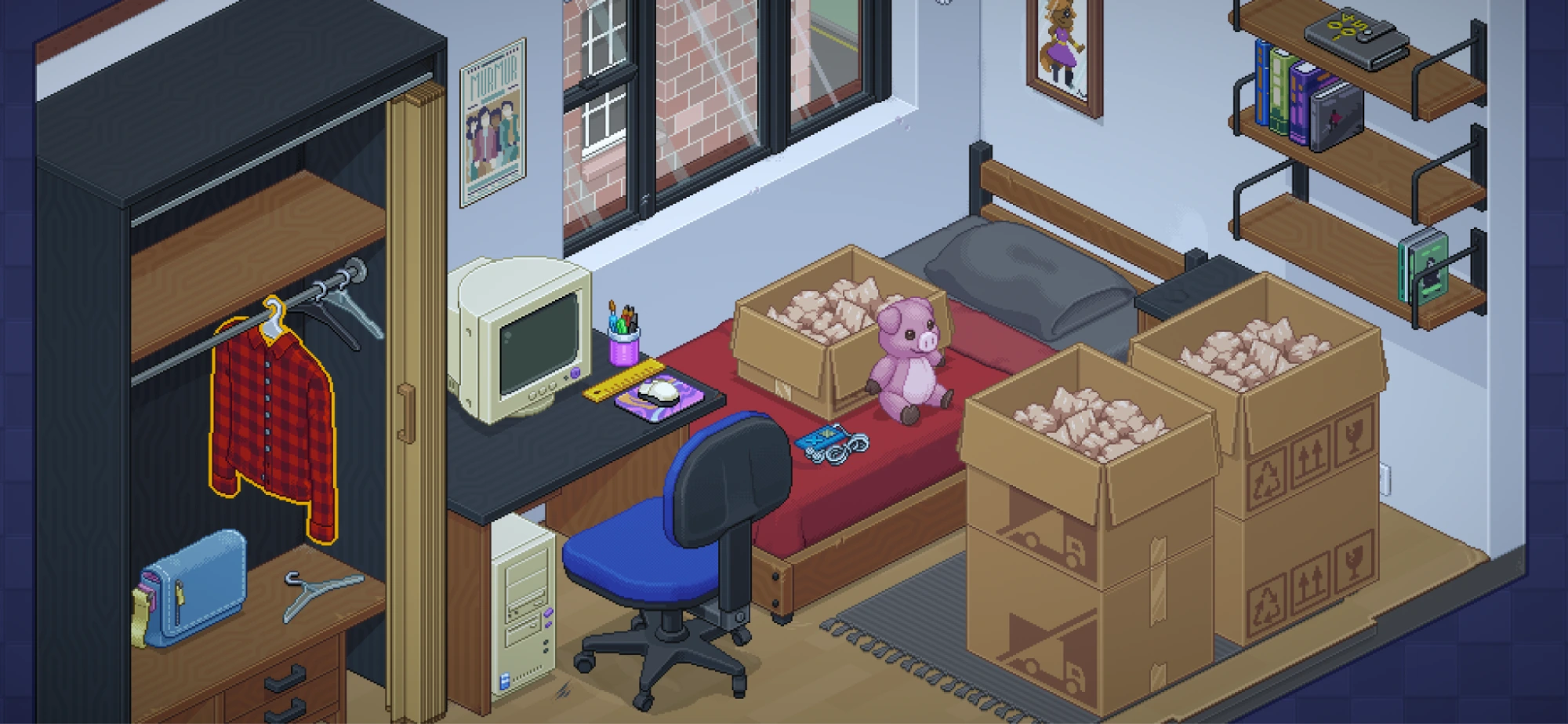
“Unpacking’ - a game focused on transforming chaos into order with 1.2 mil. copies sold
That “fixable mess” feeling is very powerful. The screen starts in disorder, and your job is to restore order. Humans like pattern completion because it reduces cognitive tension.
2. Every move gives feedback
Unlike more complex puzzles, colour sorting gives you constant micro-feedback:
You move a colour.
The screen looks cleaner.
A mistake becomes obvious.
A solution starts emerging.
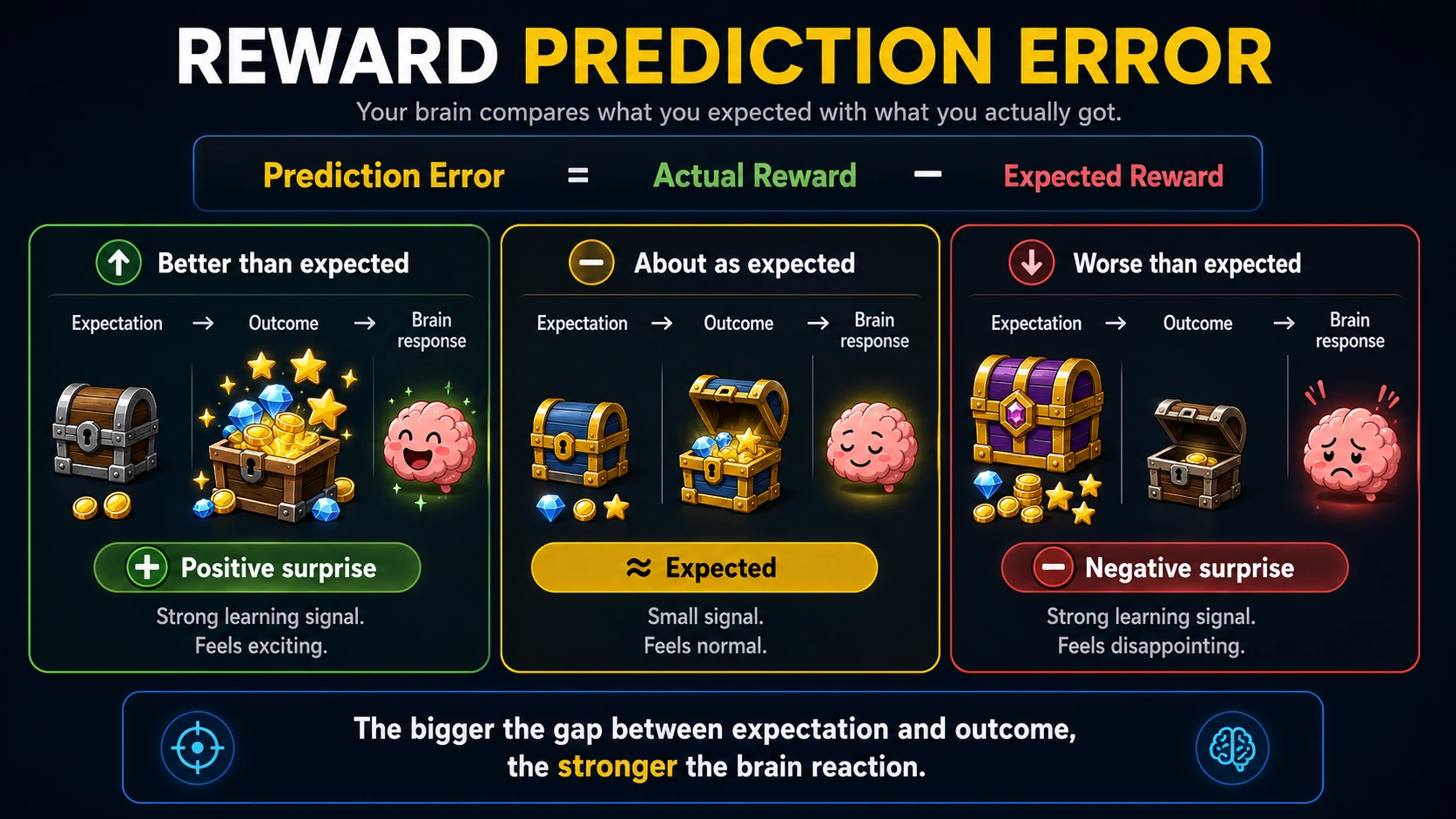
This creates a tight action → result → adjustment loop. The brain loves systems where every action teaches you something quickly. Dopamine is strongly involved in this kind of learning loop, especially when outcomes are better or worse than expected - what researchers call reward prediction error.
In simple terms: you make a move, your brain predicts what will happen, the result updates your expectations, and you want to try the next move.
3. The game constantly creates “almost solved” tension
colour sorting games often put you in a state where you feel: “Wait, I’m basically there.”
Even if you are not actually THAT close.
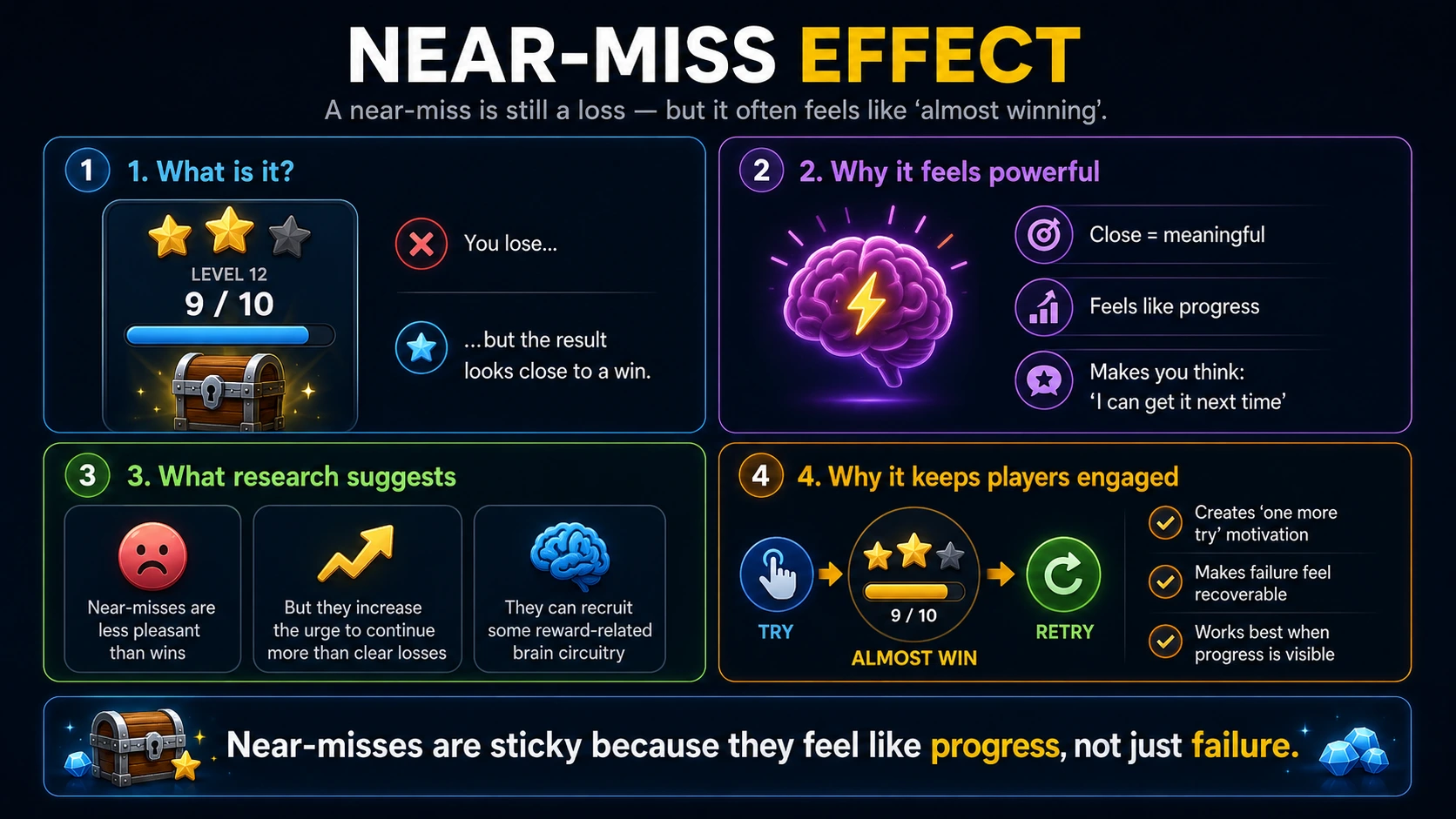
That’s important. “Almost” states are motivational. Near-miss research, especially in gambling and games, shows that almost-winning can increase motivation to continue, even when the outcome is technically not a win.
In colour sorting, the near-miss is softer and less predatory than a slot machine, but the psychology is similar:
One entity is sorted/one row is clear.
Another is one colour away.
You just need one empty slot.
You made one wrong move, but you can still recover.
So the player thinks: “One more try and I’ll clean this up.”
4. Completion gives a tiny emotional reward
When all colours snap into their rightful places, the brain gets closure.
It is not just “I won”. It is: “The chaos is gone.”
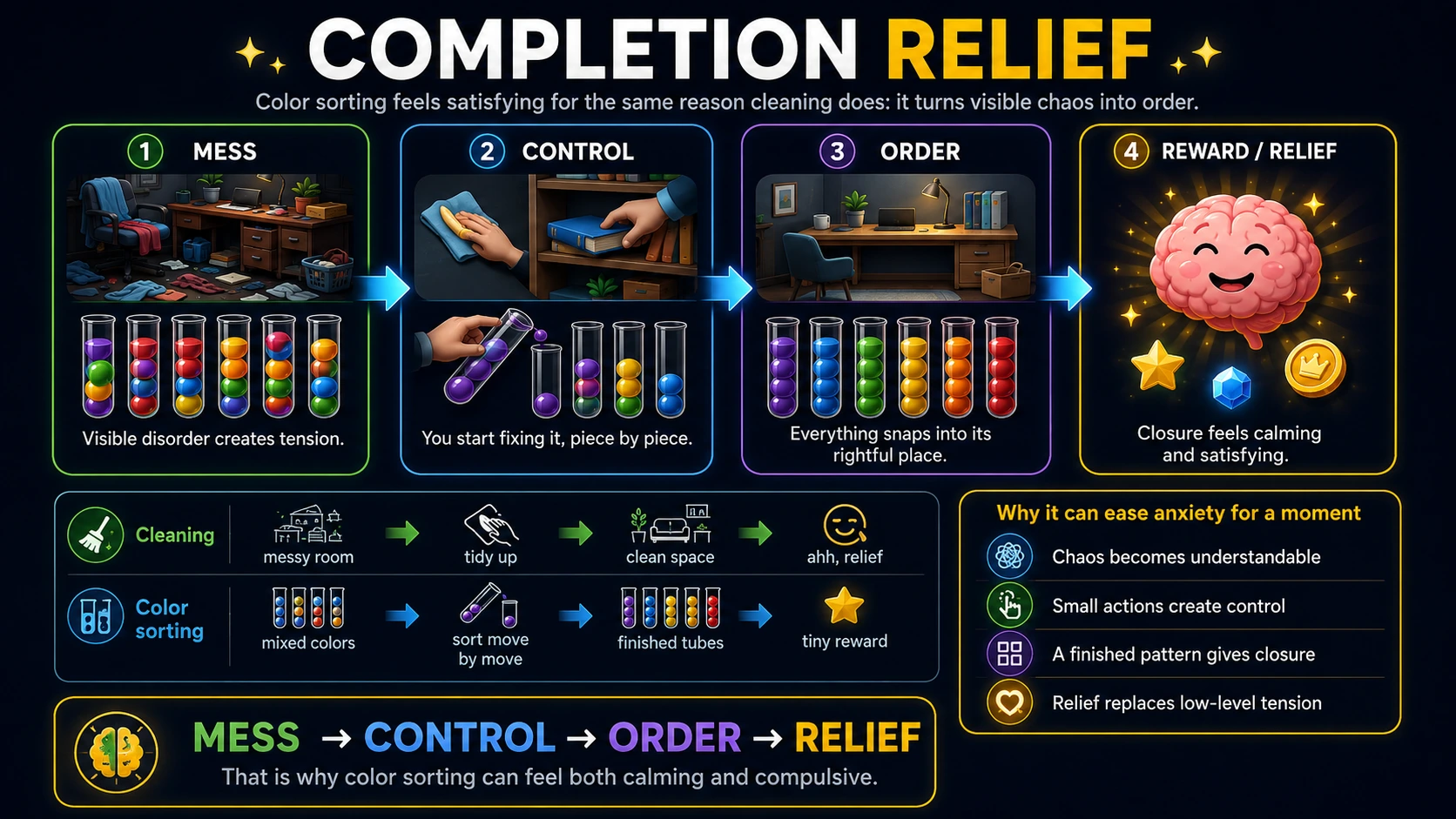
That is why colour sorting feels weirdly calming and compulsive at the same time. It gives the player a mini-cycle of anxiety and relief:
mess → control → order → reward.
The satisfaction is visual, cognitive, and emotional.
5. The difficulty curve is sneaky
Good sorting games look simple, but they add just enough friction:
-
More colours.
-
Blocked/frozen colours
-
More layers.
-
Less additional storing slots
-
Hidden colours which appear only when you use them
-
Undo/restart pressure.
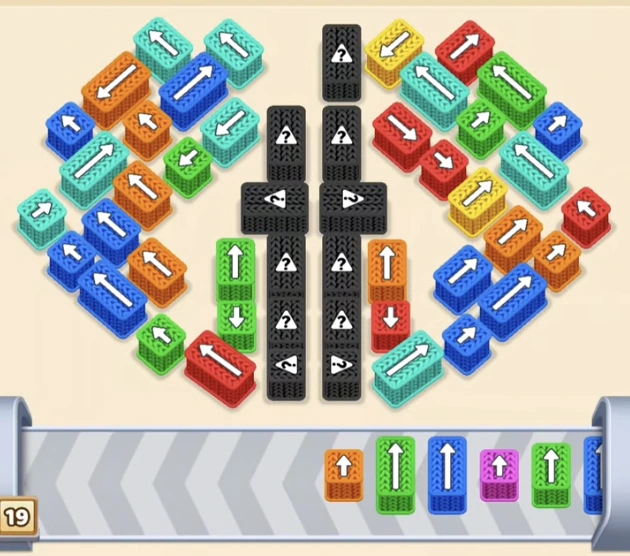
So the player is not overwhelmed, but also not bored. This is close to the idea of flow: the task is easy enough to understand, but challenging enough to keep attention locked.
The best part for retention: failure usually feels like your own solvable mistake, not like the game was unfair.
So instead of quitting, the player thinks:
“No, I know what I did wrong.”
That is extremely replay-friendly.
6. The next level is frictionless
After one puzzle, there is almost no psychological cost to starting another.
A match-3 level may feel like “another battle.” A narrative game may feel like “another session.” But a colour sorting level feels like:
“Just one more little clean-up.”
This makes session extension very easy. The game doesn’t ask for emotional commitment. It asks for 30 more seconds. Then another 30. Then another.
7. It combines control and uncertainty
This is probably the biggest reason.
colour sorting feels deterministic: there is no combat randomness, no opponent, no gacha, no reflex pressure. The player feels in control.
But it still has uncertainty:
-
Can I solve this?
-
Did I trap that colour?
-
Should I use the empty tube now or later?
-
Is the solution in starting solving it from the left or from the right?
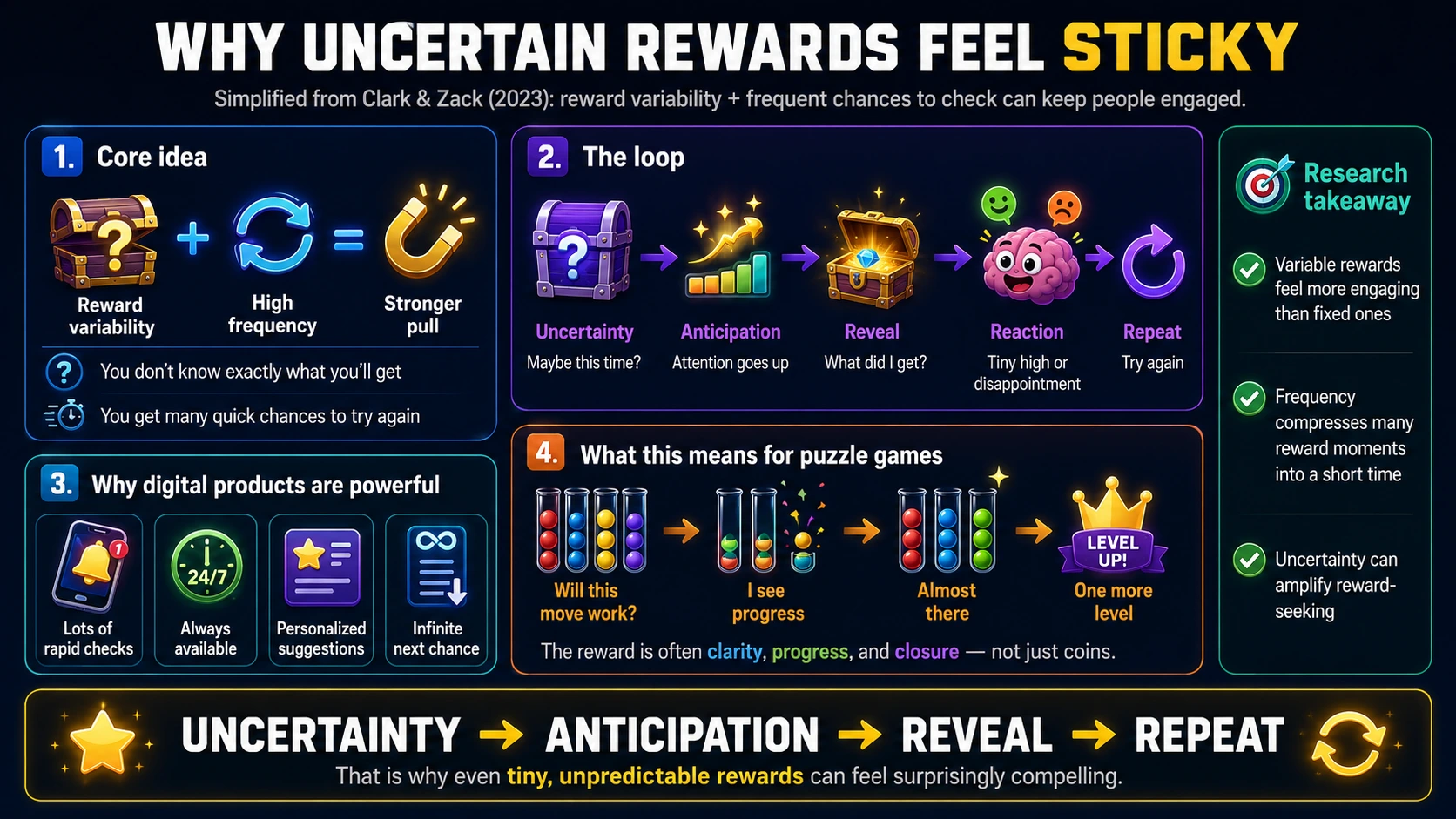
That combination - I am in control, but I’m not 100% sure - is very sticky. Reward variability
and uncertainty are known to increase motivation in non-drug reward systems.
8. Based on real-world satisfying things
Have you noticed how every Gen X and Boomer hobby now has a mobile game? Especially anything DIY: knitting, jewel colouring, colour by number, making tiny houses. But also the classics: Sudoku, crosswords, word games, math games, mahjong, even Tetris - meaning Block Blast.
And on top of that, there are things everyone finds oddly satisfying: unscrewing, flowing sand, sorting, organising, cleaning up tiny messes.
Take something calming, meditative, and highly repetitive by its nature, and put it in your game somehow.
I was absolutely in awe when I saw some developers combining several of those into one. I think my favourite was the same “unscrew a house” game, but instead of screws, you’re now unravelling yarn - which follows the same logic.
Looking forward to woolen Block Blast, yarn Sudoku, and whatever hobby becomes viral next. First it was wood, now it’s wool and yarn. What’s your bet?
But overall, the logic is simple: take something calming, meditative, and highly repetitive by its nature, and put it in your game somehow.
Also, on a fun note: some games take inspiration from successful ads. For example, the idea of the dragon chasing our hero in Wool Crush came from the success of “Save the King” ads.
How to Advertise Dumb Mobile Games
So all the reasons why those games are addictive should be instantly shown in ads.
Mindless mobile games are addictive because they deliver:
Instant readability - users understand the task in one second.
Visible progress - every move changes the board clearly.
Cognitive itch - the unsorted colours feel “wrong.”
Near-completion pressure - the player constantly feels close.
Low-stakes recovery - mistakes feel fixable.
Satisfying closure - solved sections give clean visual relief.
Infinite “one more” potential - the next level feels tiny, not demanding.
The core emotional loop is basically: “This is a mess, but I can fix it… wait, I’m almost there… okay, that felt good… one more.”
Playable is king
If you keep hearing how playables help someone scale, and that they are something you absolutely need - there’s nothing more true for simple puzzle sorting games.
The gameplay itself is so addictive that I’ve heard stories of people wanting to get the same playable again, just to solve it this time - and literally hunting for it.
The secret to a good playable in this case is balance. It should have enough actions to feel real.
The secret to a good playable in this case is balance. It should have enough actions to feel real - a full HTML5 playable with around 10-20 moves - creating the sense of an actual level where you need to plan ahead. But the moves, at least the first ones, should be very easy to spot. And they should bring satisfaction.
I personally wouldn’t recommend a fail sequence, unless you’re directly testing the “near-miss” effect. In most cases, the goal is to put the user into a flow state and let them realise they enjoy your game, which will make them want to experience more. Which is exactly what happened to me more than five different times.
Gameplay videos
Basically, an unplayable playable. Which is good for testing which level or scenario performs best before committing to the development cycle.
But here, fail scenarios might be preferable, because seeing someone being very successful at solving a puzzle is often less emotional than watching someone make dumb mistakes and thinking, “I can do better.”
The success lies in intentionally placing obvious “right” moves that the hand pointer ignores, triggering the “instantly understanding the goal” effect. The user’s brain starts screaming because it wants to see the reward of making the right decision instead of the wrong one.
ASMR and oddly satisfying hooks
You can also use something with wool or wood that you already have in-game, or go completely unrelated in terms of material and connect it more through brand or colours. But the goal is to lead with the same satisfying feeling that is the game’s main promise.
You may find out that nothing beats the gameplay hook, and that’s fine. But this approach is certainly worth testing.

And with the current state of AI, especially what Seedance 2.0 offers, you can make a fully custom satisfying sequence that connects with the gameplay absolutely seamlessly.
UGCs, but carefully
UGC is considered best practice for many puzzle games. However, you should be very careful not to drag too much attention away from the main selling point: gameplay is so addictive, you can’t put it down.
A good option might be to test a UGC hook. And here, there are several quite different approaches on the market.
UGC is considered best practice for many puzzle games. However, you should be very careful not to drag too much attention away from the main selling point.
You can have someone voice how the game makes them feel: “I never thought I’d love this game, but actually, it’s not mindless - and I just can’t put it down.”
Or you can use a comedy/drama sketch to catch attention first, place the phone somewhere in the sketch, and then zoom into it to transition to gameplay.
Or you can even merge the game world and the real world with the help of AI UGC.
Conclusion
Dumb games are beautiful. And you can’t imagine how much the screenshots I inserted in the beginning slowed down my work on this article. One more level, remember?
So let’s embrace our obvious addiction to them and move from “guilty pleasure” to just pleasure.
Also, what DIY hobby will become the next big trend in mobile gaming? Let me know in the comments!
Companies

People
