51% of game developers report player and revenue losses from cheating

| Date | Type | Companies Involved | Key Datapoint |
|---|---|---|---|
| Sep 14, 2026 | report | Anybrain |
- 55% report technical issues caused by anti-cheat, while 31% report false positives.
- 93% of studios have dedicated anti-cheat teams.
- 88% plan to increase anti-cheat investment over the next 12 months.
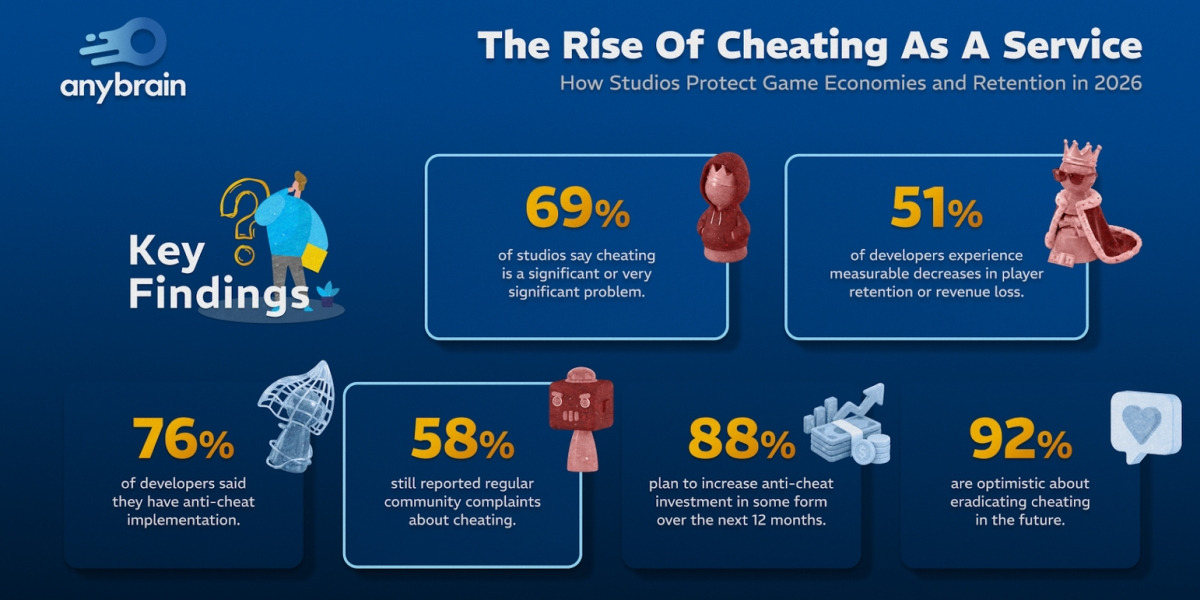
Cheating is becoming a significant commercial problem for game developers as 51% of surveyed studios report measurable declines in player retention or revenue as a result of cheating.
That’s according to Anybrain’s The Rise of Cheating as a Service report based on a survey of 250 developers working on competitive online multiplayer games in the US and UK.
The research found that 69% of studios consider cheating a significant or very significant problem, while 76% have implemented some form of anti-cheat.
The report describes cheating as an increasingly professionalised ecosystem, with cheat subscriptions, boosting services and in-game economy manipulation contributing to a global market that Anybrain estimates is worth $8.5 billion.
It also cites a 2021 case in which one cheat developer was estimated to have made $77 million from a service targeting a single game.
Anti-cheat challenges
Despite widespread adoption, developers continue to struggle to stay ahead of cheaters. 45% say cheaters are finding ways around their anti-cheat, while 58% report regular community complaints about cheating.
Anti-cheat technology can also create problems of its own. 55% cite technical issues caused by anti-cheat software, while 31% report false positives that can result in innocent players being banned. Meanwhile, 37% report community backlash around anti-cheat efforts.
Client-side anti-cheat is currently the most widely used approach at 50%, followed by AI-powered anti-cheat at 48% and third-party anti-cheat at 42%. Developers can use multiple forms of protection at the same time.
Anti-cheat investment
Studios are also increasingly treating anti-cheat as an ongoing organisational priority. 93% of surveyed studios have dedicated anti-cheat teams, while 88% plan to increase their investment over the next 12 months.
Among developers planning their next anti-cheat move, AI-powered solutions lead at 44%, ahead of third-party solutions at 42% and in-house kernel-level systems at 33%.
For developers currently implementing anti-cheat, 47% say they can move forward because they have secured a dedicated budget.
However, 24% of surveyed studios currently have no anti-cheat in place. The leading reasons are not having found a solution that works at 25%, concerns about community feedback at 22%, and believing they do not have a cheating problem at 22%.
A further 15% lack a dedicated team and 12% say anti-cheat is too expensive. Despite this, 73% of developers without anti-cheat are considering implementing it within the next year. Overall, 92% remain optimistic that cheating can eventually be eradicated from their games.
You can access the full report here.
Companies
