Building Kingdom Clash: A game designer’s perspective on a five-year project

- Kingdom Clash evolved from a simple mobile battler into a long-running live-service title.
- Early campaign progression and carefully placed difficulty spikes significantly improved monetisation and first-purchase conversion.
- Clans became a major driver of long-term player retention, creating social bonds that helped to keep players invested beyond the core gameplay.
Lev Nazin is a game designer at Azur Games.
Over five years, Kingdom Clash has come a long way: from a fairly classic mobile battler to a project that now feels quite unique within its genre.
Across many iterations, we tested dozens of ideas. Some came from successful battlers, others from completely different genres, and even from PC games. Not every experiment worked, of course. Some things had to be abandoned, and we’ll talk about those as well.
We’ll start with the core mechanics breakdown, then move on to iterations, mode experiments, and other details - all the way to fighting cheaters and some unexpected outcomes.
Combat
At launch, Kingdom Clash didn’t even have PvP, and the campaign had about two hours of content. But even that was enough for the game to show strong early metrics: R1 above 40% and average playtime around 35 minutes.
Back then, the game had only a couple of factions, 14 units, and 3 heroes. Today, there are dozens of both. Each faction has its own identity.
-
Humans fight with melee units and archers.
-
Mages cast spells.
-
Undead resurrect, summon, poison, and so on.
The main goal is to build a powerful, balanced army that can defeat opponents.
Players can recruit any units from any faction, but the talents and buffs of legendary heroes only apply to units from their own faction. So if you’re playing a Human hero, it makes sense to build an army around Human units.
Unit placement on the battlefield is entirely up to the player. There are no strict rules or fixed templates. We have a large community that comes up with formations on its own, so in a way, part of the meta is shaped by this collective player experience.
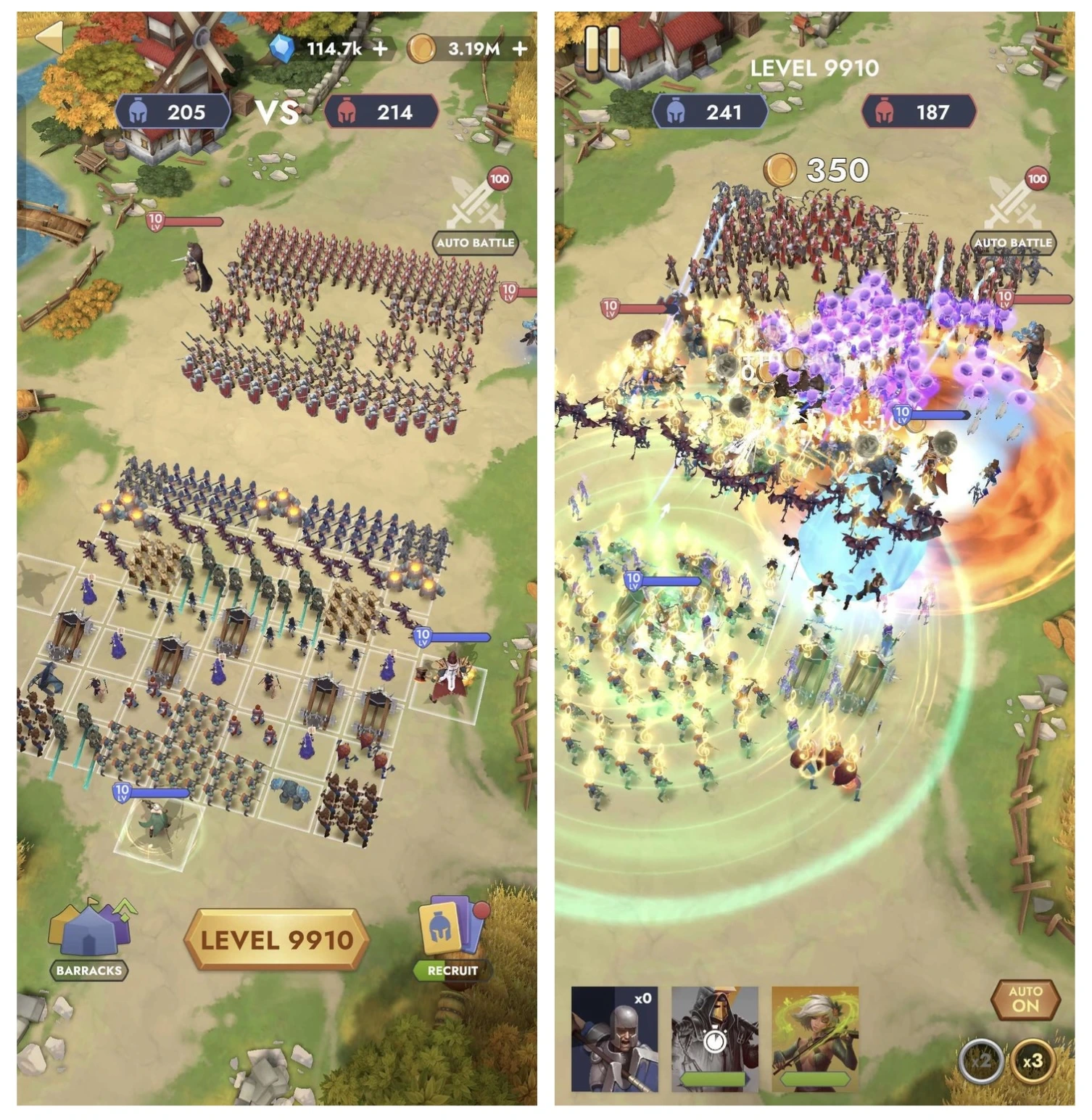
We don’t have a classic rock-paper-scissors system where knights beat archers, spearmen beat knights, and archers beat infantry, but there is still logic behind unit choices. For example, at some point we added assassins - units that jump into the enemy backline and attack from behind. Later, we added a counter-unit: explosive spiders. If you place them on the last row, assassins jump in and die to them.
Even now, in the fifth year of the project, players keep discovering new combinations with every update.
Another example: Undead have necromancers and cursed catapults that summon waves of skeletons. But Mages have a legendary hero, Edelina, Queen of the Forest, whose talent reflects part of incoming damage for allied Mage units. Against that kind of army, catapults basically destroy themselves before they can spawn many skeletons.
In short, Kingdom Clash is about tactical variety and creativity. Even now, in the fifth year of the project, players keep discovering new combinations with every update - including some we didn’t think of ourselves.
PvP arena
When we started working on PvP, the team immediately agreed that it should feel fair, and that players should climb the rankings organically. In practice, that’s not always easy: players are very vocal about fairness, but they will absolutely abuse any available mechanic if it helps them climb higher. So we tried to find a balance between competitive integrity and the product metrics of an asynchronous battler.
For matchmaking, we used the Elo system as the foundation. In this system, defeating an opponent with a higher rating gives the player more rating points, while beating a weaker opponent gives fewer.
When we started working on PvP, the team immediately agreed that it should feel fair, and that players should climb the rankings organically.
The formula was created back in the mid-20th century for chess ratings, but it turned out to work well for battlers and, more broadly, for games with leaderboards. It’s simple, doesn’t require huge amounts of stored data - only six parameters are involved - and allows for fast, convenient calculations.
At the start of each new season, every player receives a starting rating. Before each battle, the ratings of both participants are compared, and the difference determines the reward coefficient. If a player defeats a higher-rated opponent, they receive the full coefficient. Against an equal opponent, they get roughly half. Against a weaker opponent, they get less.

Globally, players are distributed across six leagues: Bronze, Silver, Gold, Platinum, Diamond, and Master League for the most hardcore players.
The speed of a player’s journey to the big leagues depends on how frequently they defeat equal or stronger opponents. At the end of the season, players receive rewards based on their performance.
While we were fully aligned on how leaderboard points should be awarded, there was a lot of debate around how opponents should be selected after introducing the Arena. We discussed two options: matching by rating or matching by army power.
While we were fully aligned on how leaderboard points should be awarded, there was a lot of debate around how opponents should be selected after introducing the Arena.
At first glance, matching by army power seems fairer, because a player’s rating depends on many subjective factors. For example, someone might not have played Arena for a while and dropped in rating, while their army remains just as strong. When they return, they can easily crush players around them on the leaderboard.
But the bigger issue was monetisation logic. If we were matched by army power, then a paying player would effectively punish themselves: every purchase would push them toward stronger and stronger opponents. That’s why we match by rating instead.
Campaign
Players usually come to mobile battlers for PvP, while the campaign often serves as a tutorial and farming layer. Still, the campaign is one of the key modes for maintaining interest in the game, especially early in the project’s lifecycle.
After years of experiments, we found that working on PvE can also boost product metrics and increase monetisation.
At first, we borrowed the level progression model from popular battlers. In the first iteration, there were no proper “blockers” with strong enemy armies that would require serious farming in side modes or in-app purchases.
Then we started experimenting and eventually added such a blocker at level 50. This happens roughly at the end of the player’s first-day session.
At that point, we saw a strong boost in IAPs and first-purchase conversion:
-
cARPU on D30 increased by 25%;
-
cNPU also increased by 25%.
There are a couple of reasons for this. First, the first hour of the game is very dynamic: lots of content opens up, new units appear, players experiment with battlefield formations, and they want to see what comes next. Second, PvP unlocks right after level 50.
We’re still working on balance, but for now we’ve moved away from adding more hard blockers.
We tried adding similar challenges every 50–100 levels - at level 100, 150, and so on - but this only led to players spending less time in the campaign and more time in PvP. We think this is because campaign pacing slows down over time. The first sessions are exciting, but later there are fewer new content unlocks, and players become more interested in competing against each other.
We’re still working on balance, but for now we’ve moved away from adding more hard blockers. Instead, we distribute more difficult but still passable levels more evenly.
A more subtle approach is a soft blocker through difficulty or bosses. These require farming in side activities that, because of timers, cannot be completed in a single day.
So the player has a choice:
-
keep farming soft currency in side activities that unlock tomorrow by timer;
-
buy a small offer and pass the level right now.
If the campaign is genuinely engaging and delivers good emotions, players are much more willing to make purchases after an hour of play because there is no rejection. Nobody is forcing mandatory IAPs to progress through the campaign. Purchases simply speed things up.
After levels 200–300, the campaign stops being the main mode for most players, and PvP becomes the main monetisation point.
In the end, leaderboards became the strongest player motivation. And to stay at the top, having the strongest army is not enough - you also need to log in every day and fight other players.
At the same time, we keep adding new units and heroes that directly affect battle strategy.
There is no strict rock-paper-scissors logic, but tactics and unit choices still matter. Players even make YouTube videos on how to build armies, what updates are coming out, and which units have been added.
Heroes
As is common in battlers, heroes in Kingdom Clash are divided into several rarity categories: rare, epic, and legendary. Mythic heroes were added later. Also traditionally for battlers, only epic, legendary, and mythic heroes are truly valuable for PvP, while rare heroes mostly exist as filler.
Our system is generally similar, but it has its own nuances. For example, Kingdom Clash has Baron - a rare hero that many players still want in their roster, including for the single-player campaign.
The reason is Baron’s active ability. He creates a special area around himself, and all enemy units inside that area become golden until the end of the battle, dropping more coins.
The reward multiplier grows with Baron’s level. If a standard enemy gives 10 coins, a level 10 Baron raises that multiplier to 15 coins. As a result, even a PvP-focused player will regularly return to the campaign and play levels with Baron to farm gold for upgrading their PvP army.
We also moved away from the common battler practice of making newly released heroes overpowered just to sell them more aggressively.
We also moved away from the common battler practice of making newly released heroes overpowered just to sell them more aggressively. The core idea in Kingdom Clash is that heroes of the same rarity are roughly equal in power, but each of them is especially good in specific situations.
For example, a year ago, the strongest epic hero was considered to be the Cleric - a solid buffer who strengthens the entire army. He works well in every mode.
Later, one of the updates introduced a new epic hero: the Lizard Rider. We balanced him in a way that made him extremely strong in the Arena, but much less useful against bosses and in the campaign.
The third popular epic is the Druid. He’s a melee hero who performs incredibly well against bosses. In Arena, like most melee heroes, the Druid dies quickly. But bosses usually damage all rows at once, so it doesn’t really matter whether a unit is melee or ranged. The Druid gives the entire army stronger damage buffs than the Cleric, which makes him 20–30% more effective against bosses.

This kind of variety motivates players to study new content more deeply, experiment with army builds, and learn new things. At the same time, we don’t ruin gameplay with constant balance swings. The game doesn’t become a contest of who has higher stats. It still allows players to win through skill and tactical understanding. Success depends on how well a player uses specific heroes in specific situations.
Another important benefit is that players become interested in collecting and upgrading as many different heroes as possible for different tasks.
The game doesn’t become a contest of who has higher stats. It still allows players to win through skill and tactical understanding.
In one of the recent updates, we gave players the ability to deploy two heroes on the battlefield at the same time. This resulted in a 10% revenue increase, not to mention higher player interest, as they got new hero integrations and a huge space for experimenting with builds.
To avoid overwhelming new players, this option does not unlock immediately. Instead, it becomes available around the player’s seventh day in the game, when they reach roughly 93–94K army power. Once they hit that threshold, they claim a reward that unlocks the second hero slot and immediately get a tutorial explaining how to place a second hero and what it opens up.
Tying this feature to power also encourages IAPs, because the faster a player progresses, the sooner they unlock the ability to use a second hero. We also plan to add a third hero in the future, especially since the technical foundation for it is already there.
Bosses
Adding bosses affected long-term retention and long-term monetisation. If you want players to keep returning to PvE again and again, you need to give them a unique game feel - something even beating the strongest PvP opponent cannot provide. Boss battles were a game-changer both visually and mechanically. The mode is also connected to the campaign, since it unlocks only after level 300.
If you want players to keep returning to PvE again and again, you need to give them a unique game feel.
Right now, Kingdom Clash has four bosses, each with its own mechanics.
The Dragon tilts the platform, and the player has to move the army away in time to avoid damage. The Spider Queen summons hordes of spiders and activates an ability that changes the player's army’s target from the boss to the spiders.
The player needs to kill them as quickly as possible. The Kraken grabs 15–20 units with a tentacle and throws them into its mouth. The player then needs to press the cannon at the right moment. If timed correctly, the boss returns the units to the battlefield.
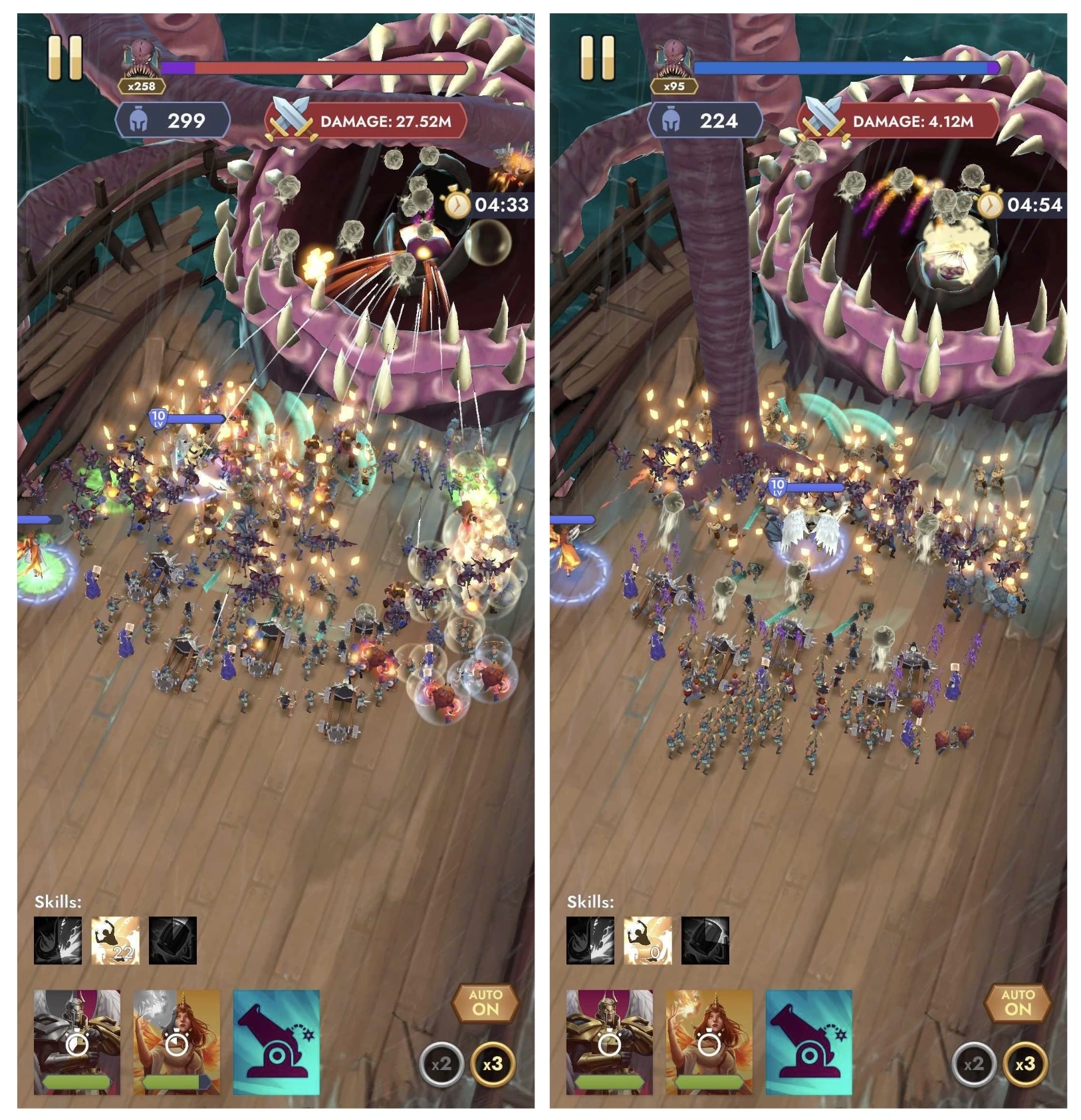
Boss mechanics also motivate players to build new armies with specific formations.
For example, there is a legendary unit whose damage increases every third attack. In Arena, this doesn’t stand out as much, because other strong units can destroy them quickly, and units are constantly moving toward new enemies.
In the fifth year of the project, we can confidently say that bosses had a strong positive impact on long-term retention and monetisation.
Against bosses, however, these units shine in a new way. During the battle, they stay in place and keep attacking one target. This lets them accumulate strong damage, and when combined with Alchemists who do AoE healing, they become even more essential. Players quickly figured this out and started building separate armies specifically for bosses.
Yes, creating bosses takes a lot of time and resources, and it doesn’t produce an immediate explosive growth in metrics after release. Still, in the fifth year of the project, we can confidently say that bosses had a strong positive impact on long-term retention and monetisation, not to mention how much the community enjoyed them.
Clans
From experience, we know for sure that clans are one of the main reasons people stay in the game long-term. Kingdom Clash is more than five years old. Veteran players have already tried and seen almost everything the game has to offer, but over time they met people, became friends, and built social ties they want to maintain.
On the project’s social channels, you can find comments like: “Honestly, I’m already kind of bored, but I can’t leave because I’d let my guys down, and we’d perform worse in clashes.” That social life keeps people in the game for a very long time.
From experience, we know for sure that clans are one of the main reasons people stay in the game long-term.
Over the years, different strong clans formed in Kingdom Clash. The most interesting part is that players invented clan competitions for themselves even before the feature existed in the game. They manually created leaderboards, tracked rating points, determined the strongest clan at the end of each season, and posted results on social media - all before we added it officially.
We also made clan progression fairly unique. In most battlers, clan rank increases because players complete quests and earn XP, or donate resources. Let’s say a clan reaches max rank, everyone gets rewards, and then something happens: people stop playing, move to another clan, or get recruited elsewhere. As a result, the game ends up with a max-rank clan with max rewards, but it’s effectively dead or full of newcomers - and it still doesn’t drop in ranking.

Our idea was that clans should constantly prove they deserve their rank. This is where our Arena rating system came in handy: with every win, a player’s rating and leaderboard position increase. Wins against stronger opponents give more rating points. We took this Elo-style rating system and applied it to clan clashes. The higher a clan’s rank, the better rewards it receives. But a clan’s rank can also drop if its members lose too many battles.
The community had long been asking for clans to fight each other, so we offered several types of competition.
The two types of clan activities work together throughout the entire week.
From Monday to Wednesday, we run Clan Hunt - a clash where clans are matched by rating and compete to deal more damage to a boss over several days. The clan with the higher total damage over three days wins.
From Thursday to Sunday, we run Clan Battle - a PvP clash where players from one clan fight players from another. The clan with more victories and more points wins.
As a result, the two types of clan activities work together throughout the entire week: boss clashes from Monday to Wednesday, and PvP clashes from Thursday to Sunday. The whole week is packed with clan activities.
Location variety
Monotony is one of the biggest enemies of a single-player campaign. During the first hundred levels, player interest can be maintained by gradually unlocking new units and modes. Later on, you need other tools, including visual variety.
The game has three factions: Humans, Mages, and Undead. We try to design level visuals so that they fit the overall theme. For example, around level 120, players reach the Magic Forest, which we created specifically for the Mage faction.
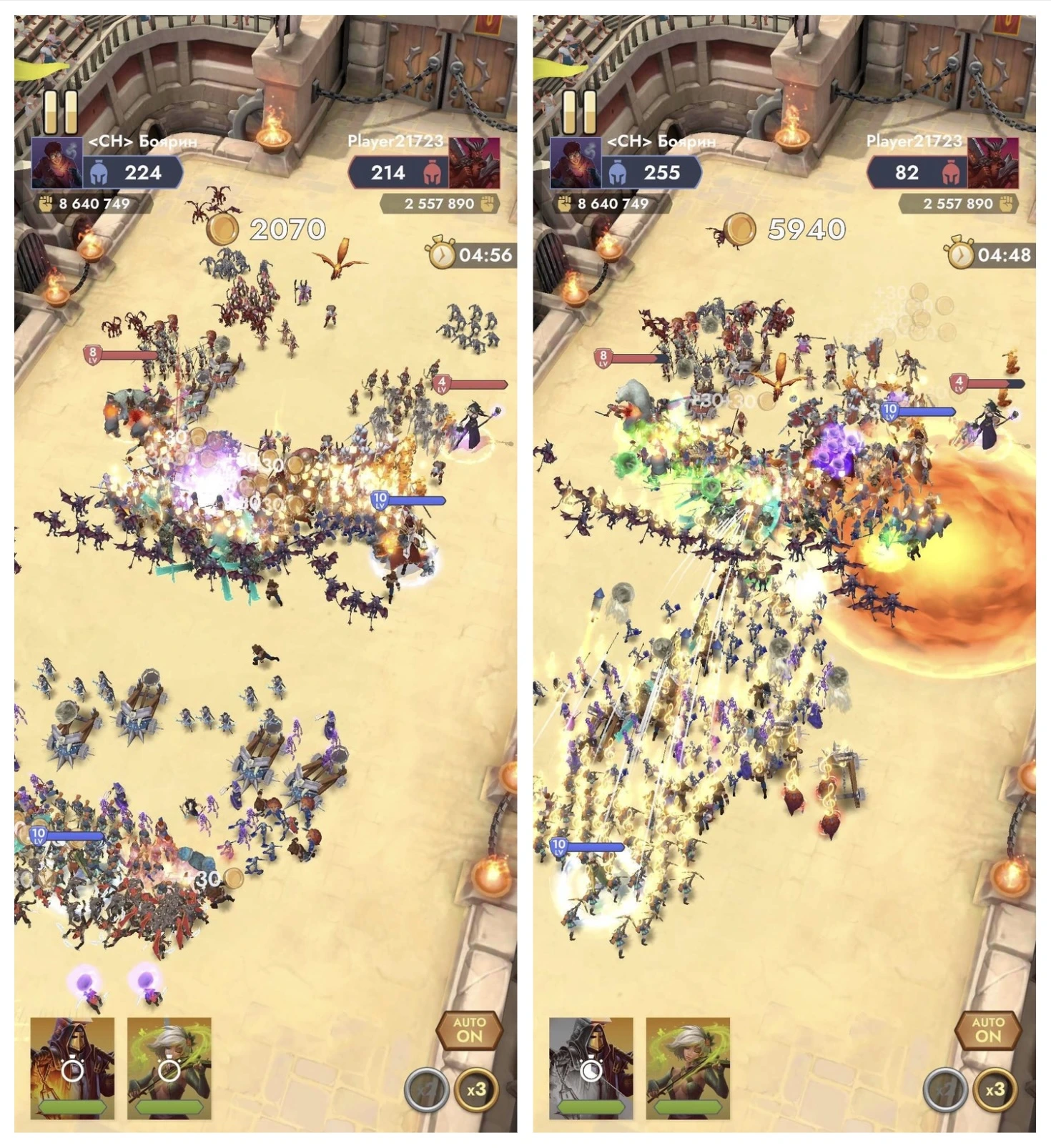
Around level 400, there is the Necropolis - a reference to the Undead faction. There is also a full city location in the style of classic fantasy strategies, a seashore, wheat fields, and so on. Each boss also has an exclusive location.
To be honest, we don’t know exactly how changing scenery affects product metrics. And can it even be measured properly? First and foremost, we do it for the vibe. But we ourselves liked the result so much that at some point we decided to create a special background for the PvP Arena as well - an amphitheatre inspired by the Colosseum.
Speed-up and auto-battle
Auto-battle and battle speed-up turned out to be a really popular feature for players competing for top leaderboard positions
For example, when only a few hours remain before the Arena season ends, speeding up battles becomes very important. It allows players to finish more fights and try to surpass opponents.
But a special offer on day two had the biggest impact on VIP purchases. The player gets VIP with auto-battle for free for 30 minutes. Once they feel that speed-up, many of them don’t want to return to playing at normal speed. Battles start feeling too slow. This decision significantly improved conversion.
Experiments with new modes and parallel gameplay
When Kingdom Clash started growing and we realised we would be developing it long-term, we began paying more attention to mechanics that other midcore battlers didn’t have. Among other things, we added parallel progression with its own unique gameplay in a different genre.
Although the community responded warmly in reviews, not everything led to real metric growth. There is still a lot of room for experimentation, but we can already share some of what we’ve learned.
Although the community responded warmly in reviews, not everything led to real metric growth.
Tower capture. This mode is actually called Conquest in-game, but internally the team calls it Mushroom Wars as a reference to the old classic. It unlocks at a certain campaign level and adds variety because it is basically a separate casual game inside a midcore game.
The hypothesis was that a new mode with a completely different core gameplay would increase long-term retention. It didn’t fully prove out. Or rather, it didn’t prove out as strongly as we had expected.
Even though the mode didn’t produce a clear metric increase, the community really liked it. Players still ask in Discord when new tower capture levels are coming, even a year and a half after the mode was added.
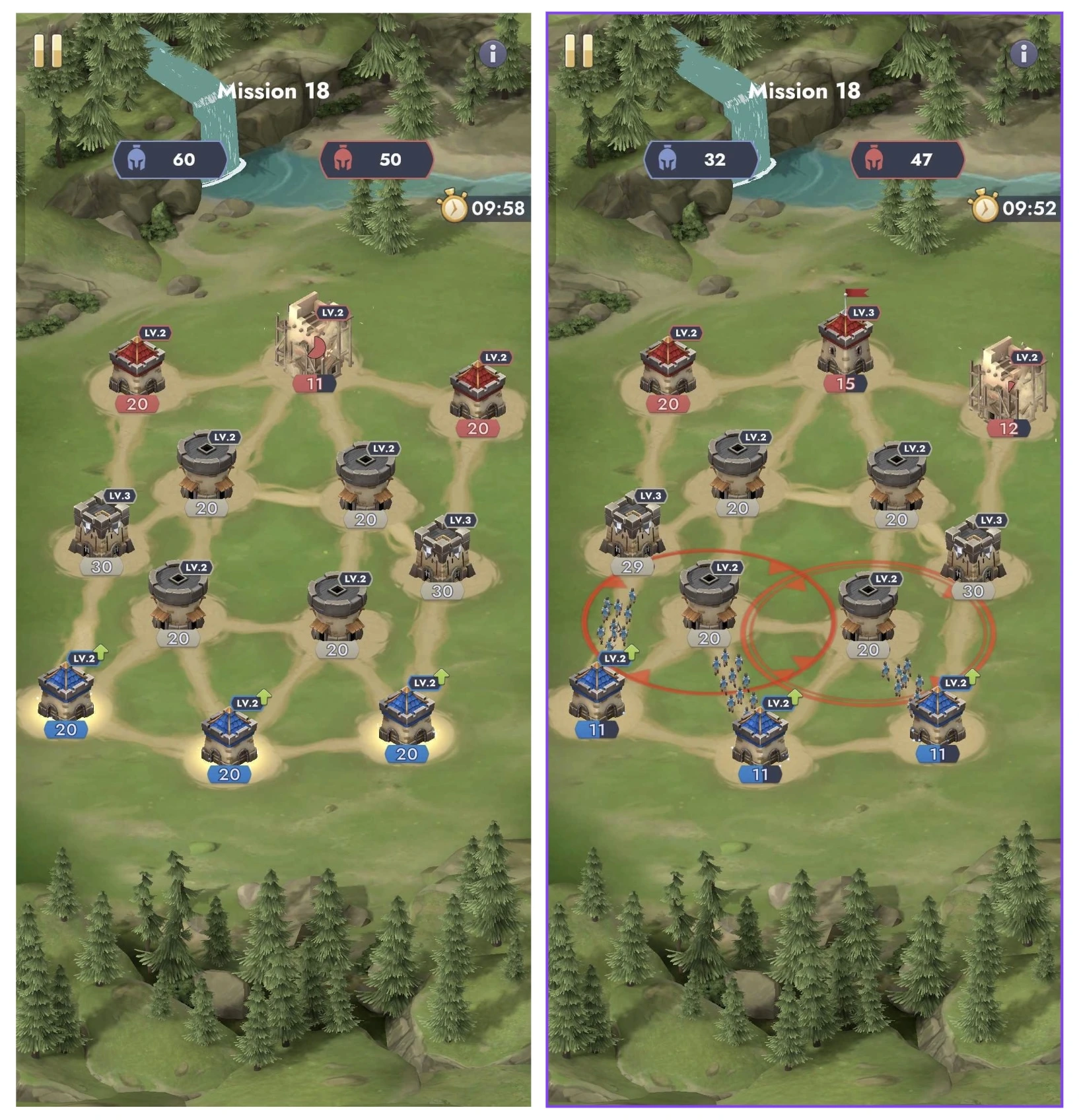
We’re now thinking about replacing the permanent mode with events that appear periodically and motivate players to return to this gameplay. This way, the mode gets a logical continuation and adds competition through leaderboards. Players who complete it faster than others would receive rewards.
In other words, parallel gameplay can genuinely appeal to the core audience, but it does not automatically guarantee growth in retention or other metrics. It may need to be tied more strongly to the core gameplay, not only logically but also through items or currency that can be farmed.
It is definitely worth experimenting with and learning how to work with this kind of content, but at this stage, I think it’s better to present it as events rather than permanent modes - something that adds variety for long-term players.
Expeditions. This mode is often found in single-player RPGs. Players can send heroes on expeditions for a certain amount of time to farm soft currency.
We’re now thinking about replacing the permanent mode with events that appear periodically and motivate players to return to this gameplay.
At first, we wanted to make it a simple text quest system, where the player opens a window and chooses how to resolve an encounter. In the end, we made a full, polished map with markers and lore. This wasn’t strictly necessary; we simply wanted to entertain players, even though I know this mechanic works perfectly well in text form in other games.
The speed of expedition completion depends on the hero. This motivates players to collect more different heroes from the very start of the game.
We also considered adding automatic expedition dispatch for VIP players, but we ultimately decided to leave the mode as a pleasant extra for players - another way to farm soft currency.
The mode also slightly increased the number of daily logins, since players wanted to send more expeditions, which take between one and a half and nine hours. One of the hypotheses we still have is to connect this mode more strongly with the number of heroes, encouraging players to build a larger collection and send more heroes on expeditions.
We took the classic tower mode, where heroes fight their way up floor by floor, and added modifiers that competitors didn’t have. Each floor had special battle conditions.
For example, on one floor, Mages dealt 40% more damage. On another, Archers were nerfed, and so on. This motivates players to build new armies for specific floors. As a nice bonus, it also increases community activity, because players actively share tips on how to clear levels.
No matter how good a mode looks or plays, it has to motivate players with rewards that genuinely affect progression to be truly effective.
The levels also had unique visual design, which made the experience feel different from the regular campaign.
As for what didn’t work: we wanted to deepen hero progression, so we introduced a second ability in the form of passive talents that had to be upgraded separately for each hero.
These upgrades require books, and the Library mode was designed as the place to farm them. Unfortunately, we only had time to add talents for legendary heroes, and because those heroes have a low drop chance, players don’t have enough motivation to engage with the mode.
Players still like it, but no matter how good a mode looks or plays, it has to motivate players with rewards that genuinely affect progression to be truly effective.
Combating game mechanics abuse
Across the entire history of Kingdom Clash, the community has never really raised the issue of unfair matchmaking. But here’s the paradox: players always advocate for equal chances, while never missing an opportunity to exploit game mechanics for an advantage in PvP.
Players always advocate for equal chances, while never missing an opportunity to exploit game mechanics for an advantage in PvP.
Kingdom Clash used to have a feature where players could leave a PvP match without consuming an attempt. We added this to protect players with poor internet connection, so they wouldn’t be punished with a loss because of technical issues. If you got disconnected, you could come back and replay the match.
Players started using this en masse to avoid fights with stronger opponents. If they saw a stronger player in the opponent list, they would attack them, then quit the game. When they came back, the attempt was still there, but the opponent list had refreshed. People started doing this constantly. They even discussed it openly in Discord and shared guides with newcomers on how to abuse Arena rules.
We noticed this and removed the loophole. Now, when a player returns, they are offered either to finish the battle or accept defeat. But before making the change, we analysed the data and found that the share of players actually disconnecting due to internet problems was tiny, while abuse had become widespread.

If you ever fix something similar, expect a lot of outrage at first - even from players who are otherwise against cheating.
We’re still working on another issue that is typical for all Elo-based games. Players live in different time zones, while technically the game day starts at 00:00 UTC. As a result, players whose sessions roughly align with the start of the server day end up at a disadvantage.
We have a hypothesis to lock player points based on the previous day’s value to neutralise the time-zone advantage, but we haven’t yet found an elegant way to implement it.
They use their daily battle limit earlier than everyone else and climb the rating first. Later, players whose sessions happen closer to the end of the game day attack those who gained rating in the morning and surpass them on the leaderboard. The first group simply has no opportunity to respond.
We have a hypothesis to lock player points based on the previous day’s value to neutralise the time-zone advantage, but we haven’t yet found an elegant way to implement it.
The more “dedicated” top players combine this issue with revenge-mechanic abuse using the following pattern:
-
At the end of the game day, they set a very weak formation so that almost anyone can beat it.
-
Players with lower but still strong army power attack them and slice off the most possible amount of rating.
-
Revenge attempts are stored for 24 hours, so the player doesn’t retaliate immediately. Instead, they stockpile them, turning those revenge battles into a hidden reserve of rating points.
-
The next day begins. Players wait until the end of the day, run their regular 20 battles during the final hour, and then also use the revenge attempts saved from the previous day, creating an even bigger rating gap from everyone else.
The problem seems obvious in hindsight, but we didn’t think of it immediately. This abuse became a common behaviour pattern for many players because clans and social communities actively taught newcomers how to do it.
A side effect of this was that many of the strongest players sat with weak defensive formations, waiting to be attacked. As a result, leaderboard tops showed players with very low army power, which also looked very wrong to us.
We solved the problem simply: revenge now returns only 50% of lost points. Losing on defence became unprofitable, players stopped doing it, and the leaderboard became healthier.
Five years in: notes to our past selves
We started with a medieval setting but quickly drifted away from realism - and honestly, it happened naturally. Fantasy just makes it easier to invent new units and effects, and scaling content is way less painful. A realistic setting can attract a niche but very loyal audience, but be ready to burn a lot of resources every time you need something new.
Clans only appeared in our second year, and looking back, we should have built them much earlier. This isn't even genre-specific - clans exist in Match-3 games. They don't need to be fully featured on day one: basic functionality is enough - create a clan, invite players, a couple of simple activities to get people invested in clan life. Today, clans are basically the heartbeat of Kingdom Clash.
Clans only appeared in our second year, and looking back, we should have built them much earlier.
Players spontaneously organise their own activities inside them. What keeps someone in a clan isn't the mechanics - it's the little family that formed around it. The earlier you start building that family, the faster you get a core player base that stays even when the game itself isn't enough.
Onboarding: give it in pieces, but move fast. Don't dump all your mechanics on the player in the first few minutes (there are cases where that works, but usually in other genres). The best way to find the right balance is to study how competitors structure their progression, play it yourself, push key events closer to the start, and check whether the interest curve falls apart when you do.
Figure out your target audience before you start building. Battlers come in very different shapes - some are built around PvP competition (like Kingdom Clash), others lean into collecting and PvE. Knowing what's actually going to keep your player around - competition or collection - determines where you put your team's energy first: pulling players into the PvP arena early, or into something else entirely.
Onboarding: give it in pieces, but move fast. Don't dump all your mechanics on the player in the first few minutes.
And speaking of PvP: any competitive mode will get abused. If we were building Kingdom Clash 2.0, we'd take our current Arena structure as the foundation from day one and think through the potential exploits upfront, before players find them for us.
The extra modes we added for variety didn't really deliver what we hoped. Maybe if you're going to build something outside the core gameplay, it needs to be tightly woven into the main game - both in terms of in-game resources and logic.
The exception is live ops events with a different core, timed around holidays. Across different projects, a completely new gameplay loop in that context tends to work well. For Kingdom Clash, we haven't gone deep on that yet, mostly because the main game is still actively evolving.

Build monetisation and economy into the architecture from the start. The minimum you should think through in advance: a character progression system with active and passive abilities, a card-based upgrade structure (common, rare, epic, legendary), multiple currencies, competitive layers - tournaments, async PvP, guild battles, events - and a flexible battle pass with enough content to feel rich.
I see genuinely impressive battlers on the market that just can't get off the ground because the monetisation was never properly designed in.
That said, don't be afraid to do something different. One of the things that made Kingdom Clash work is army-vs-army combat instead of 5v5 heroes like so many other battlers. And right now we're planning to test a completely new matchmaking system - one that's starting to appear in some games, but where nobody has published real results yet.
You can't just ship a game and walk away. If it starts working, starts generating something, starts bringing players in - that's when the real work begins.
Instead of one unified leaderboard, we'll split it into separate independent leaderboards with a fixed number of players in each. The goal is to increase engagement and make competition feel more real within smaller groups. We'll definitely share how that goes.
The main thing: midcore is a marathon, and experience can't be replaced by just watching what others do. The first year and a half, we experimented a lot, and some of it completely failed.
Now we dig much deeper into the details before shipping anything - what a feature actually gives the player, how it affects the meta, how it changes player behaviour. And what we plan usually ends up roughly matching what actually happens - both in metrics and in how players respond.
You can't just ship a game and walk away. If it starts working, starts generating something, starts bringing players in - that's when the real work begins. Five years in, it honestly feels like Kingdom Clash is still just getting started. That level of understanding only comes from your own mistakes and your own product.
Companies

People