Deconstructing a $100m idle game: What 5 years of Gold & Goblins reveals about live ops and retention

- Idle game retention degrades when progression is dominated by long timers, as players' advance interaction slows and creates a progression wall.
- Event systems perform better when they reuse the core loop but adjust balance rather than introducing entirely new mechanics.
- Limited-time events act as a second progression layer resetting friction and reintroducing fast gameplay while the core loop continues.
Igor Voronetskiy is a producer at AppQuantum.
Gold & Goblins has been on the market since 2020, generated over $100M in revenue, and still brings in up to $2M monthly.
The game effectively became one of the early titles in the Idle + Merge 2 niche. A strong core, combined with a sense of novelty and retention-driven mechanics, helped it reach - and stay in - the top charts.
But bringing something new to the market always comes with risks. You don’t really have anyone to benchmark against. That affected both the project’s architecture and the complexity of adding new content and running live ops.
Now the team is actively working on a new project, taking into account everything they’ve learned.
Even familiar features like a battle pass were implemented without relying on competitors through experimentation. As a result, the battle pass in Gold & Goblins is presented as a standalone mini-game, which was quite unique at the time.
Now the team is actively working on a new project, taking into account everything they’ve learned.
We decided to break the project down from our perspective.
First, the key differences compared to other games in the genre.
-
Gold & Goblins allows players to manually manage units (goblins), which introduces a layer of strategic planning within each level.
-
Unlike classic merge games, progression happens within a single level. When you move to the next one, the character merge progression resets.
-
And unlike traditional idle games, the player interacts with the mechanics much more frequently - moving units manually and managing timers.
Visually, the game leans into a stylised, cartoon-like aesthetic. Characters have exaggerated proportions - large heads, oversized hands - which is typical for casual games and helps reach a broad audience.
At the same time, the darker, more saturated environments shift the tone slightly toward a more mature audience.
Event timing and balance
Events in Gold & Goblins perform well and generate a fairly significant share of revenue.
Structurally, they reuse the core gameplay loop, but with different balance, time pressure, and leaderboards. The core remains the same, but the experience feels more dynamic, and monetisation performs better.
One of the fundamental issues in idle games is long timers.
One of the fundamental issues in idle games is long timers.
At the beginning, everything feels fast and responsive. There’s always something to tap, collect, or upgrade. But as players progress, timers grow longer, and interaction slows down.
Eventually, players hit a wall. They can speed things up with IAPs, but after that, they run into long timers again.
This is where LTEs help.
They act as an alternative progression layer. When players get stuck in the core loop, they can switch to an event and start fresh - with fast progression again. For 10, 20, or even 40 minutes, the game feels dynamic again.
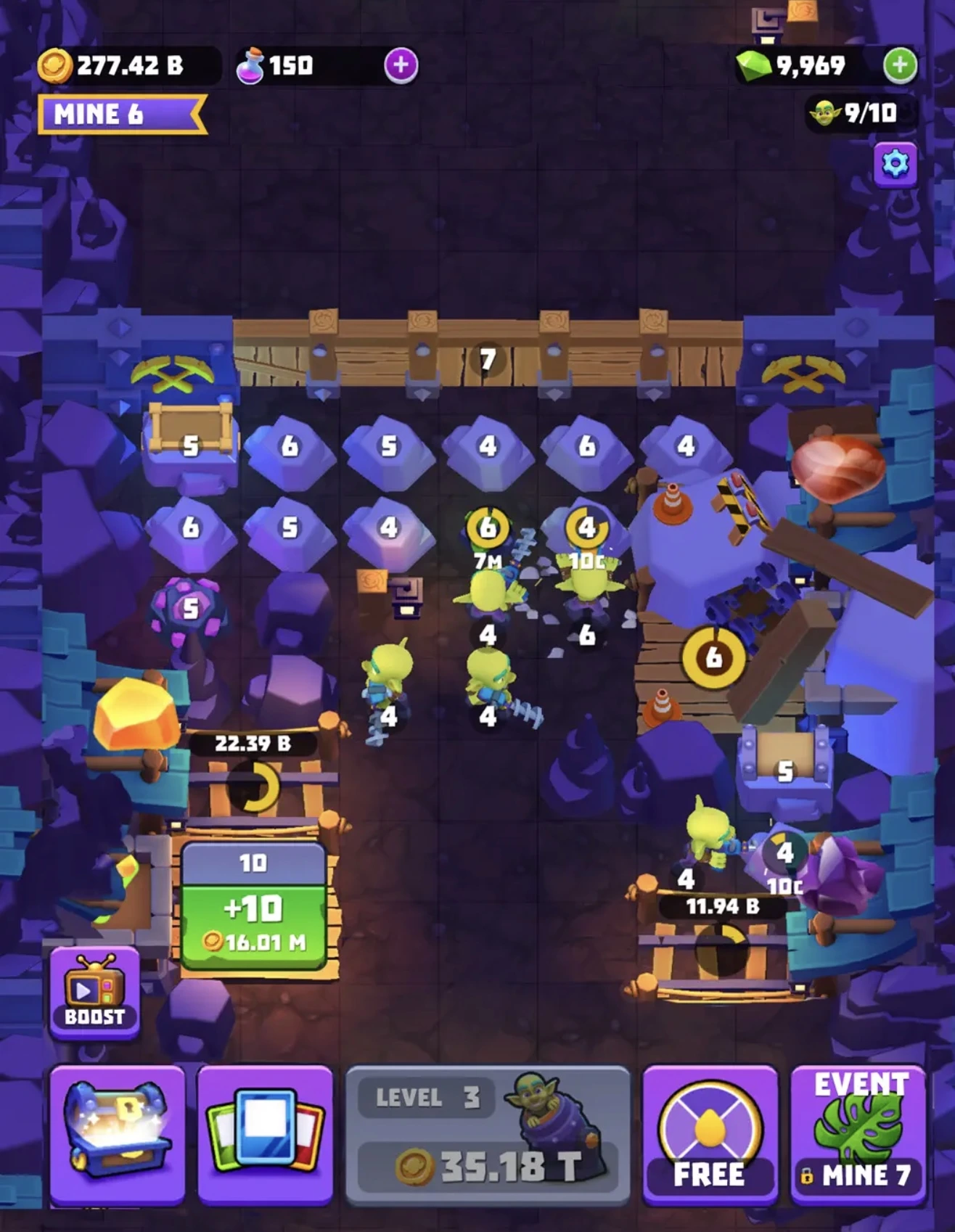
Meanwhile, timers in the core keep ticking.
This creates a pendulum effect - a well-balanced interplay between core gameplay and events.
There are a few important things to consider here.
First, the gap between events. If you consistently see spikes in player activity when an event starts, it’s worth testing shorter intervals between the live ops or limited-time events - whether that’s 24 hours, 12 hours, or something else, depending on your audience.
Gold & Goblins is relatively minimalistic compared to competitors, which, to some extent, justifies its slightly more hardcore gameplay.
Second, event balance. If most of an event can be completed without purchases, it can increase positive motivation and completion rates. Unlike the core loop, events are time-limited, so a slightly more forgiving balance often makes sense.
At the same time, Gold & Goblins is relatively minimalistic compared to competitors, which, to some extent, justifies its slightly more hardcore gameplay.
There’s less UI clutter, less aggressive monetisation pressure, and fewer intrusive interactions. Instead, the game relies on a strong core loop - a blend of idle, puzzle, and strategy - that has proven itself over time.
Because of that, the game doesn’t need to push the player as hard. Players can engage with the core mechanics at their own pace - and that balance is exactly what makes Gold & Goblins stand out.
In contrast, many competitors rely on heavier UI, more visual noise, more pressure, and a lower barrier to entry to maintain engagement. Here, the approach is different: less pressure plus more depth equals better long-term retention.
Gameplay strengths and difficulty curve
G&G has a unique gameplay loop that unfolds gradually. Early on, bonuses from collectable cards and gems may feel minor. But after level 100, players start investing serious time into optimising combinations for more efficient mine progression.
In many idle games, gameplay tends to fade at that stage. There’s simply less to do. Some games try to compensate with narrative.
In many idle games, gameplay tends to fade at that stage. There’s simply less to do. Some games try to compensate with narrative. Gold & Goblins takes a different route - expanding mechanics, management depth, and timing.
At its core, gameplay splits into two layers - and then expands even further. On one side, there’s the familiar idle mechanic of upgrading mines. On the other, there’s a completely different layer: clearing rocks using goblins.
Players choose not only where to go, but how to get there by merging goblins. Do you rush toward a valuable chest? Detour for extra resources? Split your units across multiple paths? Merge everything into one strong goblin - or build a team of weaker ones working in parallel?

This kind of decision-making - not just finding the optimal path, but also the optimal way to progress - adds layers of strategy and puzzle-solving to the game. The level of micromanagement lets players experiment with positioning, merge order, and upgrade priorities, with tactics often shifting multiple times within a single level.
As a result, each level can play out differently. Player strategies evolve, creating a sense of replayability and room to try different approaches and builds.
Player strategies evolve, creating a sense of replayability and room to try different approaches and builds.
On top of that, the game combines fast, engaging starts, a mix of short and long timers, and a wave-like difficulty curve. Difficulty ramps up, then drops, giving players room to breathe - and then builds again.
Station upgrade balance is also critical. If mines upgrade quickly but provide little long-term value, players will stop interacting with them early. That reduces the micromanagement layer, which is actually key to retention.
Many of these strengths, and some of the trade-offs, are the result of the game evolving within a new, relatively unexplored niche.
Here are the key core gameplay strengths:
-
The combination of short and long timers allows players to plan sessions flexibly. There’s always something to return to, both in the short and long term.
-
The rock-clearing mechanic - whether fully clearing a level or optimising the fastest path forward - is inherently engaging and provides frequent positive feedback.
-
The game includes a high level of character micromanagement: positioning, merging order, upgrade priorities, and resource allocation.
-
At the start of each level, gameplay feels dynamic due to a higher density of short timers, which increases reward frequency and engagement.
-
Even when offline, the game generates goblin barrels. When players return, they not only spend accumulated currency but also merge units and get a small progression boost, reinforcing positive return behaviour.
Some mechanics may feel frustrating, but they’re intentional:
-
Character cards act as a soft progression gate. Without using them to automate mines, progression slows down significantly.
-
Mines from the beginning of a level lose relevance over time. However, since the game doesn’t require players to revisit early areas, this has a limited impact.
-
Players who check the game too frequently may find there’s not enough to interact with - simply because the system hasn’t generated enough new opportunities yet.
At the same time, the studio is already working on a new project, and based on that experience, here are a few things worth paying attention to if you’re building your own game today.
Architecture
On today’s market, depth and long-term scalability are critical - not just for idle games. You need to plan for long-term retention and monetisation, which means building systems for continuous content updates and live ops.
You need to plan for long-term retention and monetisation, which means building systems for continuous content updates and live ops.
For their new project, the Gold & Goblins team rebuilt both the engine and architecture from scratch, specifically to support faster and more flexible content production: events, skins, biomes, and more.
Even small design decisions matter.
For example, giving rewards instantly during events instead of at the end. Or introducing different types of goblins with unique traits, behaviours, and perks instead of a single unit type.
If you’re building your first game, it may not make sense to invest heavily in architecture before validating the idea. But once you see traction, it’s worth reworking the foundation early, so scaling content later doesn’t become a bottleneck.
What’s next
Gold & Goblins was one of the first games in its niche.
The combination of idle, Merge 2, and strategy created a unique gameplay experience. As a pioneer, it carved out its own space, and thanks to a strong core, it managed to retain players for years.
Now, that experience becomes the foundation for the studio’s next projects - with new mechanics, improved systems, and a much stronger understanding of what works.
Companies

People