Wooga’s Holger Wurst on designing June’s Journey: Player research, AI and the UX rule you can’t break

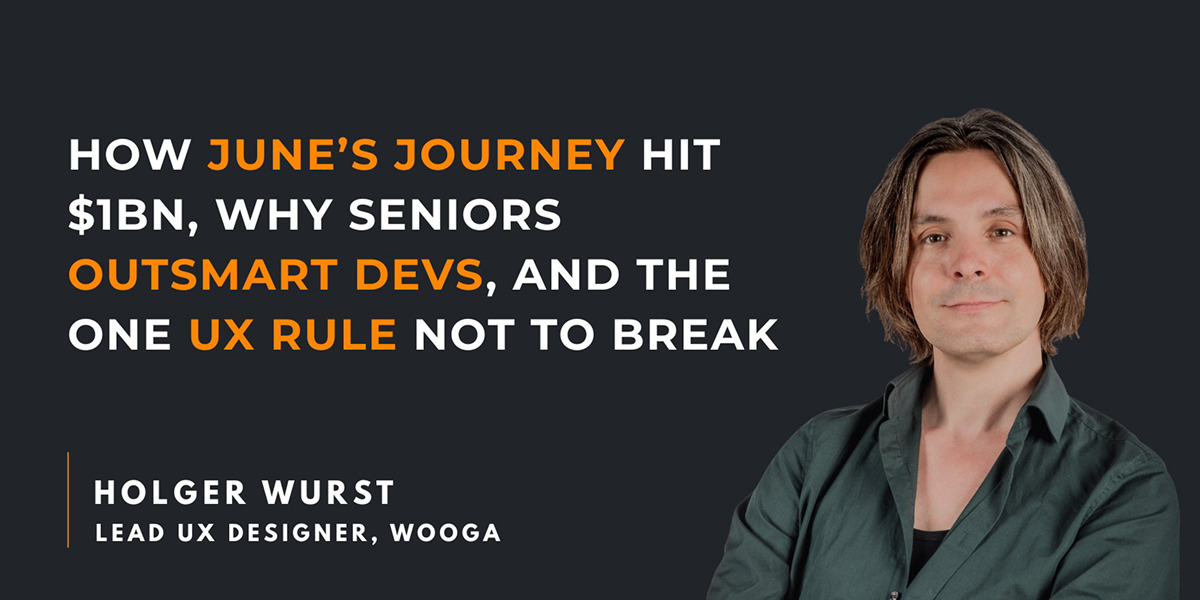
- Wicked can join June’s Journey, but “June needs to be the star.”
- Older players “outsmart” the team, so stop underestimating them.
- AI makes prototypes about 70% faster, but synthetic players are “dangerous.”
Holger Wurst joined Wooga in 2015 and now leads the UI/UX department on June’s Journey, the 1920s hidden object mystery that has passed $1 billion in revenue in 2023 and has been live for close to a decade.
He runs a team of eleven designers, animators and researchers, and joins a panel at PGC Nordics next week with one message he is happy to repeat: talk to your players.
We caught up with him ahead of his appearance at PGC Nordics to talk about all things June’s Journey, including collaborations with Wicked and Agatha Christie, AI’s possibilities and limitations, and never underestimating players.

From pixels to people
Holger started out as an all-rounder in 3D, graphic design and a little engineering. Before June’s Journey he worked on Wooga’s first Hidden Object Game, Pearl’s Peril, and before that on games pressed onto CDs and sold in convenience stores.
“You can make a fantastic game, but if people don’t understand it, you’re going to waste a million dollars.”
Back then, he says, UX mostly meant visual communication. Did the particle effects look good, and could people read the text on a phone, a tablet and a Windows build? His reasoning for moving into the field was simple: “You can make a fantastic game, but if people don’t understand it, you’re going to waste a million dollars.”
Over time, he watched players stumble through screens that had made perfect sense in isolation. So he moved away from execution and closer to design. Today UX sits in the earliest meetings on any new feature. The player he keeps in mind is someone who heats up a coffee on a Saturday morning and plays seven rounds of hidden object at their own rhythm.
His line between designer and engineer is not convoluted: “Does your code go into the game, and do you do code review? That’s where I would draw the line.”
June stays the star
Wooga’s collaboration with Universal’s Wicked, which ran in-game over the winter, followed a tie-in with Agatha Christie’s Hercule Poirot. Holger's first instinct was to research before pitching anything. He looked at what pop culture players cared about and which values they linked to June’s Journey, such as friendship, family, liberation and travel.

Players welcomed the idea, but they set one condition without being prompted. “They can never overshadow June,” he says. “June needs to be the centrepiece and the star of the story.”
With roughly four years of story already in the game, the main arc stayed untouched. Instead, the IP went into sub-features: themed decoration sets for players’ islands, and events built around conversations between June and the Wicked characters.
Don’t break the mapping
The UX rule specific to hidden object games, he says, is one players only notice when it fails. Players learn where an item sits and what it is called. Move the cushion, or rename the teddy bear a plushie, and they start wondering whether they’ve found a bug.
“Don’t break mapping,” he says. “If you do break mapping, I want to talk to you about how you made that work.”
Reliable beats fresh
For players who have made the game a daily hobby, Holger thinks reliability matters more than novelty. He compares redesigns to an operating system update: it might look smart and be “full of helpful AI and other improvements, but as a user, you will have to relearn it now.

He would happily remove the UI that isn’t needed. The real stars in the game are the hidden object scenes, the island decoration and the story and the interface exists only to get players to them. Changes also have to account for fan wikis and clubs that build playing schedules around the current flow.
Stop underestimating older players
June’s Journey’s audience reaches comfortably into players’ 60s and 70s. Holger says the industry easily gets them wrong. It's easy to assume that they mostly need large text, slow pacing and information fed step by step.
“The majority of our players that I would identify as senior players, they outsmart me on several occasions,” he says.
“It's easy to underestimate the players we're catering to. So make sure you go and talk to them and you see what works for them.”
At one focus group, a player arrived with a tablet, a phone and a written list of questions about the game’s economy, which she understood better than he did. “It's easy to underestimate the players we're catering to.” he says. So make sure you go and talk to them and you see what works for them (and what not).
Fast prototypes, not fake players
On AI, Holger is enthusiastic about speed. His designers write their own tools for jobs like batch-renaming elements or changing animation keys without breaking references. He estimates prototypes now come together around 70% faster. A clickable prototype also beats a whiteboard, especially when a game design document has to be written in your second language.
Where he draws a hard line is synthetic players: building an artificial player from audience data and asking it what it thinks of a feature. “That’s where it’s becoming dangerous,” he says, “where you somehow stop thinking about the player again.”
“We’re still building something for people. And you can’t build something for people without people in the room.”
Stay a gamer
His advice to his 2015 self: stay a game developer at heart, keep doing game jams and going to conferences, and remember that making entertainment is a privilege, “especially in times like these where the world is again in turmoil.”
Also: “Maybe buy and keep 10 bitcoins!”
Catch Holger's session, 'How AI Agents Are Reshaping The Way We Make Games' at PGC Nordics. Tickets are here.
Companies

People

Events
