In the Hot Seat: Ex-Take-Two AI chief Luke Dicken on the $2tn bubble, junior jobs and the next 2008

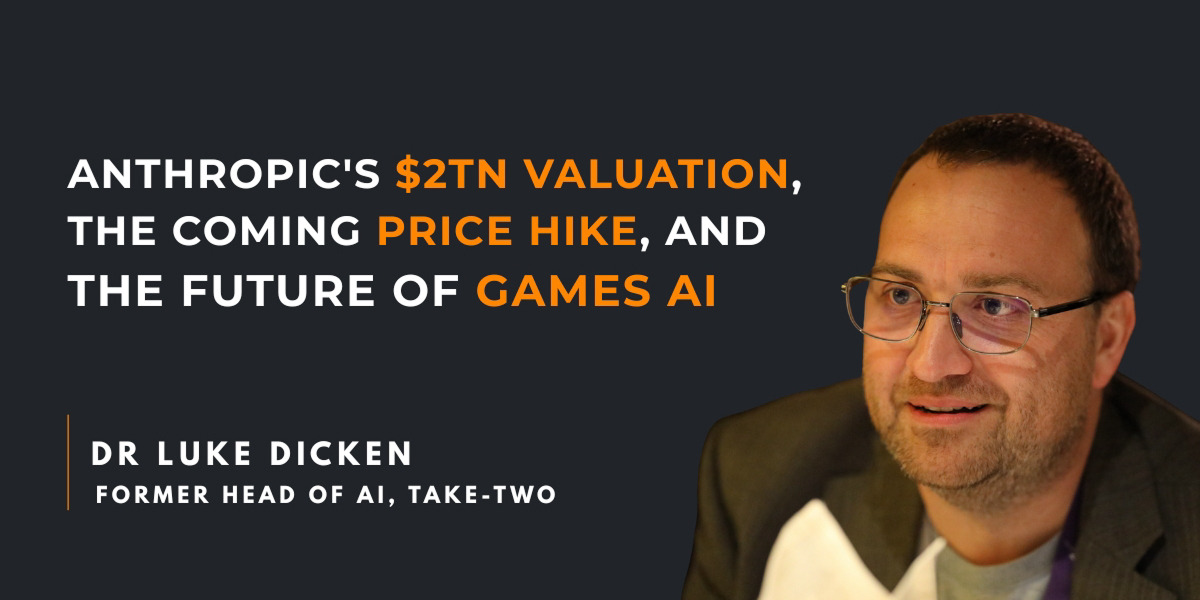
- The AI spending boom is "one of the largest misallocations of capital", says Dicken.
- Cutting junior hiring makes for good earnings calls, but leaves the industry without its next generation of seniors.
- For studios not yet chasing AI productivity, the smart move may be to wait for the hype to settle down.
Dr Luke Dicken spent a decade at Zynga building its applied AI group, then served as head of AI at Take-Two Interactive from January 2025 until the team was cut in April this year. He now runs his own consultancy, LuDic AI and brings a deliberately unpopular message to PGC Nordics in a couple of weeks: be pragmatic.

From unserious to unavoidable
Dicken's PhD was officially titled Simulated Virtual Worlds, because his university wouldn't print "games" on a doctorate. While peers worked on robotics, warehouses and space, his group were "the silly, unserious people".
That fight, he says, was won some time ago. Five or six years ago, teams would reject algorithmic level generation because their game was "this special little snowflake. Now those same people are saying, we want AI in our game."
"I've dedicated my career to advocating for the use of AI in games," he says, and now I'm like, not like this, not like this!"
"There is no business math."
Dicken describes himself as a cynic, less about the technology than "the big tech capitalism of it". He points to Anthropic, whose investors expect it to float at $2 trillion or more this month, and says the numbers don't add up.
“We are seeing one of the largest misallocations of capital through the system that assures us it's the most efficient way of allocating capital.”
"There is no business math that allows you to get to that number," he says. "We are seeing one of the largest misallocations of capital through the system that assures us it's the most efficient way of allocating capital."
The bigger cost for games is attention. "All of the oxygen is being sucked out of the room by billion-dollar press departments, more so than by actual innovation."
Where it earns its keep
He isn't anti-AI, just anti-hype. To explain where generative AI fits, he uses food: there's room in the industry for Michelin-star restaurants and for McDonald's and most businesses need a mix of both.
Performance marketing is one good fit, partly because "a lot of that already was kind of human-authored slop". Prototyping is another, as long as nobody forgets the rule: "Don't ever ship it."

Production code worries him more. "I think there is a potential state where we're going to find that we're shoving a lot of asbestos into the walls here. And then we're going to be like, that was a terrible idea, we need to rip it all out."
What's missing, he argues, is a wider view of AI. Classification and reasoning systems already exist. LLMs work best as filler between structured systems, handling the moments "players do that we haven't fully thought about", rather than as "the core and heart and soul of the system".
The bill is coming
Dicken's two biggest fears are headcount and pipelines. On headcount, he borrows a line from Cory Doctorow: AI isn't good enough to do your job, but it is good enough to convince your boss it can.
Junior roles are being hit hardest, and he thinks the industry is forgetting why it hired juniors in the first place. "You hire juniors because you want seniors." After 40 to 50 years, games is facing its first major retirement wave, and it is "choosing to invest less in the next generation. That seems unwise."
“We're building this and it's sending stuff off to Claude, but what happens when Claude starts ratcheting its prices up?”
On pipelines, he cites the Uber way: cheap prices to build the habit, then prices go up. "We're building this and it's sending stuff off to Claude," one studio told him, "but what happens when Claude starts ratcheting its prices up?" His own guess, which he admits is an edgy one, is something like a 20x increase once the subsidies end.
He also questions the infrastructure race. North America has roughly 16 gigawatts of AI-specific compute, with around 310 gigawatts planned. "ChatGPT, Claude and all these guys came out of that 16 gigawatts," he says. "So why do we need so much more stuff built?"
The case for staying on the sidelines
His advice to cautious studios is the part that gets him "yelled at by the pro-AI people". He compares this moment to the industry's move into 3D. Within three to five years, he expects AI tooling to have settled into standards, much as Maya and Blender did.
"People that are chasing the productivity conversation are just running on a treadmill," he says. The bigger opportunity is new player experiences: what the technology lets studios do for players that they simply couldn't do before.
"If you stay on the sidelines right now, my view is stay on the sidelines."

Hear more from Dicken at PGC Nordics in Helsinki on October 20th and 21st in his session Surviving the AI Hype Cycle - A Pragmatist's View. Secure your spot.
Companies


People

Events
