Most gaming companies aren't building creator platforms - they're building ecosystems

- According to this study results Only 5 of 23 major gaming companies qualify as true creator platforms.
- 18 of 23 support creator-economy features, but most stop short of enabling the full creator journey.
- Hybrid ecosystems have emerged as the dominant industry model with the study suggesting gaming's future is ecosystem-first, not platform-first.
Roman Pinskyi is CMO at 51 Games.
Roblox paid creators $922 million in 2024. Fortnite paid another $352 million. Numbers like these have fueled one of gaming's biggest assumptions: the future belongs to creator platforms.
If creator-driven ecosystems are growing this fast, shouldn't the rest of the industry be moving in the same direction?
To find out, the 51 Games research team analysed 23 major gaming companies, evaluating their creator tools, monetisation systems, marketplaces, modding support, and creator programs.
The results challenge the industry's dominant narrative. While creator-economy features are spreading across gaming, only 5 of the 23 companies we studied operate as true creator platforms.
Most are building something different: ecosystems that combine professional game development with creator participation.
23 Companies, one question: Is gaming actually becoming platform-first?
Roblox and Fortnite have become two of the most influential success stories in gaming. As a result, creator platforms are often presented as the industry's next evolution.
Roblox and Fortnite have become two of the most influential success stories in gaming.
The assumption is straightforward: if creator-driven ecosystems generate hundreds of millions of dollars for creators and attract millions of players, other gaming companies will eventually follow suit. But assumptions are not trends.
We wanted to understand whether major gaming companies were actually rebuilding their businesses around user-generated content or whether the success of creator platforms was creating a perception that did not reflect what the broader industry was doing.
Only 5 of 23 companies qualify as true creator platforms
We classified companies into three categories: creator platforms, hybrid ecosystems, and traditional studios, based on how they support content creation, distribution, and monetisation.
We evaluated every company using the same seven criteria: creator tools, user-generated content support, publishing and distribution, creator monetisation, marketplaces, creator programs, and official modding support.
Companies qualified as creator platforms only if creators can create, publish, distribute, and monetise content within the same ecosystem.
Companies qualified as creator platforms only if creators can create, publish, distribute, and monetise content within the same ecosystem.
This definition is functional rather than business-wide. A company can run a creator platform inside a larger business, as Microsoft does with the Minecraft Marketplace, or provide one as dedicated infrastructure, as Core and Overwolf do.
What matters is whether the full create-publish-distribute-monetise loop exists in one place, not whether user-generated content is the company's only line of business.
The distribution revealed a clear pattern.
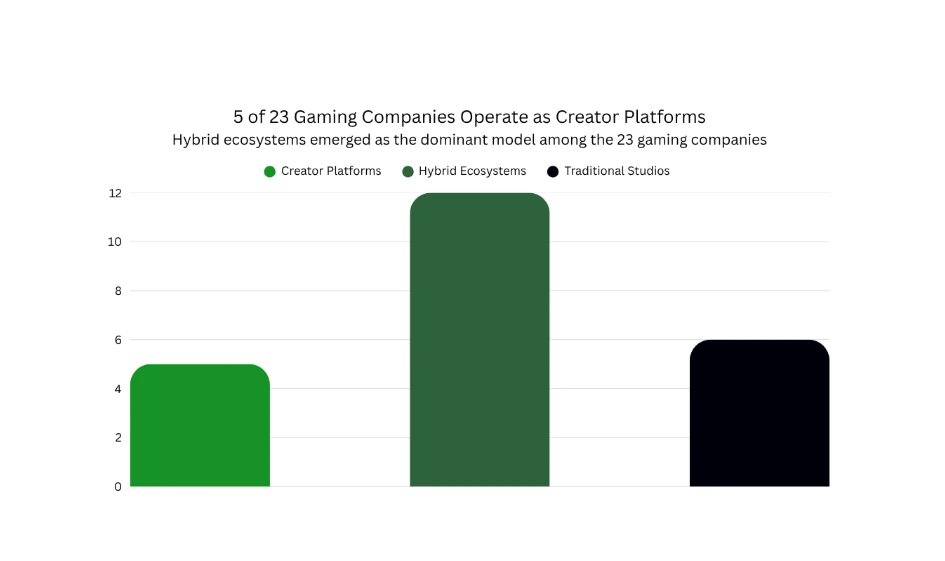
A creator platform lets users create, publish, distribute, and monetise content within the same ecosystem. Hybrid ecosystems combine studio-developed games with selected creator features, while traditional studios rely mainly on professionally developed content.
Hybrid ecosystems emerged as the dominant model, accounting for more than half of all companies analysed. Rather than fully embracing user-generated content as the foundation of their business, these companies are selectively integrating creator-economy features while continuing to invest in professionally developed games.
70% of gaming companies support creator tools, yet only 22% operate as creator platforms
The creator economy is spreading across gaming much faster than the creator-platform
model. Our research found that 18 of 23 gaming companies support at least one creator-economy feature, while only five operate as true creator platforms.
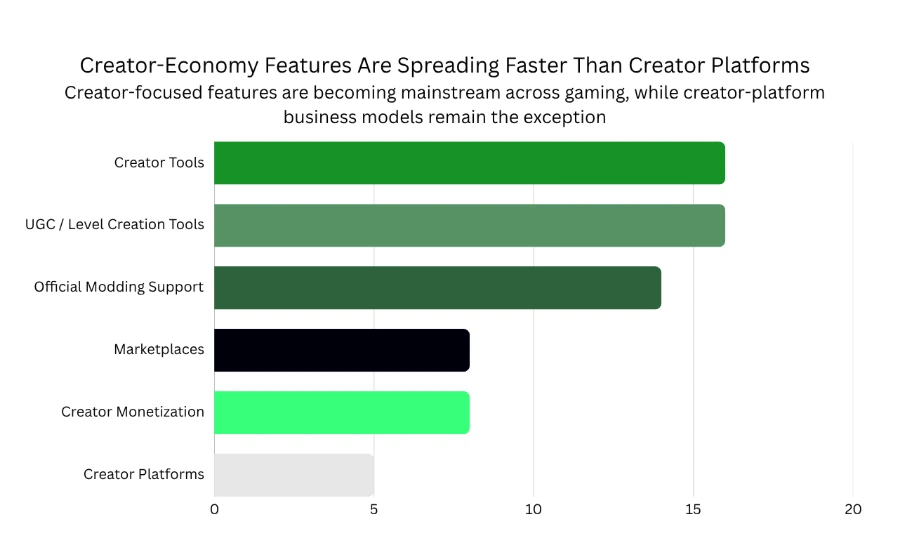
Creator-focused features appeared across much of the industry. Creator tools and user-generated content systems were present in 16 of the 23 companies analysed, while official modding support appeared in 14.
Creator features don't automatically create creator platforms
Our analysis revealed a clear distinction between creator features and creator-platform business models.
Many companies support creator tools, modding, or user-generated content, but that alone wasn't enough to qualify as a creator platform.
Under our methodology, companies had to support the full creator journey, from creating content to publishing, distributing, and monetising it within the same ecosystem.
That's why 18 companies supported creator-economy features, while only five met the criteria for a true creator platform.
Which companies made the cut
Five companies met every part of the standard. Roblox and Fortnite are the obvious two: Roblox paid creators roughly $922 million through its Developer Exchange in 2024 and hosts more than 14 million user-made experiences, while Epic paid Fortnite creators $352 million the same year across a community that grew to 70,000 creators.
Both let users build, publish, distribute, and earn inside a single ecosystem.
The other three are less obvious but clear the same bar. Manticore's Core, built on Unreal Engine, lets users create and publish multiplayer games directly on the platform and shares 50% of in-game revenue with them.
Minecraft's Marketplace pays partner creators more than half of each sale and has distributed over $500 million to them since 2017.
Minecraft's Marketplace pays partner creators more than half of each sale and has distributed over $500 million to them since 2017.
Overwolf's CurseForge, which operates as modding infrastructure rather than a single game, paid creators $300 million in 2025 and more than $800 million in total across 178,000 creators.
Most of the field looks different. Companies like Valve, Electronic Arts, and Rockstar add creator features onto studio-built games without handing over the full economic loop.
EA's partnership with CurseForge gave The Sims 4 an official modding hub, where community creators produced 39,000 clothing items against EA's own 5,000, but EA runs no direct creator-payment program of its own. These are the hybrid ecosystems that make up the bulk of the industry.
Others sit outside the creator economy entirely and remain among the most commercially successful in gaming. FromSoftware's Elden Ring sold more than 21 million copies with no creator tools at all, and Riot's League of Legends draws roughly 150 million players through a fully closed model. Creator platforms are spreading, but they are not a precondition for success.
The platforms that look like creator platforms, but aren't
The most instructive cases were the ones we expected to qualify and didn't. Several of gaming's best-known user-generated-content ecosystems fall short on the same point: monetisation.
Steam Workshop is the clearest example. Valve hosts more than 50 million user-uploaded items across over 3,000 games, one of the largest UGC ecosystems anywhere, yet it offers no systematic way for most creators to earn from their work.
Outside a handful of games with item revenue-sharing, Workshop content is free, which places Valve in the hybrid category rather than among true platforms.

Sony and Nintendo tell a similar story from the console side. Sony's LittleBigPlanet and Dreams generated millions of user creations, and Nintendo's Super Mario Maker produced 7.2 million courses in its first year alone, all with no creator monetisation whatsoever. These are powerful creation tools, but not creator economies.
Meta's Horizon Worlds is the most cautionary case. Positioned explicitly as a creator platform and backed by Reality Labs spending of more than $13 billion in 2022 alone, it never reached the engagement to match. Leaked internal data indicated that only 9% of creator-built worlds were ever visited by 50 or more people.
Building the tools, it turns out, is not the same as building the economy around them.
What the data revealed beyond the main findings
Three findings stood out against our initial expectations.
The first was how concentrated the model remains. Of roughly $9 billion invested in creator-driven gaming between 2020 and 2025, $6.7 billion, about three-quarters, went to just Roblox and Epic. Investor conviction in the platform model is real, but it sits almost entirely with the two proven incumbents rather than spread across the industry.
The second was that even the strongest platforms still run on studio-made content. In 2024, when creator-made experiences reached a record 36.5% of all Fortnite playtime, Epic's own content still accounted for the remaining 63.5%. And creator earnings are highly unequal: the top nine Fortnite creators captured 40% of payouts, while the top 100 captured 71%.
Every dollar of UGC revenue returned only about 30 cents to the platform after creator and store fees, against roughly 70 cents for first-party content.
The third was the clearest warning sign of all. Rec Room, a platform built entirely on user-generated content and valued at $3.5 billion in 2021, shut down in March 2026. Its CEO was unusually candid about why: every dollar of UGC revenue returned only about 30 cents to the platform after creator and store fees, against roughly 70 cents for first-party content.
As engagement shifted toward creator content, the economics worked against the platform itself. It is the most complete illustration we found of why so few companies have committed fully to the model.
The industry is building ecosystems, not platforms
The dominant industry narrative suggests that creator platforms represent the future of gaming. Our data does not support that conclusion.
What is spreading across the industry is not the creator-platform model itself, but the individual features behind it. Creator tools, modding support, marketplaces, and creator programs are becoming increasingly common, while fully creator-driven business models remain the exception.
The companies shaping gaming's future are not becoming the next Roblox. They are selectively adopting the features that made Roblox successful.
The future of gaming is not platform-first. It is ecosystem-first.
Companies

People