OEM advertising for every model: Understanding mobile game user acquisition
- OEM advertising runs on three pillars: Dynamic Preloads, on-device display advertising and alternative app stores.
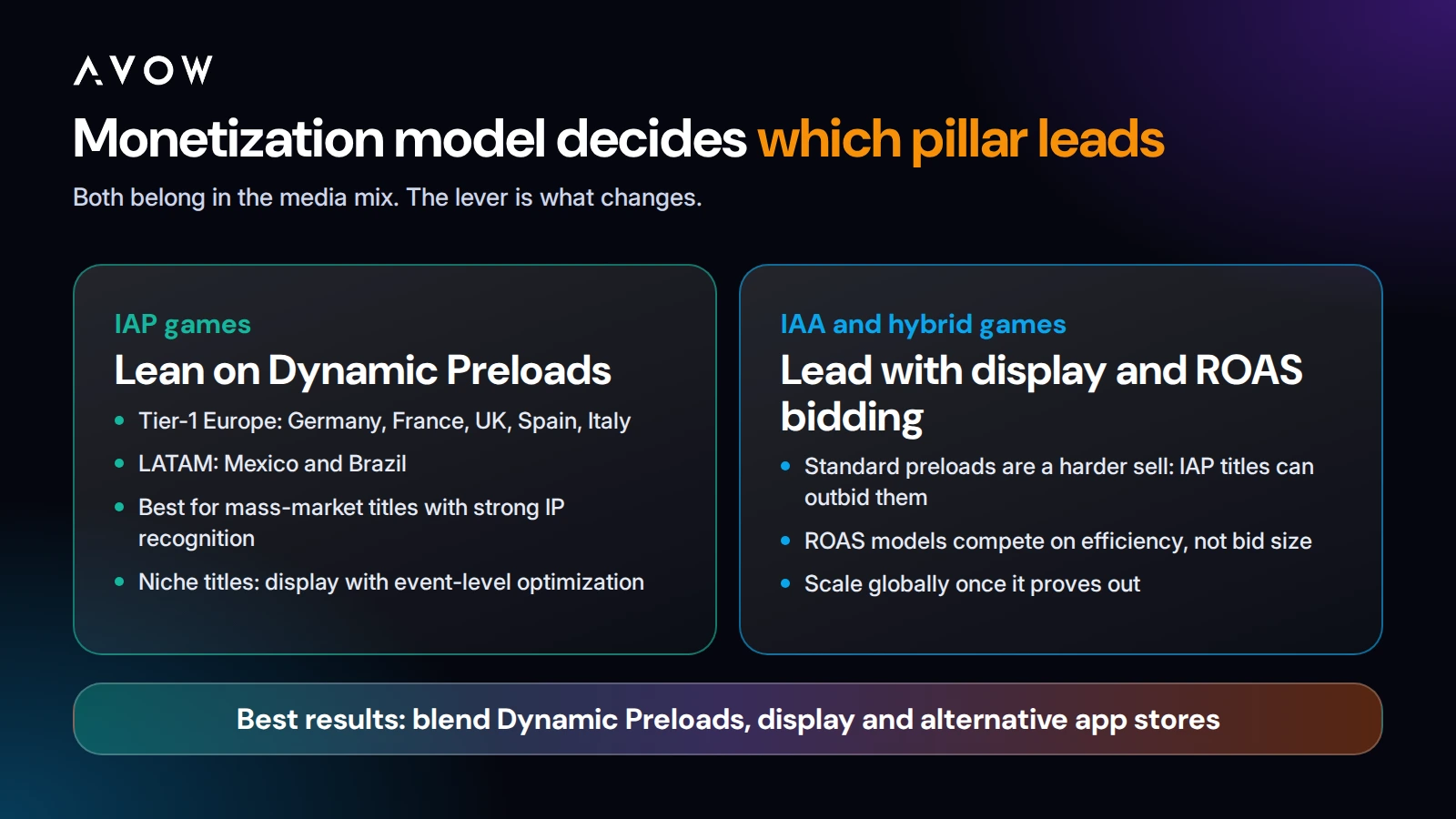
- IAP games get the strongest lift from Dynamic Preloads in Tier-1 European markets, plus strong LATAM performance in Mexico and Brazil.
- IAA and hybrid games face tougher competition for standard preloads, so OEM display advertising with ROAS-based bidding carries more weight.
- For best results, blend Dynamic Preloads with display advertising and alternative app stores.
Robert Wildner, CEO and co-founder of AVOW, busts some myths around the assumptions that many mobile developers make about the value of OEM advertising across multiple game types.
Picture this. A UA manager tests a new channel, sees strong numbers on one title, and assumes it only works for that monetisation type. That assumption costs studios reach every year. Mobile game user acquisition through OEM advertising does not favour one business model over another. It performs across in-app purchase (IAP), in-app advertising (IAA) and hybrid games, just through different levers.
Mobile original equipment manufacturers (OEMs) like Samsung, Xiaomi, vivo, HONOR, Transsion and Huawei sit on a trove of first-party device data and reach users before they ever open an app store. That inventory works whether a studio monetises through purchases, ads or both.
TL;DR
- Mobile OEM advertising runs on three pillars: Dynamic Preloads, on-device display advertising and alternative app stores.
- IAP games get the strongest lift from Dynamic Preloads in Tier-1 European markets plus strong LATAM performance in Mexico and Brazil.
- IAA and hybrid games face tougher competition for standard preloads, so OEM display advertising with ROAS-based bidding carries more weight.
- Funvent Studios hit 2.5m+ installs and 18% D7 ROAS combining Dynamic Preloads and display; Tripledot Studios beat EMEA targets by 20% with the same mix.
- For best results, blend Dynamic Preloads with display advertising and alternative app stores.
What is mobile OEM advertising for games?
OEM advertising places a game directly on the device, not just in a browser or social feed. It covers the first-boot moment on a new phone, the app store the phone ships with and the native display surfaces (app vault, launcher, browser homepage) users check daily.
This matters because a growing share of gamers never see traditional search or social ads. In several regions, AVOW’s mobile OEM inventory reaches the majority of the Android install base: 91% in Africa, 87% in Southeast Asia, 84% in India and 75% across the CIS countries. With worldwide smartphone shipments reaching 1.25 billion in 2025, hardware distribution still shapes how players discover new titles at that scale.
The OEM pillars gaming apps can use
Dynamic preloads
Dynamic preloads (Play Auto Install) put a game on the device during setup, before the user searches for anything. They require no SDK integration, run on a cost-per-install model (first open) and include opt-out functionality so every install represents an engaged user. It suits titles with broad appeal and strong IP recognition, since users see it as one of the first apps on a brand-new phone, recommended by an OEM and device they have already placed their trust in.
On-device display advertising and alternative app stores
Display placements live in the app vault, browser, app store and native launcher. AVOW targets users by existing app usage and on-device behaviour, then optimises toward in-app event conversion, retention rate and ROAS. This pillar depends less on brand recognition and more on precise targeting, which is why it carries the weight for harder-to-win categories.
However, display advertising and a listing in the OEM's own app store are not separate initiatives; they run together. For OEMs like Samsung, OPPO, Huawei and vivo, listing the app in their respective store (Galaxy Store, App Market, AppGallery, etc.) is required for display campaigns to run at all. Xiaomi works a little differently, though.
Display ads can run for an app that's only on Google Play, with no GetApps listing required. Listing on GetApps is still recommended, since it unlocks additional placement options, but it isn't a prerequisite the way it is with the other OEMs.
“For a title fighting for shelf space on Google Play, that combination of display advertising, extra app store visibility and better economics adds up fast.”Robert Wildner
Alternative app stores like Samsung Galaxy Store, Xiaomi GetApps and Huawei AppGallery run their own featured slots, editor's picks and banners, independent of Google Play. That means a second discovery surface entirely, plus placements built specifically for games: pop-ups, Editor's Choice (Samsung's Essential Games Pick program features titles prominently on the main store page, for example), main banners and push notifications tied to in-game events.
These stores also let studios run keyword, genre and other app store optimisation (ASO) tactics on top of the placements, and negotiate billing terms outside the standard 30% platform tax. For a title fighting for shelf space on Google Play, that combination of display advertising, extra app store visibility and better economics adds up fast.
How results differ by monetisation model
IAP games
Tier-1 European markets such as Germany, France, the UK, Spain and Italy, perform exceptionally well with OEM preloads, alongside strong LATAM results in Mexico and Brazil. The common thread across these regions is buying power. IAP titles depend on users who convert into paying players and these markets have the purchasing capacity to support that.
Within those markets, fit still matters. Dynamic Preloads work best for mass-market titles with strong IP recognition, since users are more likely to keep an app on a new device when they already recognise it. Niche categories tend to underperform on preloads for the same reason, since an unfamiliar app is easy to opt out of. For those titles, display advertising with advanced targeting and event-level optimisation delivers better results.
IAA and hybrid games
Standard preloads are a harder sell for IAA and hybrid titles. High-margin IAP games can simply outbid them for the same preload inventory. The workaround is not to force the preload model; it is to shift toward OEM ROAS campaign models, which use performance-driven bidding so IAA and hybrid titles compete on efficiency rather than raw bid size. These models scale globally, which matters for studios pushing into new markets rather than defending existing ones.
The proof is in the numbers
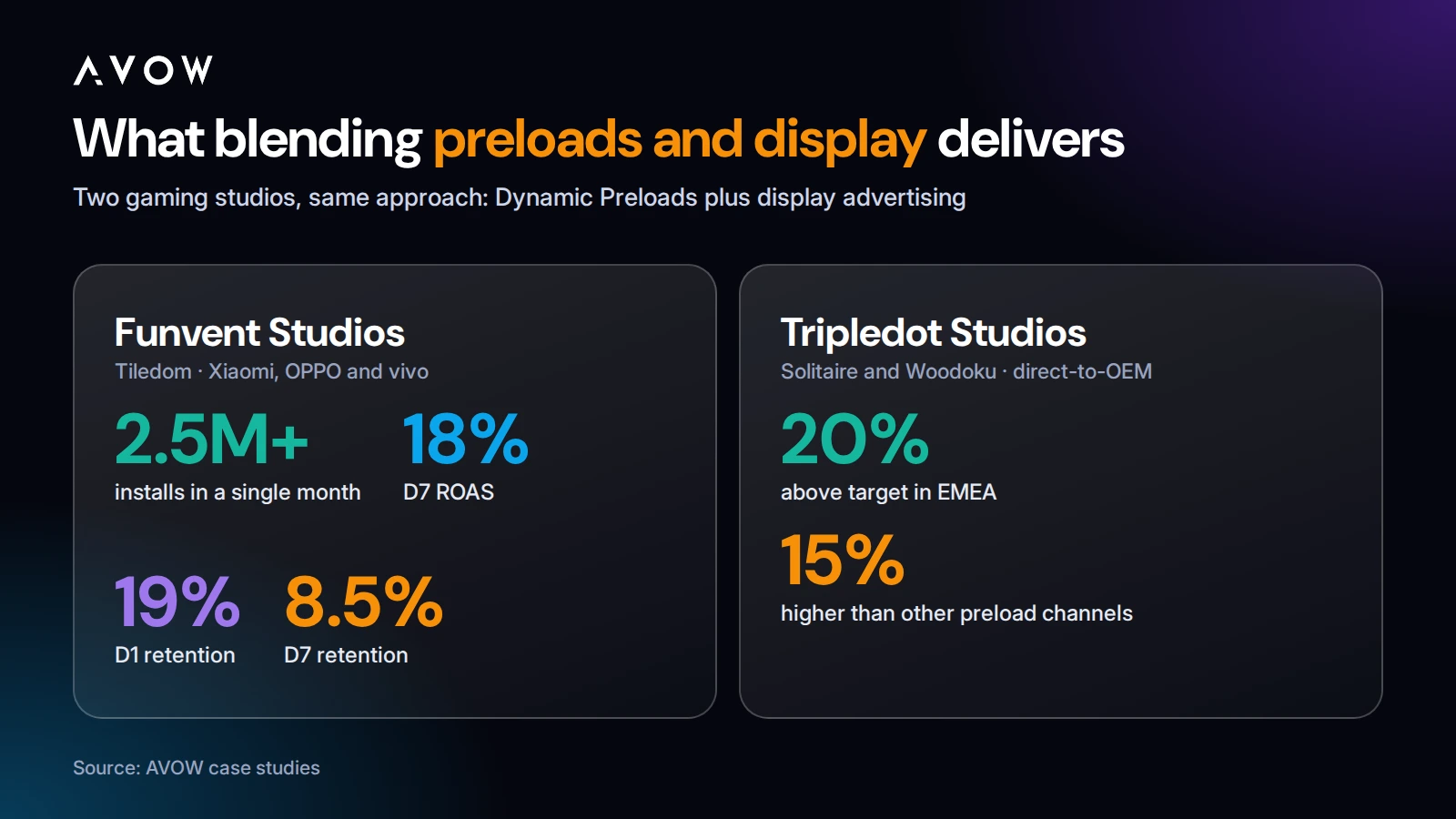
Funvent Studios, the team behind the tile-matching puzzle game Tiledom, combined display placements with Dynamic Preload inventory and event-based optimisation across Xiaomi, OPPO and vivo devices. The campaign delivered over 2.5 million installs in a single month, an 18% D7 ROAS, 19% D1 retention and 8.5% D7 retention.
Tripledot Studios, known for Solitaire and Woodoku, took a direct-to-OEM approach that blended display advertising with Dynamic Preloads through Google PAI. Results came in 20% above target in EMEA and 15% higher than other preload channels, with the clearest upside in EMEA specifically.
Axlebolt's UA Team Lead, Artem Tolstobrov, summed up the broader pattern: through AVOW's approach, the studio's gaming apps reached new audiences and grew inside alternative app stores.
Finding success with OEM advertising
No single approach fits every game. But several trends and best practices can guide advertisers based on patterns and what has worked for those who have already found success with mobile OEM advertising.
“The campaign delivered over 2.5 million installs in a single month, an 18% D7 ROAS, 19% D1 retention and 8.5% D7 retention.”Robert Wildner
Funvent Studios and Tripledot Studios both blended Dynamic Preloads with display advertising rather than picking one. That combination, preloads for the initial install and display for ongoing targeting and optimisation, is why both campaigns beat their targets. Where budget allows, running both pillars together tends to outperform relying on either alone. And this is true regardless of monetisation model or IP recognition.
The bottom line
Monetisation model changes which OEM pillar deserves more of the budget, not whether OEM advertising belongs in the media mix. IAP titles should lean on Dynamic Preloads in Tier-1 Europe and top LATAM markets. IAA and hybrid titles should push toward display advertising with ROAS-based bidding and scale it globally once it proves out. Or better yet, combine these pillars into a multi-pronged strategy that serves both short- and long-term goals.
Ready to see which OEM pillar fits your game's monetisation model? Book a demo with AVOW.
Companies

People
