Asia and MENA video game revenue set to surpass $100bn by 2030

| Date | Type | Companies Involved | Key Datapoint |
|---|---|---|---|
| Jun 3, 2026 | report | Niko Partners | $100 billion by 2030 |
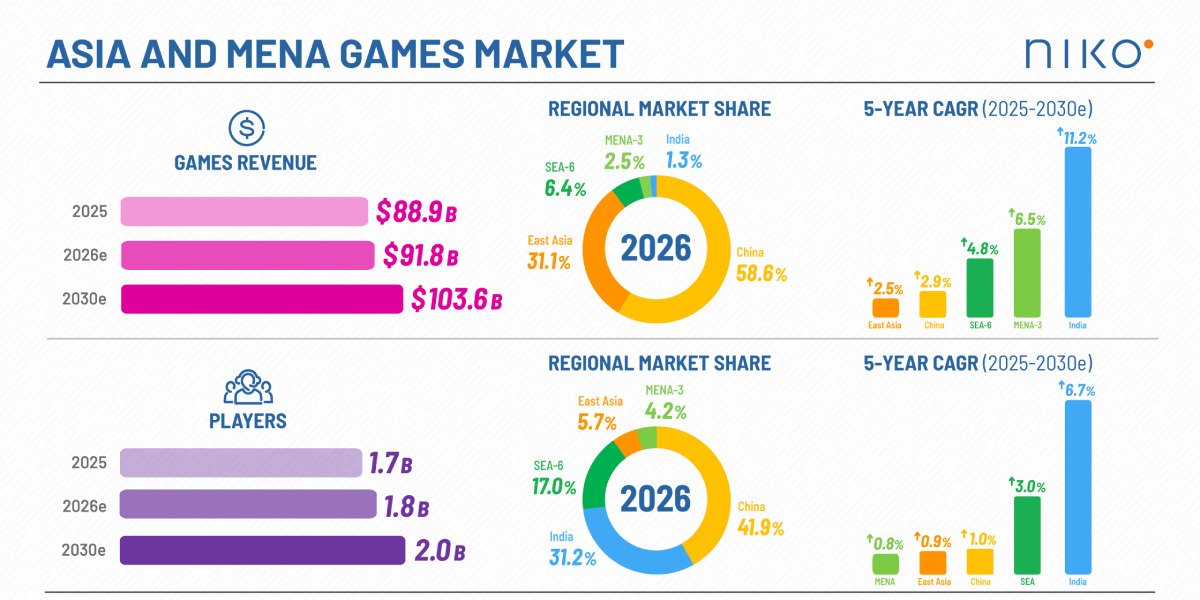
- Asia and MENA generated $88.9bn in video game revenue in 2025, up almost 3% year-on-year.
- The combined market is forecast to reach $103.6bn by 2030 at a five-year CAGR of 3%.
- India is the fastest-growing market tracked, with an 11% five-year CAGR and over 500m players.
- India's mobile player spending is projected to cross $1bn in 2027.
The Asia and MENA video games market is on course to cross the $100 billion mark within five years.
That's according to a new Market Model report from Niko Partners, and driven by expanding player bases and multi-dimensional growth across emerging markets.
The two regions generated $88.9bn in revenue in 2025, up almost 3% year-over-year. Niko projects growth of more than 3% in 2026 to $91.8bn, reaching $103.6bn in 2030 at a five-year CAGR of 3%.
Total players are forecast to reach just shy of 2bn by 2030, up from around 1.8bn in 2026.
India, MENA and Southeast Asia lead the charge
While China, Japan and Korea are projected to account for 89% of total revenue by 2030 at $91.7bn, the fastest growth sits elsewhere. India has crossed 500 million players and is set to become a nearly $2bn market by 2030, growing at an 11% CAGR.
MENA-3 (Saudi Arabia, UAE and Egypt) is projected to reach $3bn in player spending by 2030, ranking second in revenue growth behind India, with annual ARPU rising by $10 over the forecast period.
In Southeast Asia, Thailand is on track to hit the $2bn milestone in 2026. Indonesia is forecast to reach $1.5bn by 2030.
Vietnam is set to reach 68m players by 2030, while Indonesia is expected to reach 144m players over the same period.
Market expansion
Elsewhere, China's mini games now account for nearly 20% of mobile game spending. India's mobile player spending is projected to cross $1bn in 2027, with genre diversification beyond battle royale driving that growth.
Female players now account for 42% of the player base across Asia and MENA, up from around 40% the prior year. India and MENA-3 having skewed 80% male five years ago.
On generative AI, Niko Partners found that player sentiment in Asia is materially more positive than in Western markets, with studios increasingly reporting development efficiencies, though players remain more supportive of AI assisting workflows than replacing core art or marketing assets.
You can access the full report here.
Companies
