Strategic Alternatives’ Rhys Dekle: How to keep the value AI creates at your studio

- AI cuts production costs most in indie development and least in triple-A, where bigger scope eats up the savings.
- AI only adds value to a studio that already owns something rivals can’t copy, such as IP, community or data.
- Sellers have to prove a human made their work, or buyers will pay less at closing.
AI may make games cheaper to build, but that doesn’t make studios worth more, says Strategic Alternatives partner Rhys Dekle.
Speaking on the Global Trends track at PGC Summit Montréal, Dekle said his talk was “the money conversation, not the creative-AI debate.”
Dekle is a certified M&A advisor who works only in games. His sell-side deals include Spry Fox to Netflix, System Era to Devolver and PeopleFun to AppLovin. Before that, he spent 11 years in business development at Microsoft, where he helped set up ID@Xbox.
Are costs really falling?
Dekle said AI has come in two waves. First came generative tools that make single assets like art or dialogue. Now there are agentic tools that can handle whole jobs like QA. Square Enix, for example, wants AI doing 70% of its QA and debugging by the end of 2027.
Saving time on one job doesn’t do much to the overall budget, and someone still has to check everything AI makes, Dekle mentions. In triple-A, any time saved usually just goes into making the game bigger. Dekle thinks some studios are calling layoffs “AI efficiency” when they’re really just cutting costs after the boom.
His take was that the savings are real for indie devs, mixed in mobile and “mostly a mirage” in triple-A.
“The saving is realest exactly where there’s least to buy, and thinnest where the money is,” he said.
Value created is not value captured
Dekle compared AI to a new oven that lets every bakery bake twice as fast. Bread gets cheaper for everyone, but no bakery gets richer unless it owns something the others don’t.
“AI relocates value. It doesn’t create it,” he said. “It moves value away from anything that can be prompted, toward anything that can’t.”
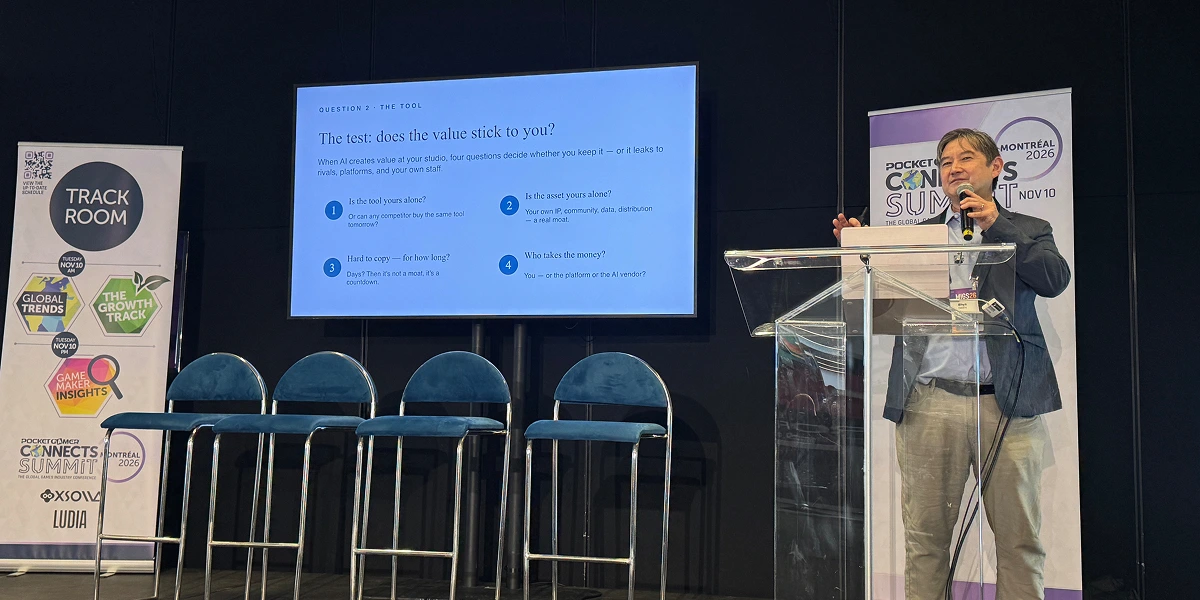
He gave studios four questions to ask. Is the tool yours alone, or can a rival buy it tomorrow? Does it sit on something only you own, like IP, community or data? How long would it take to copy? And who actually takes the money: you, the platform, or the AI vendor?
How that plays out depends on the studio. A co-dev shop with no IP of its own loses out, since AI now does cheaply the work it used to charge for. A studio with a big franchise comes out ahead. And if your best pipeline only exists in three people’s heads, Dekle said that’s “not an asset, a risk.”
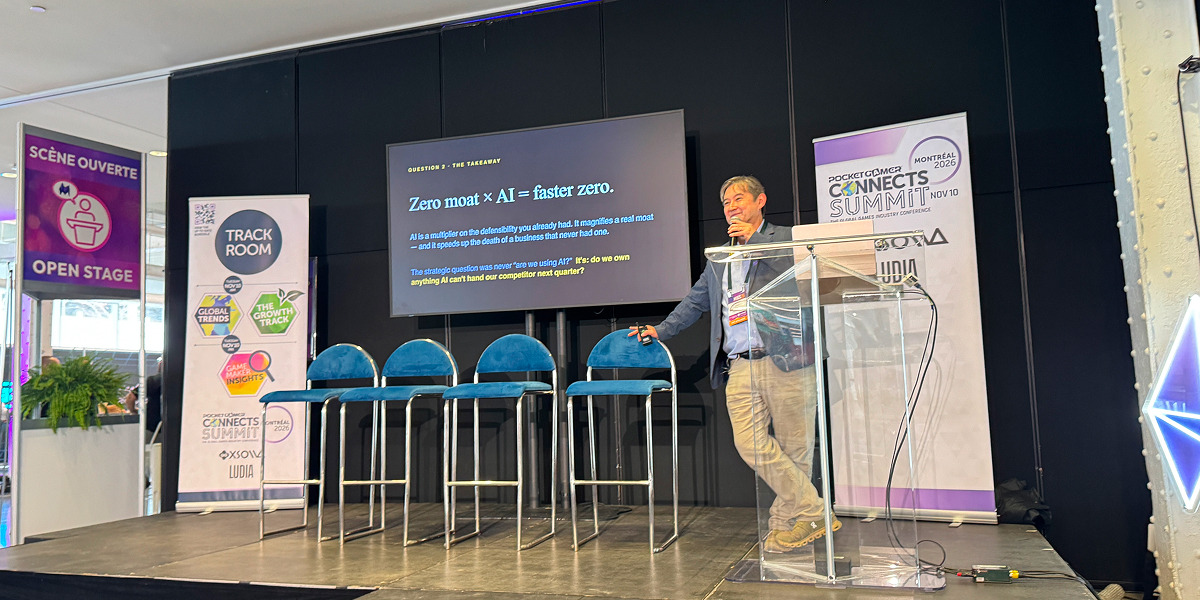
Or as he put it: “Zero moat times AI equals faster zero.”
What buyers check
This is where it gets tricky for anyone looking to sell. Dekle pointed out that content made purely by AI can’t be copyrighted in the US or Europe, which basically means anyone can copy it. And if you can’t say for sure that you own your content, or that it doesn’t infringe on someone else’s, buyers will want to hold more money back, so you walk away with less when the deal closes.
According to Dekle, it’s on the seller to prove a human actually made the work. That means things like source history, layered working files and some kind of asset register that tracks what was made by a person, what had AI help and what was fully AI-generated.
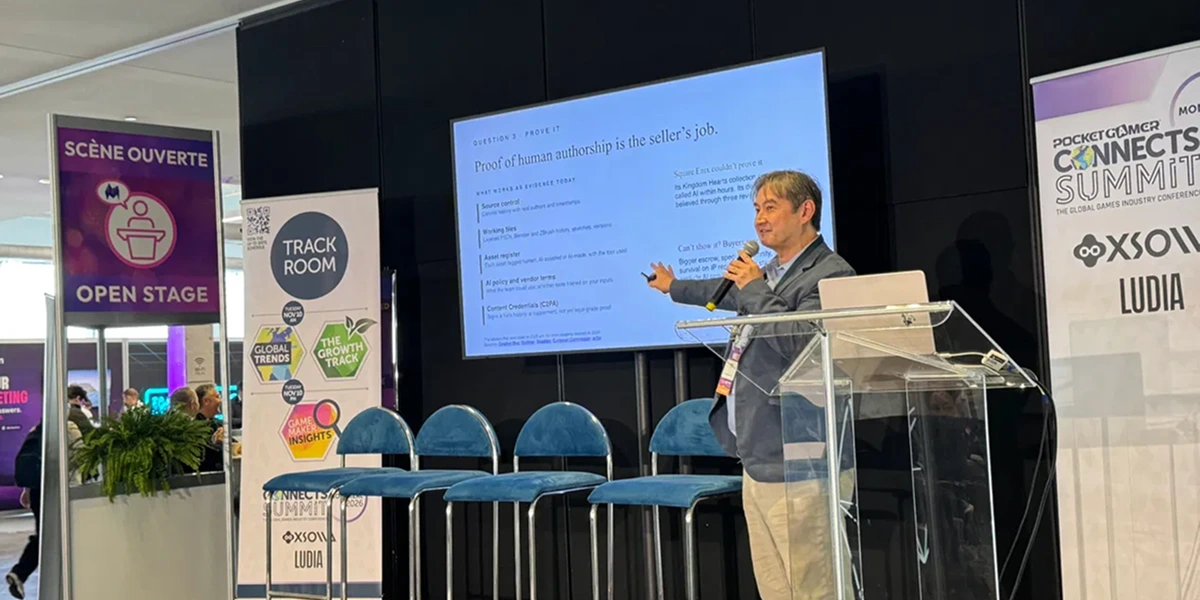
He also cited the backlash over Square Enix’s Kingdom Hearts collection cover. Fans called it AI-made within hours, and the company’s denials weren’t believed through three revised covers. If one of the world’s biggest publishers can’t prove its art is human-made, smaller studios face a harder task in front of a buyer’s lawyers.
“The studios that look clean in 2028 are the ones keeping records in 2026,” he said.
Not using AI isn’t always a discount
Dekle said avoiding AI hurts value only when a studio can’t adopt it. Studios that choose human craft can earn a premium as “AI slop” backlash grows. For studios that have value in their IP, it barely matters either way.
“A clean, all-human studio can be worth more,” he said. That means less to prove in diligence and nothing to insure around.
What to do on Monday
Dekle ended with three steps. Name your moat: the one thing AI can’t hand a competitor. Get your IP house in order by tracking what’s AI-made. And don’t expect AI alone to lift your price.
“Adoption is table stakes now, not an edge. It protects a moat; it doesn’t make one.”
His closing line summed up the talk: “You don’t get paid for the horsepower everyone can buy. You get paid for the track only you can run on.”
Companies

People

Events