The key numbers on China's booming Mini-Games market


| Date | Type | Companies Involved | Key Datapoint |
|---|---|---|---|
| Jul 7, 2026 | report | Tencent | $7.65bn |
- The overall Mini-Programs space attracted 1.021bn monthly active users in March 2026.
- China’s Mini-Games market generated approximately $7.65bn in revenue last year, up 34.39% Y/Y.
- In 2026, Mini-Games are forecast to rise to $9.72bn.
- IAPs accounted for 68.11% of revenue, while ads made up 31.89%.
This article was first published in the PocketGamer.biz newsletter. Subscribe for more content like this straight to your inbox here - you'll even get 10% discounts on PGC events.
You might have heard of Mini-Games - the instantly playable games available to play directly in an app without a download. In China, they are a fast-growing part of the games market.
Super app WeChat is the key driver. As of March 2026, WeChat welcomed 1.43 billion monthly active users - and a key chunk of that user base is located in China.
To get you the details on the key numbers and opportunities for WeChat Mini-Games, and the wider Mini-Games market, Meridian Play and Outfit7 parent company Jinke have compiled the China WeChat Mini-Games Industry Report 2026 - which we can share with you, PocketGamer.biz readers.
According to QuestMobile data, in March 2026, Mini-Programs attracted 1.021bn monthly active users, with WeChat Mini-Programs accounting for 973 million - a 5.8% increase year-over-year.
Massive market
While WeChat dominates the Mini-Games, it isn’t alone. Mini-Games platforms include Douyin, Kuaishou, Alipay, Meituan and Bilibili. WeChat Mini-Games recorded an industry-wide MAU of 571m, while Douyin stood at 171m (a penetration rate of 51.5% versus 18.4%).
Citing the China Games Industry Report, in 2025, China’s Mini-Games market generated approximately $7.65bn in revenue, up some 34.39% Y/Y. The space is forecasted to grow to around $9.72bn in 2026.
In-app purchases generated approximately 68.11% of total revenue. Ads, meanwhile, contributed around 31.89% of sales.
Those stats are interesting on two fronts: you might think that web games are powered more by ads than IAPs. Meanwhile, here we’re getting actual insights on ad revenue, something missing in the wider market.
Naturally, as the Mini-Games space gets larger, the ad spend is ramping up too. According to DataEye’s 2025 Mini-Game Advertising Data Report, there were 51,000 games running ads across different platforms to get downloads and sign-ups, a rise of 54% Y/Y.
This was said to outpace ‘traditional mobile games’, which had 22,000 ad-running titles, up 5.2% Y/Y. As the report notes, “it shows how incredibly competitive the Mini-Games space has become”.
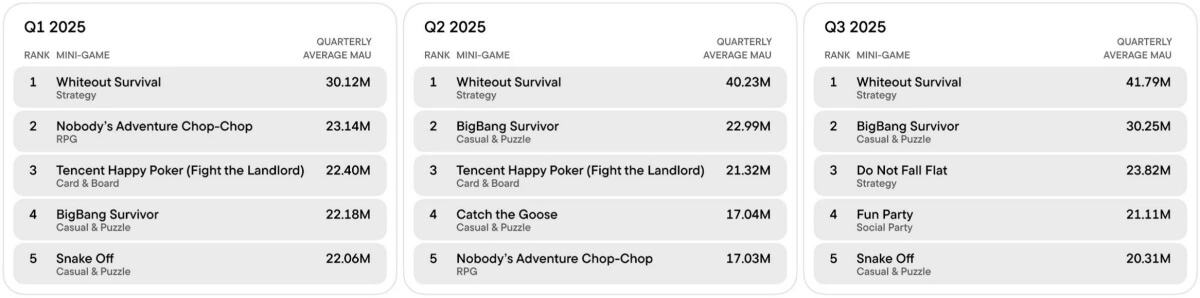
As for the top games, MoonFox Data shows quarterly average MAUs between Q1 and Q3, 2025. In Q3, Whiteout Survival had attracted 41.79m MAUs on average during the quarter. It was followed by BigBang Survivor at 30.25m, Do Not Fall Flat at 23.82m, Fun Party with 21.11m and Snake Off at 20.31m. Whiteout Survival - also a hit on global mobile app stores - ranked top for average quarterly MAUs between Q1 and Q3, growing 38.7% during the period.
The report also delved into WeChat Mini-Games business terms. It notes that revenue share depends on the game type, with a 50/50 split between publishers and the platform for in-game ads. For IAPs, the publisher keeps 60% of revenue, while WeChat takes 40%.
It’s worth noting that WeChat has an annual incentive policy that gives back ad credits to publishers to spend within the Tencent ecosystem. For 2026, games earn a 5% bonus ($100k) for every $2 million in gross revenue generated within any 30-day window.
The full report dives into more data on audience type, gameplay sessions and top games. You can download the PDF here.
Be sure to also check out this article on WeChat Mini-Games from SocialPeta CMO and head of overseas business Summer Liu, which analyses the market and dives into revenue figures for the top games. For example, Seek Dao Qian Da Qian (Nobody’s Adventure: Chop-Chop) peaked at monthly revenue of around ¥700m and over 35m MAUs. After going overseas, it started making over $10m in daily revenue globally.
We also had Hyperjoy CEO Lemon Choi - one of the most prominent experts on the Mini-Games space - on the PocketGamer.biz Podcast just a few months ago.
If that’s not enough - you can learn more about the market and China’s games industry at Pocket Gamer Connects Summit Shanghai on July 29th.
Companies

Events
