How Railroad Empire built a live game around a niche audience

- Railroad Empire’s corporation wars increased DAU by around 10% and revenue by 10–18% during events.
- The game’s fourth map increased daily revenue by around 35%.
- Railroad Empire reached a new monthly revenue record of more than $600,000 this year.
Tatiana Vinogradova is a producer at Azur Games.
Shortly after its release several years ago, the midcore strategy game Railroad Empire showed solid metrics: R1 was around 40%, R30 was close to 2%, and the game quickly formed a very loyal Tier 1 audience. This was largely driven by the high level of authenticity, realistic locomotives based on real blueprints, historical accuracy, nostalgia for classic tycoons and the overall visual quality of the game.
Later, we pushed the visuals even further toward realism and released the second map, which increased R30 by more than three times. After that, each new map continued to give a strong boost to monetisation and retention metrics. As a result, the game has been generating stable revenue of around $500,000 per month for quite some time.
Last year, we focused heavily on reworking core mechanics, and most of that work is now complete. One of the biggest new features is connected to clan wars - but in a different interpretation.
How clans became corporations and made players start spying on each other
In Railroad Empire, clans are called corporations, and the clan war event is called Expansions. But the difference goes much deeper than naming.
The mechanic itself is largely based on what players were asking for. They were very interested in the real-world competition between historical railroad companies: the fight for cities, routes, and trade dominance during the heyday of North American railroads, a very specific period in history. We turned that fantasy into game mechanics, and now it has become one of the pillars of the project’s economy.
This is something we try to do quite often: look at how things actually worked and then find a simple way to turn that into gameplay. Railroad companies really did compete for routes, cities and access to markets. Obviously, we don’t want to simulate all of that in detail, but the real-world logic gives players something they can understand immediately. You are a railroad company, there is valuable territory, and other companies want it too.
This is something we try to do quite often: look at how things actually worked and then find a simple way to turn that into gameplay.
Technically, it works like this. There is a map of America with cities scattered across it. Each player belongs to a corporation. Together with other players, they need to deliver a certain amount of resources to build a railroad to a city. Once the railroad is completed, both the route and the city become yours. The corporation that captures the most routes by the end of the event receives the biggest rewards. At the same time, corporations can also recapture routes from each other.
To be honest, we didn’t expect the audience to respond to this mode so warmly. We thought it would be a smaller feature - something to keep players entertained between major content releases. Instead, players really embraced it.
Now they create complex strategies, up to and including infiltrating other clans, spying on each other, and negotiating how to divide trade dominance. Clan recruitment also became much stricter.
Capture mechanics are common in midcore games, of course, but we built an original version around our own systems and setting.
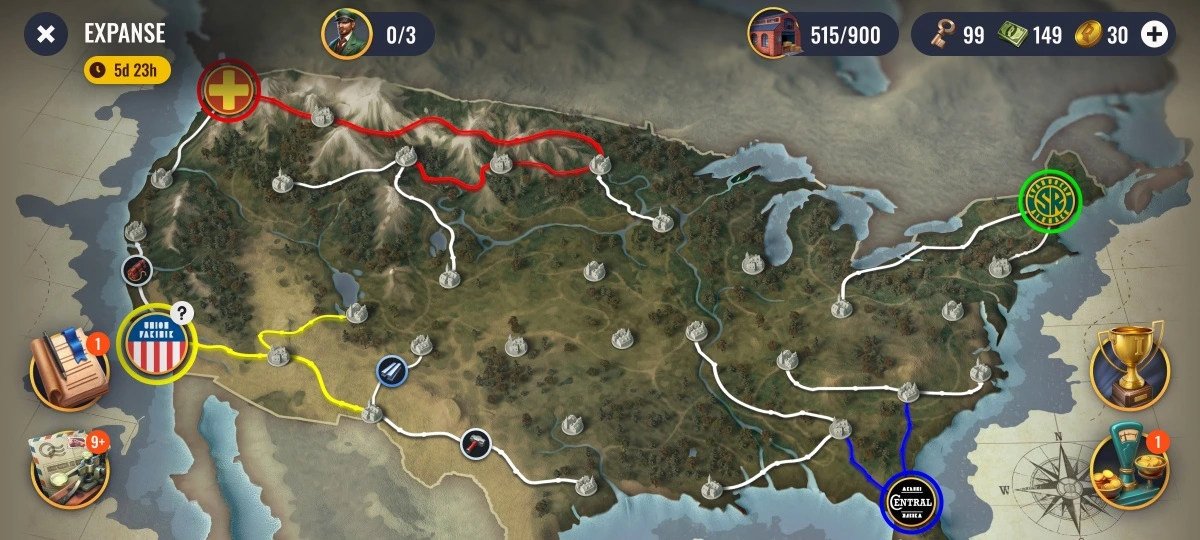
That is generally how we work with references as well. We can spot some particular ideas, but copying the whole mechanics rarely makes sense. Instead, we deconstruct them, understand what makes it interesting, and then rebuild that part so it fits Railroad Empire. For example, territorial competition was a useful idea, but it only really worked once we connected it to railroad companies and the historical setting.
Right now, expansions run once every two weeks, but we're still looking for the optimal schedule and duration. There is currently no separate shop or dedicated offers specifically for this event. The competitive mechanic itself pushes players toward progression.
Players started playing longer, and DAU grew by about 10%, and revenue increased by 10–18% during the event.
There is a place where players can exchange goods from the main game for goods required for capture, deliveries can be accelerated, and train upgrades naturally help deliver more goods. All of this gives players an advantage in corporation wars and indirectly affects monetisation.
The new corporation expansion mechanic has had a positive impact on retention. Players started playing longer, and DAU grew by about 10%, and revenue increased by 10–18% during the event.
There probably isn't another mechanic quite like ours. It is an original idea built partly on our own mechanics and partly on a very meticulous approach to realism, shaped by a specific audience.
Major content updates: Maps and the Union Pacific collaboration
Last year, we released our fourth map, Santa Fe. It increased daily revenue by around 35%. This year, we released the fifth map and then shifted our focus toward events.
Our five maps represent five railroad company stories: one map, one company. We approach visual detail and realism so carefully that almost every rivet on a train looks close to its real-life prototype.
But we don't really think of new maps or events as just "more content". Each map tells the story of a different company, region and set of challenges. That seems to be one of the reasons why the audience likes our new maps: players are not simply moving on to another level, they are reliving the next chapter of railroad history.
Our artists can practically give lectures on how mines and factories are built, down to the structure of the buildings. We even signed a license agreement with Union Pacific so that trains, stations, and buildings could look as close as possible to the real ones. Similar agreements with other major companies are currently in approval, and this will be especially important for events.
This year, we plan to launch these events once every two months, and by next year, we want to move to a monthly cadence.
An event is a separate small map available for a limited time. It tells a smaller story connected to America or another part of the world - usually focused on human achievements in engineering, construction, infrastructure, and similar themes.
We don't want to add a temporary activity just because a live game is expected to have one. It still has to give our players something meaningful. What we want is for them to feel like they are part of humanity's greatest engineering achievements, participants in major historical events.
That is why engineering projects, infrastructure and historical milestones are much more interesting to us than simply putting Christmas decorations on the same mechanics for a few weeks.
This year, we plan to launch these events once every two months, and by next year, we want to move to a monthly cadence.
We also plan to cover the taming of difficult regions and the construction of large-scale engineering infrastructure. For our target audience, which really values realism, these are genuinely interesting historical milestones. We've already taken this approach with the Kennedy Space Center and River Rouge Complex - one of the largest automobile plants of its time.
To make this possible, we had to significantly rework our workflow. Previously, creating a map took around eight months. Now the art team can produce several maps a year. And while AI can help speed up 2D concept creation, our game puts a strong emphasis on realism.
We research the history of each railroad company, key cities, and notable events in the region. So the workflow is getting faster not only because of tools, but also because the team has accumulated a large base of real-world knowledge.
I can see that our approach has become an inspiration for new projects. New train games released after ours are more often choosing a 20th-century American setting, putting more emphasis on historical accuracy, and trying to tell company stories. Reaching the same level of consistency and detail takes a long time, and this is one of the advantages of choosing a niche product with a specific audience from the very beginning.
Partial core gameplay rework, monetisation, and future growth
Content and social features were only part of our efforts. We also focused on developing the core gameplay mechanics. On one side, we wanted to create a clearer and simpler experience for players - more understandable, predictable, and less restrictive. On the other, we wanted the game to feel more like an extension of the railroad hobby, with more focus on locomotives, collecting, and long-term progression.
Previously, we had strict timers and one-hour orders. This naturally made sessions shorter. A player could spend five minutes in the game: collect resources, sort them into wagons, and send a train on a one-hour delivery.
Now we removed those one-hour deliveries, moved timers from orders to factories, and added mine limitations. This performed quite well: players started staying in the game longer, increasing average session length to more than 16 minutes.
The same principle applied to locomotive progression. Previously, players unlocked new locomotives from one type of chest, received upgrade materials from another, and collected some resources through timers. Duplicate locomotives, meanwhile, had to be dismantled into resources. As a result, the system had too many intermediate "currencies" and steps, with no single, clear progression path.
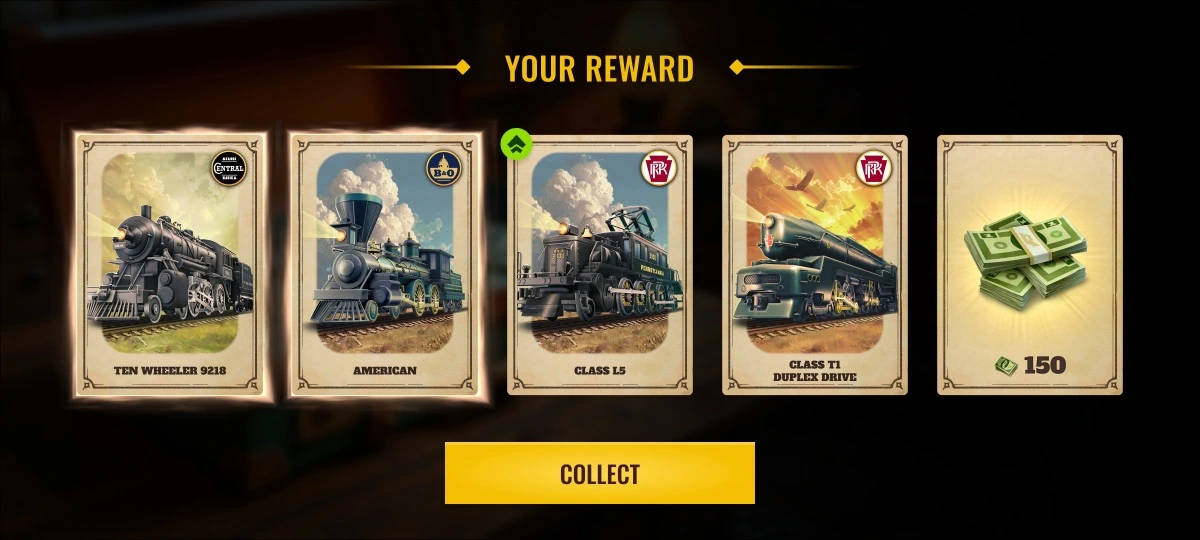
This year, we moved to a new card-based locomotive progression system. The first card unlocks a new locomotive, while every additional card for that locomotive is used to upgrade it. It’s a familiar, easy-to-understand mechanic that replaced the previous, more complicated system.
The game has been staying at around $500,000 in monthly revenue for a long time, and this year we set a new record by earning more than $600,000.
The new card system brings all locomotive progression into one place. Players now only need to obtain and open chests, which can contain both new locomotives and cards used to upgrade them. Progression has become much simpler, clearer, and more predictable.
But simplifying the core experience was only one side of the work. We also wanted to give players more reasons to engage with locomotives themselves and make the game feel more like an extension of the railroad hobby.
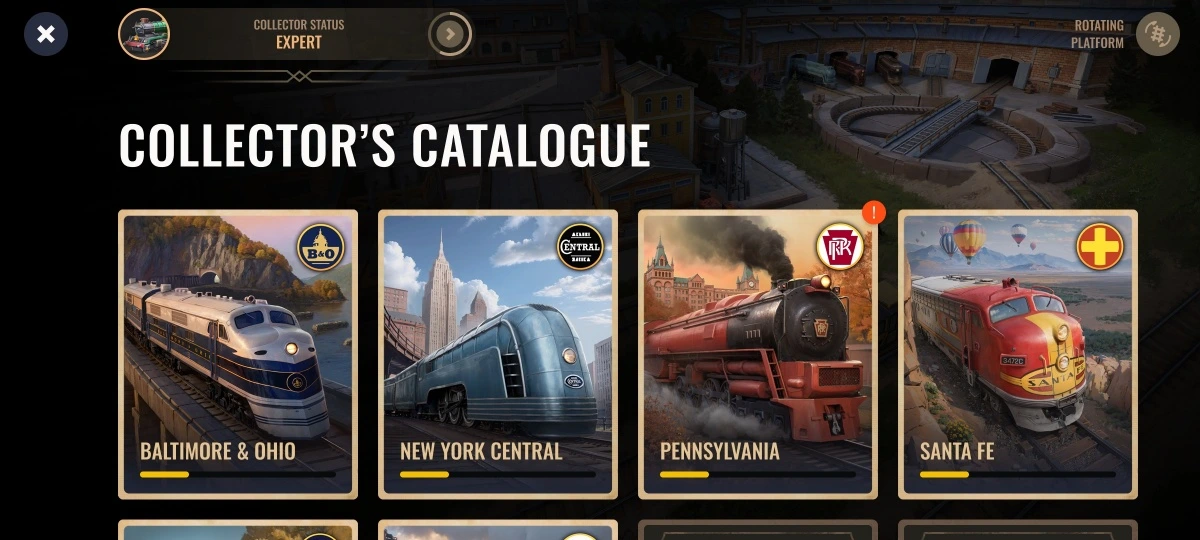
This year, we also introduced locomotive collections, as well as a separate limited-time event where players can obtain a unique locomotive that is unavailable outside of the event. Collections, special locomotives, and events provide additional depth and make the game feel more like an extension of the railroad hobby without making the basic experience harder than it needs to be.
Together, these changes improved both the core experience and the longer-term value we could offer players. As a result, the game has been staying at around $500,000 in monthly revenue for a long time, and this year we set a new record by earning more than $600,000. In the current market, that level of stable revenue is a strong result for a game.
Key takeaways
One of the main lessons from the last few years is that growing a live game doesn't necessarily mean constantly adding more things to it.
In our case, some of the best results came from being more selective: starting from what players expect when they come to Railroad Empire, removing things that got in the way of that, and making every new feature serve that same experience.
One of the main lessons from the last few years is that growing a live game doesn't necessarily mean constantly adding more things to it.
Corporations, historical maps, licensed trains, events and the new progression system may look like very different features, but they all push in the same direction. Every update should reinforce the same vision: building a railroad empire during America's Industrial Revolution.
Players come to us for the experience of being a pioneer of the railroad era, and our job is to give them exactly that. Growing a live game isn't about adding more. It's about making the game increasingly true to the experience players came for in the first place.
Companies

People
