In-game vs. web store: How to price and package for D2C without breaking your game economy

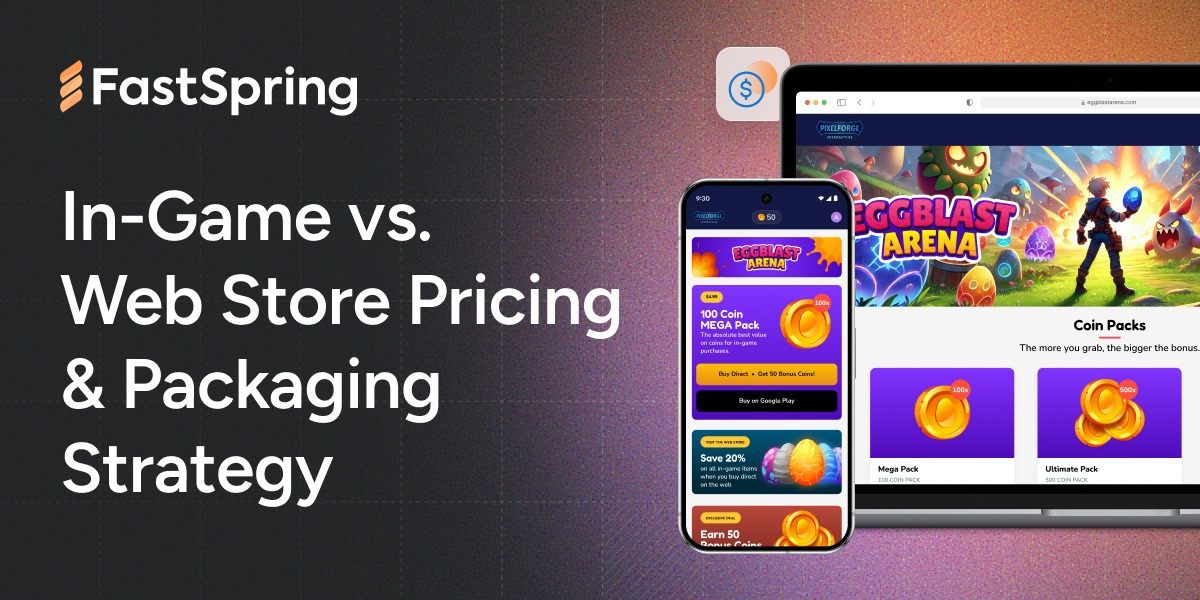
- Securing that first web store purchase is the hardest challenge in D2C monetisation.
- Additional entitlements consistently outperform price discounts.
- Direct checkout removes the steps that players don’t want to deal with, and conversion rates show it works.
- There’s no universal D2C pricing playbook, but there are proven principles to build from.
Only 2% to 3% of players will ever spend money in many mobile games and getting that first purchase is the hardest challenge in game monetisation. It gets even harder when you’re asking a player to step outside of the app to make it.
That tension sits at the heart of a direct-to-consumer (D2C) pricing strategy. Publishers who manage it well build thriving web stores. Those who don’t either leave money on the table or, worse, destabilize the in-game economies they’ve spent years crafting.
Start with economy management, not the price point
Most publishers start building their web store offer by asking what price to charge. But the better question is about what their economy can actually support.
A game’s economy runs on sources and sinks. Sources are anything the game gives to players: rewards, currency, loot. Sinks are anything that consumes those resources: hard levels, gear upgrades, consumables. Every pricing and packaging decision exists within that balance and it’s worth getting a clear picture of that balance before setting up any D2C offers.
Here’s why it matters: If half of a publisher’s revenue flows through a D2C channel offering 10% more per purchase, the overall economy is absorbing 5% more currency than it was before.
For games with elastic economies such as social casino games, that additional sourcing is manageable. For mid-core games with tighter mechanics, it demands more deliberate planning. The goal isn’t to avoid D2C incentives but to make sure the economy has enough sink capacity to keep pace with them.
More entitlements vs. lower prices: What the data says
The most common question publishers face when designing their web store offerings is whether to give players more for the same price or the same for less. An A/B test comparing both approaches found that additional entitlements consistently outperformed discounts across the metrics that matter: conversion from mobile to web store, total revenue, and new D2C customer creation. The discounts didn’t drive the proportional lift needed to justify the lost margin.
The psychology behind it makes sense. When a player sees that $10 buys 100 gems in the app but 110 gems on the web store, the value comparison is immediate. When the price drops from $10 to $9 for the same 100 gems, the math is harder and the perceived benefit is murkier, even if the actual value is the same.
“Most publishers start building their web store offer by asking what price to charge. But the better question is about what their economy can actually support.”Chip Thurston
There’s also a straightforward revenue consideration. Offering a discount means taking in less per transaction. Additional entitlements hold the revenue per purchase steady while still giving the player a real reason to make the journey off platform. For most games, entitlements are the stronger lever, as long as the game’s economy can handle the additional sourcing.
Of course, this is only one A/B test from one game, not a universal truth. Each game is unique. What’s most important is considering all of the factors surrounding your game’s economy and player base to provide the appropriate D2C incentive.
Reducing friction with direct checkout
Beyond pricing, the structure of the purchase journey itself has a meaningful impact on D2C conversion. The traditional web store flow has multiple handoffs:
- Tap a button in game.
- Land on a web store or product catalogue page.
- Add to cart.
- Proceed to checkout.
- Complete the purchase.
- Return to the game.
Each step is an opportunity for a player to drop off.
Direct checkout streamlines that journey significantly:
- Tap on a specific item in game.
- Land directly on a web-hosted checkout page for that item.
- Complete the purchase.
- Return to the game.
Players who have already decided what they want to buy don’t need to waste time browsing - they need a fast, frictionless path to completing the transaction. Across FastSpring’s larger clients, return purchase rates on web stores reach around 90%, a figure that reflects what happens once the habit of D2C purchasing takes hold.
One caveat worth flagging: The regulatory environment around steering is moving fast. As steering fees continue to roll out globally, the appeal of direct checkout vs web store checkout will vary from one region to another. Publishers need to stay current with the rules in each territory they operate in.
How to drive D2C behaviour without touching your prices
Not every game needs to offer more entitlements or cheaper prices to run a successful web store. For publishers who want to maintain pricing parity between in-app and web store - whether to simplify economy management, protect platform relationships or both - there are proven paths to driving D2C behaviour without changing the offer itself.
At FastSpring, we found that several triple-A game publishers monetising games on our platform incorporate two key strategies.
The first is a content creator program. By integrating a creator code into the web store, publishers give players a reason to purchase there that has nothing to do with price. They can easily support a creator they follow, because a percentage of what the players buy for themselves goes to that creator.
The player benefits, the creator benefits and the publisher builds D2C volume without touching their pricing structure. It creates a flywheel of awareness and engagement that keeps running.
The second is a loyalty currency. Purchases made on the web store earn a separate currency - loyalty points, VIP credits, exclusive gems - that can only be redeemed back in the web store.
The mechanic creates a purchase-and-return loop contained entirely within the D2C channel. Players have a tangible reason to keep coming back and the behaviour compounds over time.
Exclusive products as a strategic tool
Beyond pricing and incentives, product exclusivity is one of the most effective tools for driving web store behaviour. A subscription tier, a cosmetic item or a content bundle that only exists on the web store gives players who want it no other option than to engage with the D2C channel directly.
The product has to earn its exclusivity - meaning that the value has to be real and apparent. But when it lands, it creates a permanent revenue driver tied specifically to the direct channel.
“Product exclusivity is one of the most effective tools for driving web store behaviour.”Chip Thurston
One example we’ve seen work: a subscription created specifically for a web store, unavailable inside the mobile game, became a meaningful and recurring revenue stream on its own.
FastSpring’s subscription management tools are built to support exactly this and publishers that use FastSpring can create and manage web store-exclusive subscription tiers that are entirely separate from in-app purchase flows, with full control over pricing, renewal logic and player communication.
Player sentiment around this has shifted considerably too. What felt unfamiliar or inconvenient to players a few years ago is now routine. Web stores have become standard across the major titles, and players broadly accept that some products live on different platforms.
The only universal rule: Nothing is universal
The most important thing to understand about using a D2C pricing strategy is that there’s no universal playbook. The right incentive level, product exclusivity strategy, checkout structure, etc., will all vary - not just between genres, but between individual titles within the same genre.
What does work is forming a clear hypothesis based on the game and its player base, rolling it out, measuring it against the right metrics and iterating quickly.
Companies

People
