"IP and creator partnerships will never carry a bad game": The Mobile Mavens on what makes collaborations work

- "Both brands notionally win by bringing their fandoms to each other and in 2026, attention is the economy." - Will Luton.
- "The stronger the overlap between the game's audience and the IP or brand's audience, the better the results tend to be." – Alexandra Pullinets.
- “If discoverability is the hardest problem to solve for new games, an IP partnership puts a game in a more advantageous position - but not for long” - Rebecca Liao.
Partnerships have become a defining feature in the modern games industry. From blockbuster IP crossovers and celebrity tie-ins to content creator collaborations and platform partnerships. Studios continue to look beyond their own games to attract new audiences and boost engagement.
But simply having a collaboration doesn't equal success. While the right partnership can boost discoverability, engagement, and even revenue, some risk feeling like a marketing ploy that doesn't resonate with players.
We asked our Mobile Mavens how important such collaborations have become and what separates a successful partnership from a forgettable one. They also discuss how important collaborations are as growth strategies.

Pascal Clarysse
In an era dominated by user acquisition costs, both partners can exchange massive traffic and expose one another to their DAU audience in a way that resonates on both sides. Beyond the free exchange of players, it also acts as a coefficient to improve CPM and CPI rates due to the exciting big brands' appeal and the good ole time-pressure of a limited event.
Then, it also serves as a community and fan-service moment in the live ops calendar, which is also strategically critical in the current mobile gaming ecosystem. It's possibly the most affordable and effective way to try out expanding your brand or game to a new audience. As always when going outside your comfort zone, you have to respect both lairs in ways that make sense for the existing communities otherwise, you might end up alienating the base more so than conquering new lands.
“It's quite amazing how the teams not only at Rovio and LucasArts but also Hasbro, ToysRus and countless other companies worked in symphony to bring mobile into its blockbuster era.”Pascal Clarysse
Partnerships can go much deeper and multi-dimensional than one-offs too. If you look at Angry Birds Star Wars, for example, which I had a chance to analyse thoroughly while writing The Slingshot Formula, it's quite amazing how the teams not only at Rovio and LucasArts but also Hasbro, ToysRus and countless other companies worked in symphony to bring mobile into its blockbuster era.
Rovio gained from Lucas a connection with an older audience of fans, avid toy collectors, physical world expertise from Hasbro, and a lift for their brand by association with a timeless legend. Star Wars gained a direct connection with a new generation of fans ahead of the final trilogy, a first-ever launch in China for the franchise, and also learned a lot from Rovio when it comes to direct fan relations through social media and mobile.
It's no surprise that to this day, Angry Birds is so keen on partnerships and collaborations through their entire portfolio of active titles. Just over the last six months, we've seen Angry Birds x My Talking Tom (aka the most downloaded franchise of all time on mobile), Angry Birds x 8 Ball Pool (the common ground here is the control mechanic; pull & release) and Angry Birds x Subway Surfers (aka the most downloaded game of all time on mobile).

Licensing big-name stars from sports, music, or cinema is another way to achieve that mix of big events and credibility by association with a familiar face and name. Especially if you are an up-and-coming hit from a younger studio trying to get into a new division. Make sure you secure advertising and marketing NIL rights in addition to the in-game license, because nowadays passive usage of a famous star is insufficient to cut through the noise.
One must propagate and proliferate the image play across the entire marketing mix, at every step of the funnel, in order to truly leverage the deal: UA videos, static CTA pages, App Store & Google Play screenshots, menu screen, influencers campaigns, etc. Ultimately, the goal of such a campaign is to reduce the CPI and increase the conversion ratios.
“The biggest YouTube stars come with both recognition and distribution capacities through their own channels.”Pascal Clarysse
Collabs with YouTube creators offer the advantage of being hybrid: the biggest YouTube stars come with both recognition and distribution capacities through their own channels. And there's nothing preventing you from still securing UA rights to replay the short highlights of the original long-form videos in commercials, while also boosting these original long-form videos themselves through media buys on YouTube directly, to still maximise the impact. Again, think exponential scaling.
Fortnite has truly proven to be the masterclass of how to combine all of the above techniques and tactics into a universe of partnerships that grew much bigger, wider, higher, longer, larger, vaster, and more diverse over its 11 years on the market than anyone even at Epic Games would have imagined back in 2015 when the game was initially released.

Rebecca Liao
IP and creator partnerships will never carry a bad game. They can sustain a good game for a limited amount of time, and they can make a great game even more successful. Their value lies more in distribution than in branding.
Having a built-in fan base gives a game a significant head start for user acquisition and engagement, but neither of those translate into revenue if the game lacks a good monetisation engine. To recognise the full value of an IP collaboration, it's best to align incentives with the IP owner.
For instance, a deal where the latter receives minimum guarantees and has absolutely no obligation to help market or distribute is suboptimal because it likely means they will not be bringing their key strengths to the game to make it successful.
“Having a built-in fan base gives a game a significant head start for user acquisition and engagement, but neither of those translate into revenue if the game lacks a good monetisation engine.”Rebecca Liao
From the owner's perspective, they do not want to be on the hook for marketing a game that ultimately turns out to not be great and reflects badly on the brand, so consistent communication and review of game progress are essential to ensuring a mutually successful partnership.
If discoverability is the hardest problem to solve for new games, an IP partnership puts a game in a more advantageous position - but not for long, maybe not even long enough to realise positive ROAS, if the other game and deal fundamentals are not also strong.

Jan Sommerfeld
Exclusive IP crossovers or partner collaborations are actually one of the few elements that still provide a differentiator in a market where successful gameplay gets copied quickly and many similar games are readily available.
IP and creators can't be copied readily. This is primarily beneficial to games that rely on long-term re-engagement and retargeting, where a certain level of brand recognition is most helpful.

Will Luton
I think this is a fascinating topic and something I made a podcast about last year, alongside Wayne Emanuel.
X-Men: Children of the Atom back in 1994 was the first real example of this in games, but it is a little older in other media and the first examples are likely found in comics.
Generally, I think the idea is smart. Both brands notionally win by bringing their fandoms to each other and in 2026, attention is the economy. If you can find a way where you’re effectively sharing audiences, they can both grow.
“I think where these deals fail is when it either feels forced and inauthentic.”Will Luton
I think where these deals fail is when it either feels forced and inauthentic. Often, where one of the brands approaches as a pure licensee or is restrictive in their creative and players feel more like they got an advert than a novel experience which naturally fits both properties.
By the time this goes out, we’ll have a collaboration in the Hack ’95 demo. The game has some authentic early internet pop-ups, which players always try to click on but do nothing. So I reached out to a friend (Jake Birkett at Grey Alien Games) and asked if he’d like his game Forbidden Solitaire to be one of them. He said yes, made some art and I put it in (see screenshot).
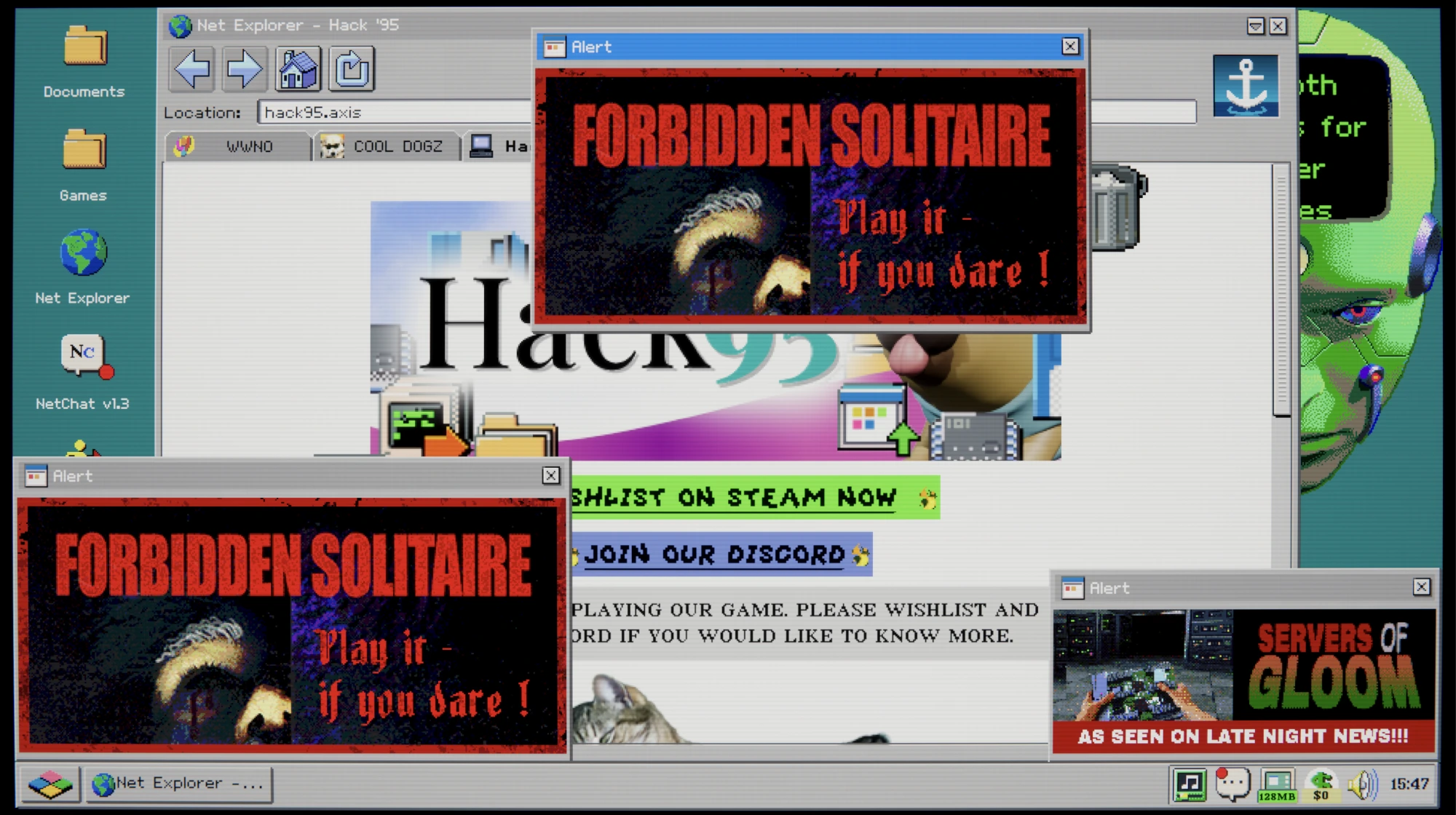
Now clicking on this takes you straight to Forbidden Solitaire’s Steam page. No money has exchanged hands here. Mostly I offered it because it seemed like a cool thing to do.
“It doesn’t have to be Astro Bot being backed by 30 years of PlayStation IP.”Will Luton
Jake’s game has a similar feel and is set in the same year and for us it broadens our game's world. Maybe Grey Alien will tweet about it or something, that would be nice, and hopefully we share a bit of audience. But I think this only really works because it feels authentic and not forced.
I’d like to see a lot more of this kind of collaboration from smaller teams too. It doesn’t have to be Astro Bot being backed by 30 years of PlayStation IP. I think it works at every level if the consideration is how to broaden audiences and it’s done in a way which feels unforced and fun.

Jared Steffes
Throughout my career, almost everything I have done has involved collaboration. At EA, it was musicians, at NVIDIA, it was creators and celebrities, and my own companies have frequently worked with creators. These partnerships work, or companies wouldn't use them.
However, because collaborations have become so common, the real challenge today is creating something unique enough to stand out in a crowded market.
“Because collaborations have become so common, the real challenge today is creating something unique enough to stand out in a crowded market.”Jared Steffes
Currently, I specialise at the crossroads of games, influencers, and viewers. I help run Muxy, a software company rather than an agency. Our technology facilitates and tracks the conversion lift when a game partners with a creator to turn viewers into players, or to reactivate lapsed players.
Collaborating with a celebrity or creator can significantly boost a title's success, but it requires a deep understanding of how to make your content stand out. Too often, the focus is solely on paying certain creators. The ultimate goal should be driving organic growth.
The advertising executive David Ogilvy was right when he said that celebrity testimonials are often below average in changing brand preference because viewers know the celebrity was paid. Viewers often remember the celebrity but forget the product. I frequently hear people ask about "the game that creator X was playing," but they rarely remember the title if they weren't already following it. Without capturing that audience in the moment, the opportunity to convert them into players is lost.
To succeed, you cannot rely on the approximated metrics that often accompany video reports. You must measure a creator's impact with factual data, bringing the attribution tracking to the same level of sophistication as a mobile ad network.
“When you focus on engagement rather than just paying for content, you drive organic streaming.”Jared Steffes
The most successful and cost-effective collaborations happen when you facilitate in-game, live-streamed experiences that help creators engage with their communities, combined with virtual in-game items that let viewers support those creators.
When you focus on engagement rather than just paying for content, you drive organic streaming. Creators influence other creators, and if they see a game is fun and can help them engage their audience, they will stream it.
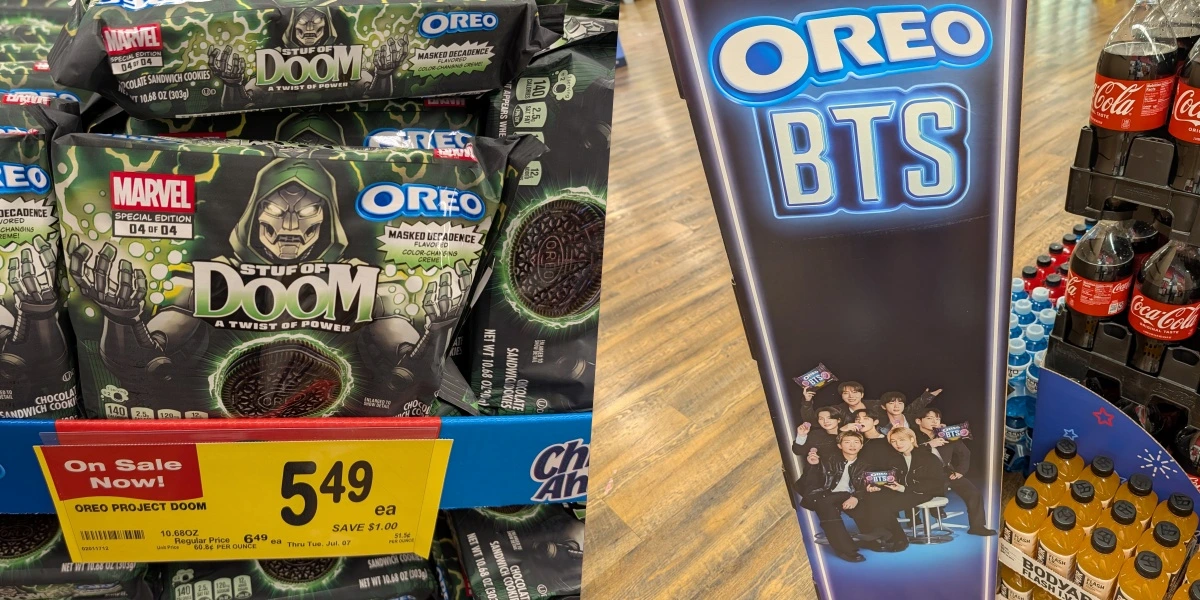
Are Dr Doom or BTS fans buying branded Oreos? You bet they are.

Alexandra Pulinets
Collabs in mobile are such a close-to-my-heart topic. Just for context: I missed the chance to buy the My Hero Academia skins in Brawl Stars, and I’m still desperately waiting for them to resurface in the shop. So, to avoid being too biased, I’ll give two perspectives: a gamer one and a marketer one.
“The stronger the overlap between the game’s audience and the IP or brand’s audience, the better the results tend to be.”Alexandra Pulinets
My gamer perspective is pretty simple: even if I play a game purely for research, every time I see a character or skin from a universe I like, I feel a desperate need to obtain it. This is how Lilith Games almost got me to spend money on dimensional heroes from Overlord and Delicious in Dungeon. And if I had been there for the Persona 5 collaboration, I probably would have monetised, because it’s my favourite game ever -even though AFK Arena is not exactly my favourite type of game to play.
From a marketer’s point of view, what I see is that the stronger the overlap between the game’s audience and the IP or brand’s audience, the better the results tend to be. If both brands share the same geographies, age groups, and motivational profiles, the chances of success increase -even when the IP itself is not huge, as in the case of the Goddess of Victory: NIKKE and Dave the Diver collaboration.

Stepping into pure-assumption territory, collaborations may also help games find new audiences through ad-network algorithms. For example, Meta sees that you are running Naruto content because of a Naruto collaboration. It shows the ads to Naruto fans, who turn out to be very similar to your target audience. They install the game.
So, to be bold, collaborations could potentially help games reach audiences that algorithms would not otherwise show their ads to. This may be part of what happened with Naruto Shippuden × Garena Free Fire: Sea directly credited the collaboration with bringing average DAU close to Free Fire’s pandemic-era quarterly peak, including both new and reactivated players.

Christopher Kassulke
Gaming is the ultimate entertainment medium, making it a goldmine for brands. While reaching this audience is key for brands, finding the right partner is the real driver of success. Instead of building games from scratch, the industry trend is heavily shifting toward strategic partnerships and collaborations. Such a partnership needs to build on a good foundation and trust! You need to find the right fit!
Let's be honest: we’ve all seen cheap, uninspired games built around giant IPs by traditional agencies. That’s not how this market works. Gamers see right through it. If a collaboration feels forced, it flops.
“Considering that 95% to 99% of games on mobile, PC, and console fail, choosing the right IP and the right developer is a high-stakes decision.”Christopher Kassulke
To get a real return, you need an authentic fit that translates into sustained revenue, not just a fleeting marketing buzz. You should also discuss your goals with your partners and whether they are even achievable. So many partners have an issue afterwards because this was not clearly communicated, and no one talked about the real agenda behind it.
Considering that 95% to 99% of games on mobile, PC, and console fail, choosing the right IP and the right developer is a high-stakes decision. You need a partner with the muscle and the know-how to actually execute.
We’ve spent decades collaborating with world-class IPs, creating legendary partnerships that fans still talk about. If you want to leverage an IP, don't just hope it makes your game better by default. Work with the experts who know how to make it happen.
Besides this topic, I see more and more gaming IP crossovers, which I celebrate if they fit, but again, it is about trust and market fit. You always need to build a win-win situation, nothing else!
Check out our Collabs Corner roundup for the latest partnerships and collaborations featured in a host of games.
People