Nativex on what AI gets wrong about marketing your game in China

- Studios are researching China through AI tools, but the answers are often "outdated… incomplete… partially true".
- Nativex tested eight mainstream AI tools and found none got the most answers right.
- The myths it busted: every game needs an ISBN, foreign studios can't run campaigns and testing costs a fortune.
Studios are doing their China homework through AI and getting a distorted picture back. That was the argument from Yolanda Huang, senior director of client growth, Europe, at Nativex, in a session on user acquisition in China at Pocket Gamer Connects Barcelona.
Nativex has been briefing the market on Asia for years, she said, but "the difference this year… it's more AI related."
Clients now research the market in-house using AI tools, then "add another layer of human validation" before deciding whether to try China. The problem is what the models feed into that process. Despite being built for language, the information they gather "could be outdated, they could be incomplete, they could be partially true," Huang said.
So Nativex put the tools to the test. We cover Huang's talk, from the ISBN myth to the real cost of a China test.

Testing the machines
Rather than argue the point, Nativex ran an experiment: ask a list of mainstream AI tools to name the best AI tools for a developer marketing in China, then put the same prompt to every tool on that self-selected list. That way, she said, "our selection of AI tools is not going to impact or skew the results too much."
There was also "a little trap we left in the question." Huang had never specified she was a game developer, yet the tools returned gaming answers regardless. "If there's any app developers out here," she noted, AI "will right away give you all the relevant answers from the gaming side" - despite the approach differing for PC, Android, iOS and apps.
The ISBN myth
Six of eight tools put regulation and compliance first, which Huang agreed should be question one. But only one of those six suggested asking what restrictions actually apply. The rest went straight to "a step-by-step guide to obtain a ISBN," the full publishing licence. "Is it really necessary?" she asked.
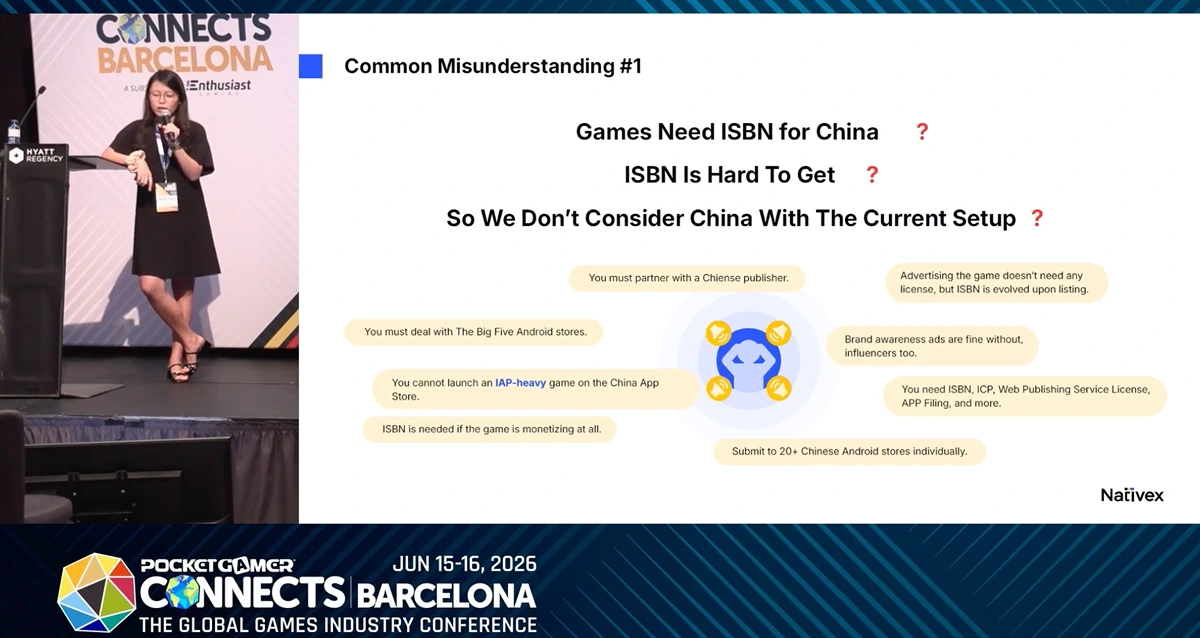
That feeds the most common misunderstanding she meets, one she fields "at least a few times a week": that games need an ISBN, that ISBNs are hard to get, and that China is therefore off the table. Of the AI-generated statements her team collected, "none of this statement is true," she said. They "seem to mix a little bit of facts with one another… the others, they are even self-contradicting" - one claimed advertising was fine while listing the game was not. "What are you advertising about if your game is not listed at all?"
The reality is a software copyright licence, "the much cheaper and much faster version of the licence" and a prerequisite for the full ISBN. It is enough to run a marketing test across paid media and influencers, letting studios "validate the market potential before any decision making" rather than committing upfront.
Can foreign studios run their own campaigns?
Every tool recommended asking about channel mix, and all of them assumed the question came from a Chinese entity. On whether foreign entities can promote games in China and keep their own campaign and user data, the answers were scattered - and that was the finding. "There's no single AI tool that is giving the most right," she said. "They're getting everything wrong." Nor was there "a single question that the most AIs are getting it right," leaving answers "basically all over the place… there's not even a source of truth."
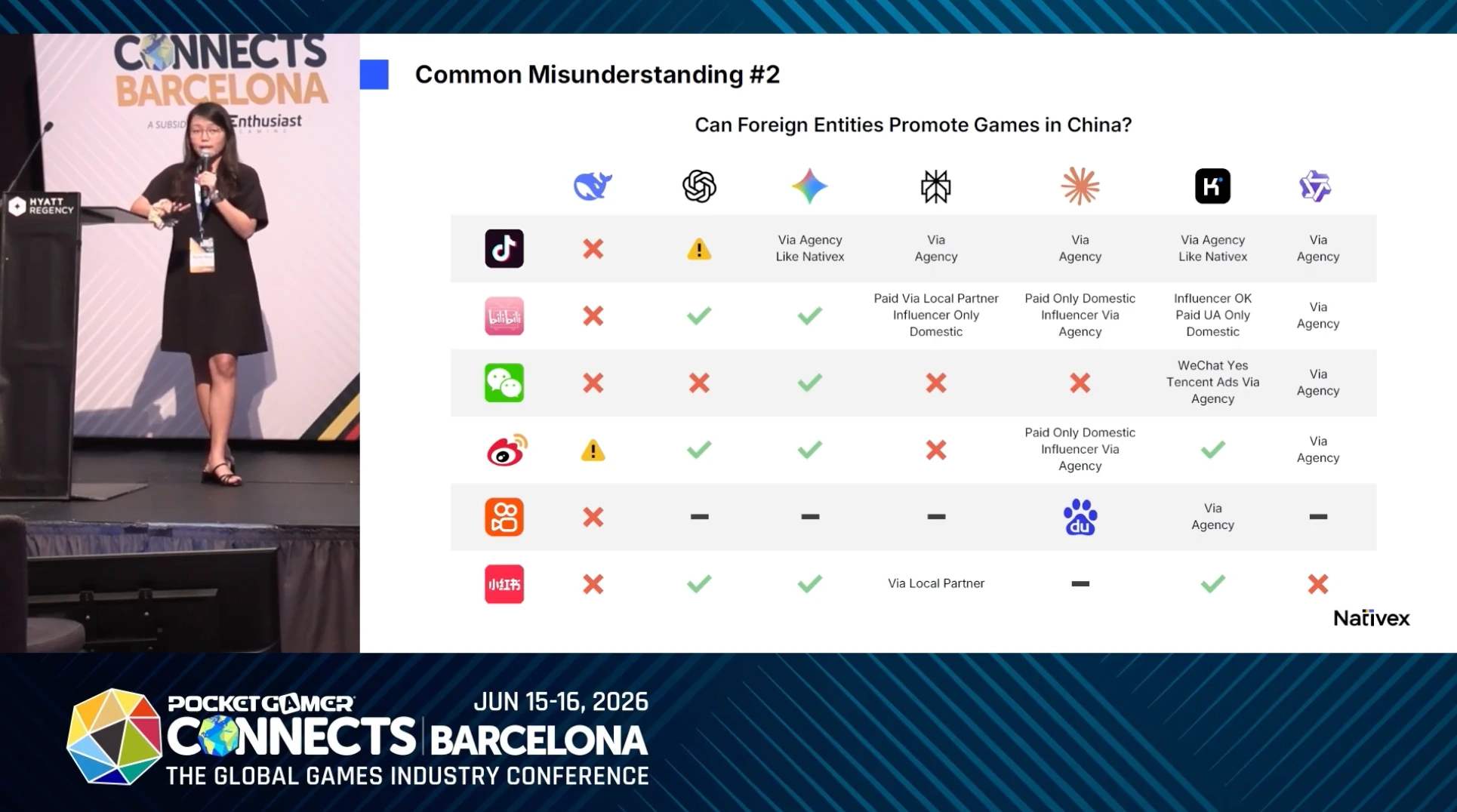
The correct answer is yes. "Everything is possible - that's why we exist, right? That's why I'm standing here," Huang said, crediting the tools that at least suggested going via an agency. Foreign entities observe "very similar rights and platform guidelines as compared to a local entity," she said, and "the only difference is sometimes logistic," since they must work through an agency legally able to deal with them.
On channel mix the tools offered so many contradictions that "basically everything was just noise." Real campaigns vary at the margins - Apple Search Ads, Baidu, Tencent or Kuaishou trading places as the second-biggest source - but one constant held. "The most scaled channel of most of the titles that we deal with, all of them are Ocean Engine," she said, ByteDance's platform and the route to China's Douyin traffic.
What a test actually costs
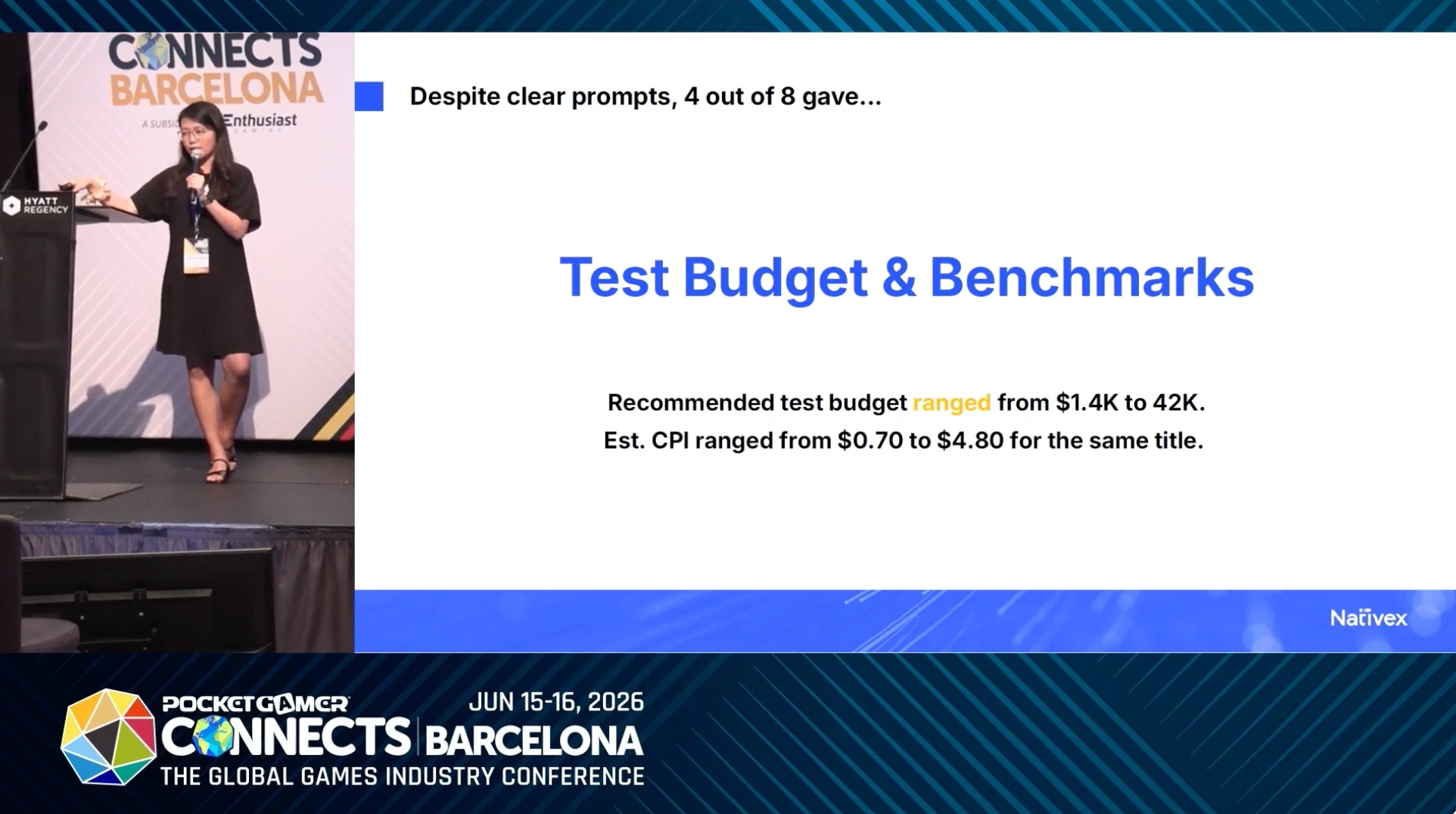
Asked for budgets and benchmarks with deliberately precise prompts, only half the tools produced numbers at all, the rest "just talking around" it. Those that did suggested test budgets spanning a fortyfold range and estimated CPIs from 70 cents to $4.80 - "for exactly the same title." That spread, she said, tracks the questions Nativex fields: China is "among the countries that we see extremely opposite perceptions from the market."
Her rules of thumb are blunter. "Don't start with Android," despite it "having 70% of the market share there," because for comparable ROAS an Android campaign "can scale as much as to one-third of that of iOS" while forcing studios to handle "20-plus Android stores with different bills, different trackings." Use tier-one benchmarks, which are "a very good indication." And work back from a recommended daily budget to price a one or two-week test. The upshot: testing "is really not as crazy as what the market is thinking."
The influencer blind spot
Every tool agreed creators are mandatory - "more mandatory for China because of the audience behaviour," as Huang put it and every tool could quote a cost per video. "However, none of them actually mentioned that influencers could be performance-based."
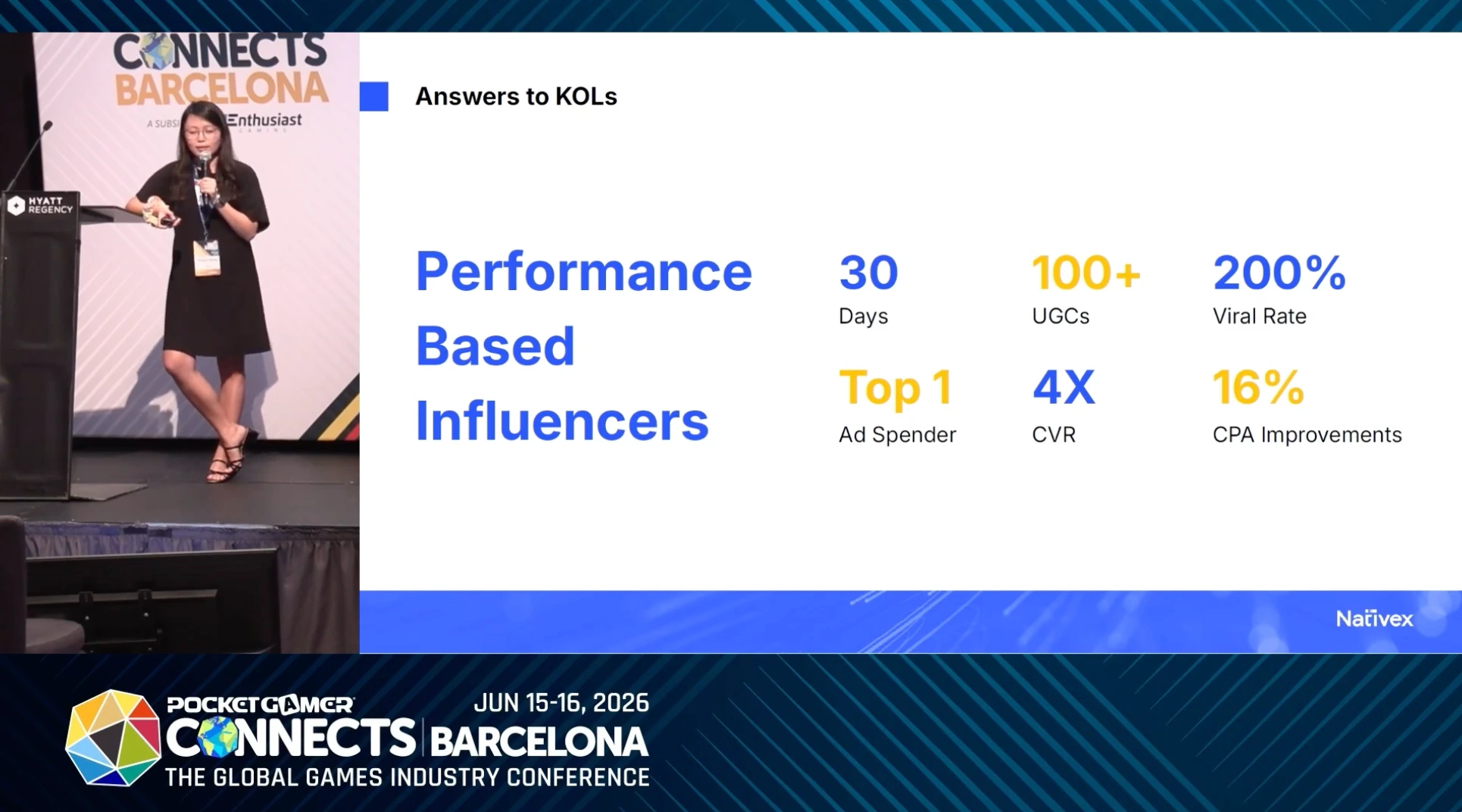
That gap matters, because Nativex is "the first and exclusive agency for the creator marketplace from ByteDance." Huang closed on a performance-based campaign that, in a month, collected "over a 100 UGCs from the players," with a viral rate "doubling what we see from the regular UA creators," click-through up fourfold and CPA improved by 16%. Within three or four weeks, those creator assets "became the top spenders in the account."
Wrapping up, the host called the scale of misinformation "incredibly scary" - a fair summary of a session whose real message was less about China than about how confidently the tools get it wrong.
To learn more about China, the Pocket Gamer Connects Summit Shanghai takes place on July 29th. Register here.
Companies

Events
