The link between product and marketing teams in a competitive market


- Many studios still lack structured collaboration between product and marketing, relying instead on fragmented or reactive workflows.
- High-performing creatives are increasingly shaping gameplay decisions, influencing mechanics, features, and even full product directions.
- Testing concepts through creatives before full development is becoming a practical validation tool, especially for smaller teams.
Evgenii Dobrelia is head of creative & production at AppQuantum.
The question of coordination between product and marketing (creative) teams is far more complex than it may seem. In theory, a deep and well-structured workflow between the two should have existed long ago.
In reality, most companies still don’t have one. Marketing teams rarely look closely enough at the product itself, and creative exploration often resembles pulling a slot machine lever, hoping the right combination appears. But in today’s competitive market, this kind of randomness is no longer enough.
There have long been cases where creatives directly influenced game development. Mechanics born in advertising often migrate into core gameplay or appear as mini-games.

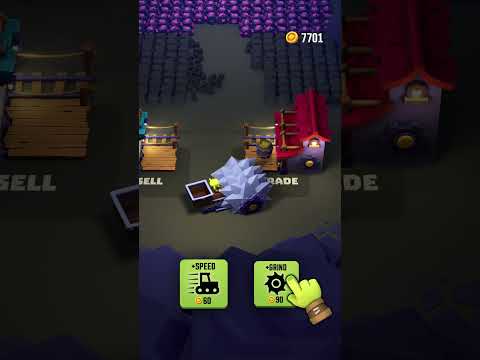
For example, when our marketing team came up with the drilling machine concept for Gold & Goblins, the mechanic later appeared in the game between levels. While it didn’t deliver a major metrics boost, it added variety and depth, making the project feel more complex and richer.
Later, expanding on this idea, we created a series of successful creatives featuring a bulldozer. While it’s impossible to run retroactive tests, we believe part of their success came from the fact that machine-based gameplay already existed in the product. The new creatives are naturally aligned with existing mechanics and player experience.
In this way, creatives inspired a new gameplay feature, which then supported the performance of future creatives.
Another example comes from Idle Outpost. While testing creatives, we noticed that the strongest performers consistently featured intense combat scenes: characters fighting waves of zombies, chaotic action on screen - combat clearly drove user interest.
“Yes, it meant rebuilding half the game and investing significant time and resources. But this year we’re releasing the biggest update in the project’s history.”Avetis Zakharyan
Avetis Zakharyan, co-founder of Rockbite Games: “The issue was that the in-game combat wasn’t nearly as dynamic. Because of this mismatch, we were losing part of the players after acquisition. From the very beginning, Idle Outpost had a dual structure: trading and combat. But it wasn’t a 50/50 balance, it leaned heavily toward trading. Trading was well-developed, while combat felt too simple in comparison. So players were drawn in by massive zombie battles in the creatives, but didn’t find enough of that experience in the game itself. That inevitably led to disappointment.
We had already been considering a major combat rework, making it deeper, more engaging, and giving it far more focus. Creative testing simply confirmed the hypothesis. Yes, it meant rebuilding half the game and investing significant time and resources. But this year we’re releasing the biggest update in the project’s history, one that will completely reshape the game. We’ve never made changes on this scale before.”
A systematic approach
Finding truly breakthrough creative concepts has become increasingly difficult. The market is so saturated that developers have even returned to copying top-performing creatives, something that not long ago was considered ineffective. And while imitation can deliver short-term results, long-term success still relies on your own expertise and R&D.
This pushed us to ask a simple question: can we systematise collaboration so that product and marketing teams continuously reinforce each other instead of working in parallel?
We’ve already conducted large-scale research into trending settings and mechanics (which we’ll be sharing soon), along with regular smaller market studies. On top of that, we introduced creative team digests that flow directly to producers and development teams. The goal is to help the product team view the market through a marketing lens - and increase the marketability of new projects from the earliest stages.
Today, we’re no longer seeing just mechanics or mini-games born from creatives. Entire projects are launching that look exactly like the ads people see during breaks, and they’re easily climbing the charts.
Marketing creatives have reached such a level of polish in terms of look & feel that players genuinely want to play what they see in ads. As a result, for new game development, it’s critical to understand which creative formats and concepts are currently resonating with users. Previously, product and marketing teams moved roughly in parallel, occasionally intersecting. Now, market pressure is forcing those paths to increasingly intertwine.

At the early stage, to help product teams explore trends through a marketing lens, we use an internal digest that highlights promising projects, growth patterns, and standout mechanics.
Alongside it comes a structured HTML document with creative-focused market snapshots - genre leaders, platform-specific trends, top-performing networks, and store dynamics.
Here’s what it looks like in practice
The app list inside the digest is custom-built every month based on specific criteria, for example, install growth without recent product updates. This allows any producer or developer to conveniently explore trends without analytics subscriptions.
“Most of these are hypotheses we’ve either already tested or strongly believe in based on market behaviour and creative performance.”Evgenii Dobrelia
The primary collaboration happens with producers. Over time, this builds a bank of product ideas, which can be turned into design documents and discussed directly with the dev team. Most of these are hypotheses we’ve either already tested or strongly believe in based on market behaviour and creative performance.
As a result, the product team and producers gain an additional source of validated ideas, not just from other games, but from the creative market itself. These are concepts that already demonstrate strong conversion and engagement.
Reiterating why this approach matters
1. A real input stream for new products, settings, and ideas.
By analysing high-performing creatives and the digest, we understand what currently works in acquisition. From there, we identify promising gameplay directions, strong genres, and trending settings.
Instead of guessing what might work, developers get concrete market-backed signals.

For example, casual-style farming games are still dominating installs every month with hundreds of millions of downloads flowing into the genre. That’s actionable insight, not speculation.
2. A different angle on market analysis.
Product and marketing teams naturally view the market differently. Even analytics tools are structured around different goals. If a product manager notices a spike in installs without content updates, it’s hard for them to explain why.
That’s where creative analysis comes in: Which creatives drove growth? What mechanics were showcased? What settings were emphasised? How does this align with our expertise and broader trends? Often, what looks like a mysterious growth spike turns out to be a creative-driven breakthrough, something that should be reflected in the product itself.
To summarise, one team looks for product updates. The other looks at the creative users actually reacted to.
3. More targeted experimentation.
When product expertise is combined with creative performance insights, teams can select far more precise ideas for prototyping. This is especially powerful when strong development pipelines already exist - fast prototyping, reusable engines, streamlined production.
“While raw prototypes no longer perform as well as they once did, launching a polished early prototype ahead of competitors still matters.”Evgenii Dobrelia
While raw prototypes no longer perform as well as they once did, launching a polished early prototype ahead of competitors still matters.
The faster you spot creative trends, build a convincing prototype, then test CPI, CPM, IPM, and marketability, the better your odds. Fail fast, fail cheap - that principle still works, just with higher quality expectations from day one.
4. A path for teams with limited resources.
Young, smaller studios, this one’s for you. The cost of mistakes has risen sharply. Even prototyping now requires serious resources. For independent teams, testing ideas through creatives before building full prototypes can be a viable starting point. It’s not as powerful as testing retention and full funnels, but it can still help validate market interest before heavy investment.
Companies

People
