What Burny Games learned about building puzzle games over four years and 65 million downloads


- Burny Games reached 65 million downloads in four years.
- Knowing when to stop development is critical, projects are discontinued when acquisition costs and retention metrics show limited scaling.
- Publishing works best as a hands-on partnership rather than a high-volume testing pipeline.
Anatolii Henis is CEO at Burny Games.
This March, Burny Games turned four. For those who haven't heard of us: we're a Ukrainian mobile gaming company and publisher focused on puzzle games.
Our portfolio includes Colorwood Sort, Colorwood Words, Playdoku, Colorwood Associations, and Colorwood Blocks – titles that have hit the top charts in the US, Japan, and other key markets.
We're celebrating our birthday with 65 million downloads, a team of 140 people, and a spot in the top 3 best employers in Ukrainian game development (according to DOU).
Here are four lessons that keep pushing us forward and help the team hit its most ambitious goals.
The foundation: Top-notch daily
Everything at Burny Games is built on a principle we call top-notch daily. The idea is simple: do your best every day and keep getting better.
Everything at Burny Games is built on a principle we call top-notch daily. The idea is simple: do your best every day and keep getting better. This mindset helped us build a team where everyone genuinely cares about the business and takes ownership of their results.
In the early days, I personally ran final soft-skills interviews for every candidate. Now that we're 140 people, team leads handle that – but the values and approach haven't changed.
Lesson 1. The courage to say "no" at the right time
Over the past few years, we've made the call to stop development on more than a few projects. Games like Super Cooker, Balls Path, Block Brush, and Colorwood Screw all showed promising signals at the concept stage – but when the data pointed to no real scaling potential, we pulled the plug.
Colorwood Screw was probably our most instructive case. The team was so fired up about the idea that they decided to go all-in on quality from day one – instead of running a quick test, we chased pixel-perfect visuals and a complex production pipeline.
We wanted to enter a familiar genre and be the best thing in it. But while we were polishing, the market moved on. CPI climbed well above acceptable limits, and day 1 retention didn't hit the target.
The lesson was clear: flawless execution won't save a project if you've missed the window. Our level of polish was way too much for an MVP stage, and perfectionism just got in the way of listening to players early enough.
With Super Cooker, we confirmed something important: great code and beautiful UI mean nothing if the game doesn't click with players.
Super Cooker followed a similar path – six months of development without ever finding its audience. Block Brush had a strong launch (100,000 downloads) but completely failed the long-term retention test.
With Super Cooker, we confirmed something important: great code and beautiful UI mean nothing if the game doesn't click with players. We tried to fix the metrics through UX updates and new feature tests, but after six months, we'd run out of hypotheses. The core mechanic didn't deliver enough playtime, and the cost of bringing in new traffic for tests kept rising.
Eventually, continuing to invest in saving the project just didn't make economic sense.
Our approach now is straightforward: if the cost to acquire a player exceeds projected revenue and retention metrics aren't where they need to be, we stop. Knowing when to say "no" frees up resources for the projects that actually have a shot at being hits. And we've gotten a lot faster and smarter about making that call.
Lesson 2. Linear structure and team autonomy
We keep adapting our internal processes to match what the market demands. Right now, our answer is autonomous teams structured as separate business units, each led by a producer. This setup makes teams more cohesive, aligns everyone around the same goals, and keeps the focus on the product.
We've moved away from the idea that one universal process can work across all games. A product's lifecycle isn't uniform – it needs different tools at the prototype stage, during active growth, and at maturity.
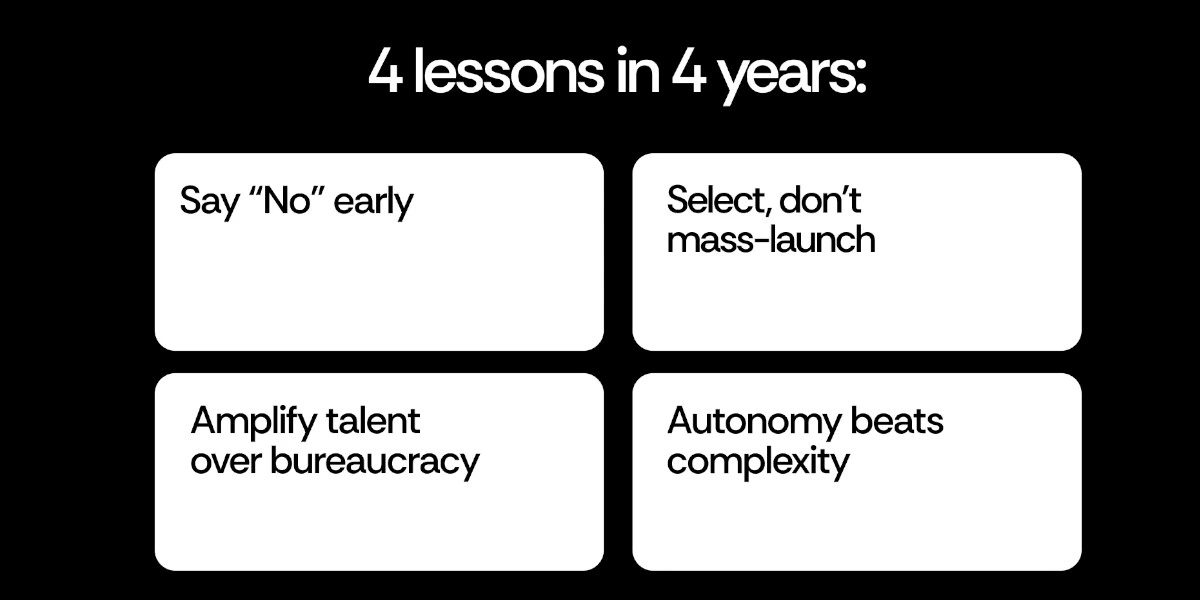
We used to think flexibility meant being able to quickly move people between projects. But as our product count grew, that cross-project juggling act became too complex – managing the system was eating up all the benefits it was supposed to create.
We turned business units into autonomous mini-studios within Burny Games. Now teams decide their own priorities – even when working on multiple games at once. There's no need to escalate every decision upward or sync with other departments. It gives the people actually building the product the freedom to move fast.
Lesson 3. Publishing as a partnership, not a pipeline
When we launched publishing in 2025, we immediately ruled out the "conveyor belt" model. Instead of blindly testing thousands of prototypes and hoping one sticks, we chose to work with focus.
When we launched publishing in 2025, we immediately ruled out the "conveyor belt" model.
We come into a project as a real partner – we bring resources and get genuinely involved in development. It's not a mass "maybe we'll get lucky" approach; it's a real push into the market together with people who believe in their idea. Partners get direct access to our internal expertise – analytics, game design, monetisation, all of it.
The first result of this approach was Colorwood Associations, released together with Portuguese studio Infinity Games. Our original focus was squarely on puzzle games, but the success of that project – 5 million downloads and top chart positions – pushed us to think bigger. Burny Games
It is now open to different subgenres and teams who are ready to squeeze the most out of a strong idea.
Lesson 4. Technology as a superpower and a growth lever
Today, technology gives small teams a real superpower. With the right tools, a compact unit can build complex, large-scale projects faster than any slow-moving corporation. Things that used to require huge headcounts can now be handled with the right toolset in the hands of talented people.
Today, technology gives small teams a real superpower.
At Burny Games, this has become a core part of our strategy: amplify great professionals, don't slow them down with bureaucracy. Large companies will have to adapt to this pace – or become uncompetitive. Modern structure and strong tech aren't just nice-to-haves; they're how you put the right cards in your team's hands and cut out unnecessary busywork.
Quick takeaways
Know your stopping point before you start. CPI ceiling, day 1 retention target, maximum runway – agree on those numbers upfront, and the difficult conversations later become much less difficult.
Once you've run out of hypotheses, the project has probably told you everything it's going to.
Once you've run out of hypotheses, the project has probably told you everything it's going to. Experiments cost money, and there's usually something more worth spending it on. Moving on is part of the work.
A lot comes down to how teams are set up and what they're working with. Four years in, we're still convinced that big results don't need big budgets or big teams. Keep the focus tight, use your tools well, and let people do what they're good at. That's the job.
Companies

People