From web shop to ecosystem: The next stage of mobile D2C

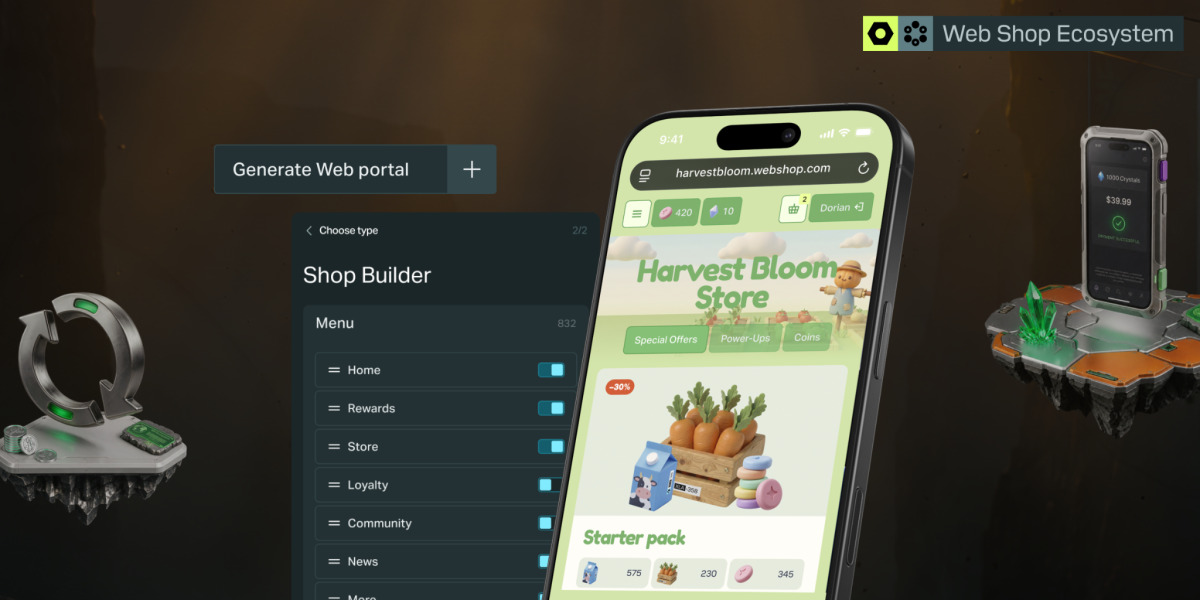
- The success of direct-to-consumer (D2C) storefronts is now a recognised success story for mobile games.
- Many developers assume that growing beyond their original web shop storefront requires huge resources. This is rarely the case.
- The real growth opportunity lies in the ecosystem which wraps around the D2C web shop.
- Xsolla connects monetisation, engagement and operations around the storefront and sees double the share of revenue, compared with those focused on sales alone.
Whether direct-to-consumer works is no longer the question developers are asking, with web shops often being the entry point. What matters more now is how much of the opportunity a studio actually captures once the store is live.
Many assume that growing beyond the storefront means a big investment, such as more tools to buy, vendors to manage and more time from a team that has none to spare. But in practice that's rarely the case. To win the next stage of D2C, studios will need to build an ecosystem around their web shop, working across three layers that each do a different job:
Monetisation covers the tools that make it easy to capture payments across every player segment.
Engagement turns player engagement into revenue opportunities by giving them reasons to come back, spend more and bring their friends.
Operations keep the other two running, letting a studio plan, launch and measure the whole thing day to day from one place.
Together, these three layers help studios build a more sustainable D2C strategy that grows revenue while strengthening direct relationships with players.
Build an ecosystem around the web shop
A great web shop shows its value the moment a player lands on it, whether or not they came to spend, and gives those who did arrive intending to buy somewhere to spend more. But many studios don't know there's room to grow way beyond that, to drive new paying users, encourage repeat buyers and increase LTV.
That’s where ecosystem layers come in, because each one reaches players the storefront never would on its own. Take, for instance, loyalty mechanics, such as quests and referral programs, which give players a reason to visit that has nothing to do with buying anything. There’s also Offerwall, which turns players who might’ve never made a purchase into a revenue stream of their own, as well as community channels, which pull players toward the store from the places they already spend their time.
None of this replaces the storefront. It surrounds it, and in doing so it changes what a direct channel can make.
What the numbers say
Xsolla has launched more than 800 Web Shops since 2021, more than twice any other provider, which makes for a large enough sample to see what separates the high-performing studios from the average ones, across genres and scales.
“The studios winning D2C today are going beyond the storefront. They're running the full player lifecycle on the web: engagement, monetisation and operations, all connected.”Artem Liubutov
The metric the company believes is worth watching is capture rate, that is, the share of a title's total mobile spend that moves through the direct channel rather than the app stores. And it matters more than raw revenue because it describes how much of the available opportunity a studio is actually claiming.
On that measure, partners using the full Web Shop Ecosystem, Xsolla’s approach of connecting monetisation, engagement, and operations around the storefront, see roughly double the share of revenue moving direct compared with those focused on sales alone. That’s the same storefront and product, but twice the share of spend coming through a channel the studio owns outright.

Artem Liubutov, Executive Vice President of Monetisation Products at Xsolla, frames the shift in terms of what those studios are doing rather than what they have switched on.
"The studios winning D2C today are going beyond the storefront,” he says. “They're running the full player lifecycle on the web: engagement, monetisation, and operations, all connected. The store converts, and everything around it keeps players coming back."
Where the growth comes from
Monetisation and engagement need to work together, and studios need the right operational tools to manage both as their D2C business grows.
“Two years ago the question was whether to build a web shop at all. Now, the question is how much of that potential studios are realising.”Artem Liubutov
Running everything from one place sounds like an administrative detail until you see the benefits it can bring. Take, for instance, how a seasonal campaign can be planned weeks ahead rather than assembled the week it launches, and because it’s not waiting on engineering time, the store can reflect what is happening in the game in real time.
This means loyalty mechanics, quests and referral programs can stay live permanently, rather than running as experiments that get switched off when nobody has time to maintain them.
That continuity is what brings players back, and more visits mean more first-time buyers, with many finding something worth returning for.
What’s next for D2C?
This isn’t the first time this trend has appeared. Live operations went from a competitive advantage to a baseline expectation in just a few years, and studios that treated updated content less frequently struggled to keep pace with changing player expectations.
D2C looks to be on a similar path. Two years ago the question was whether to build a web shop at all. Now, the question is how much of that potential studios are realising, which many haven’t measured yet.
The next step is to measure what your web shop is delivering and identify where there’s room to improve. Studios using more of the available tools see capture rates on average of around 25%, compared with roughly 13% for those using fewer. Reviewing what’s already in place can help you find practical ways to capture more revenue from the players you already have.
To see where your own D2C setup stands, explore Xsolla web shop ecosystem.
Companies

People
