From Nokia to AI: Neogames Finland’s Suvi Latva on the changing realities for Finnish studios

- Suvi Latva has advised Finnish game founders since 2005, now as chief business advisor at Neogames FInland.
- Latva argues that genre and platform choices lock in a studio's audience, monetisation and risk - whether founders realise it or not.
- The most common mistake she sees: founders build the game they want to play without first checking whether anyone else wants to play it.
Suvi Latva has watched Finland's games industry take shape for over two decades - first in support roles from 2005, now as chief business advisor at Neogames Finland.
Ahead of her talk at PGC Nordics, which takes place on October 20th to 21st, Latva speaks to PocketGamer.biz about what's changed for Finnish founders, what Finland's reputation as an industry "model" gets wrong and the one decision she wishes more first-time founders recognised as a decision at all.
For more insights on the Finnish and wider Nordic games industry, read our free-to-download report, published in association with Xsolla. You can also check out our Top 30 Nordic Game Makers list here.
Pocketgamer.biz: You've watched the Finnish games industry since before Neogames existed. What's changed the most about who gets to start a studio here - and what hasn't changed at all?
Suvi Latva: When I started working in support for the Finnish games industry in 2005, founders usually needed either a publisher for a PC or console game or a larger customer such as Nokia for mobile development. Developers focused mainly on the creative and technical work. The publisher or buyer evaluated the market and handled commercialisation, distribution and marketing.
Digital distribution changed that. App stores removed some traditional gatekeepers and tools such as Unity later made development more accessible. But the commercial responsibilities moved from the publisher to the developer.
Self-publishing meant that studios also had to understand their audience, discoverability, marketing, monetisation and analytics. Nowadays, AI is lowering technical barriers further, but it does not create demand.
Over two decades, making and releasing a game has become much more accessible. Building a profitable, let alone scalable, company around it is still difficult.
Finland is often held up internationally as "the model" for games industry support. What does that reputation get wrong, or oversimplify, about how things actually work on the ground?
I think Finland's most sustainable form of support is the ecosystem and developer community itself. You can see it at IGDA Finland and other community events: people share contacts and experiences, help one another and encourage others to try things. Because our domestic market is small, studios don't see one another as competitors.
“Finland benefited greatly from the mobile disruption because the relevant skills and networks already existed.”Suvi Latva
Public funding, particularly through Business Finland, has also mattered. But Finland's success cannot be explained by one funding instrument or a support model that could simply be copied elsewhere. It came from talent, community, companies, public funding and being ready when a major market opportunity appeared.
Finland benefited greatly from the mobile disruption because the relevant skills and networks already existed. We are now facing new disruptions, but nobody can reliably predict where the next opportunity will come from. This is exactly why public funding for early experiments matters, especially when private investors are cautious.
Neogames sits across hundreds of studios rather than inside any one of them. What's a mistake you've seen multiple unrelated studios make independently - something that looks like bad luck each time, but is actually a pattern?
One recurring pattern is that a team starts by making the game they themselves really want to play, but does not critically test the demand for that type of game.
There is nothing wrong with loving the game you are making. The problem is when the team does not align realistic sales potential with development costs, available financing and its actual ability to execute the project.

In those cases, I have also often seen important choices being made by default rather than deliberately. The project gradually takes a certain direction because of the team's existing skills, familiar tools, the platform they started with or simply the path of least resistance. By the time the commercial consequences become visible, some of those choices may be expensive or impossible to reverse.
Marketing is part of the same pattern. Teams may spend years making a precious game and leave too little time or money to make sure anyone knows it exists.
The Nordic region punches well above its weight in mobile gaming. Why mobile and why here - is that a deliberate strength?
Nokia mattered in Finland a lot. It outsourced a great deal of work to smaller Finnish developers, giving many people an early opportunity to learn mobile development.
Finland also had mobile studios such as Sumea, Universomo and other early mobile games studios, so experience and networks already existed before the modern mobile market emerged.
When mobile games distribution was disrupted, Finland was ready to take advantage of it. I would not describe this as one deliberate national master plan. It was a combination of telecommunications expertise, early mobile development, a small home market that encouraged international thinking and good timing.
How has the makeup of who's founding studios in Finland changed - first-time founders vs industry veterans, solo devs vs teams spinning out of bigger studios?
Looking at studios founded in Finland during the past two or three years, I think we are seeing somewhat more companies founded by industry veterans and teams spinning out of established studios, rather than founders coming directly from schools.
“It is easier for solo developers and very small teams to create and release games, so there are more routes into entrepreneurship.”Suvi Latva
It is also easier for solo developers and very small teams to create and release games, so there are more routes into entrepreneurship.
But starting development and building a business are not the same thing. A solo developer can create a commercially successful game, but significant and sustainable growth usually requires complementary creative, technical, commercial and leadership skills.
You work closely with public funding bodies, policy and the private sector. Where do their interests genuinely align on games and where do they pull apart?
The interests align when the Finnish games industry creates sustainable companies, skilled jobs, exports, intellectual property and tax revenue in Finland. Games are Finland's largest creative industry export, but they also have cultural value and impact.
The groups still look at the industry differently. Studios want to create games, maintain control over their work and build sustainable companies. Investors need the potential for scalable commercial returns. Public funding bodies must consider wider economic impact, additionality, public rules and measurable outcomes. Policymakers have to balance the industry's needs with other sectors and objectives.
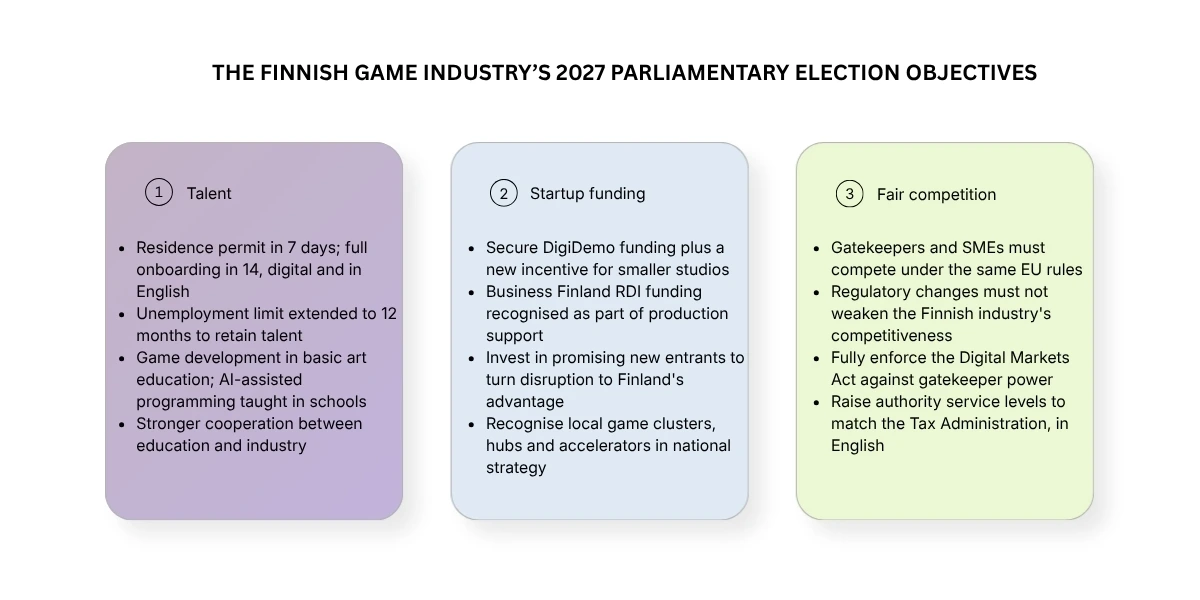
A large part of Neogames' work is translation: helping policymakers understand game-industry-specific issues, helping developers understand regulation and helping the groups understand one another's objectives and limitations.
At PGC Nordics you'll be talking about the early decisions founders don't realise they're making. What's the one "invisible" decision you wish more first-time founders understood was a decision at all?
The invisible decision is what market opportunity the founders are actually choosing and what kind of company they are building around it.
Genre and platform may initially look like creative or technical choices. In reality, they also affect the potential audience, competition, production expectations, discoverability, monetisation, marketing costs, financing needs and possible partners.
Founders may think they are simply choosing the kind of game they want to make. At the same time, they may already be choosing a business model, a funding path and a level of risk.
The question I would like more founders to ask early is: what is the genuine market opportunity for this game, what is our unfair advantage within it, and do we understand the business consequences of our genre and platform decisions?
Tickets to PGC Nordics on October 20th to 21st are available here.
Companies
People

Events
